Normalize Audio Before Transcribing? What 30 dB Quieter Does to the Words
What we sent and what came back
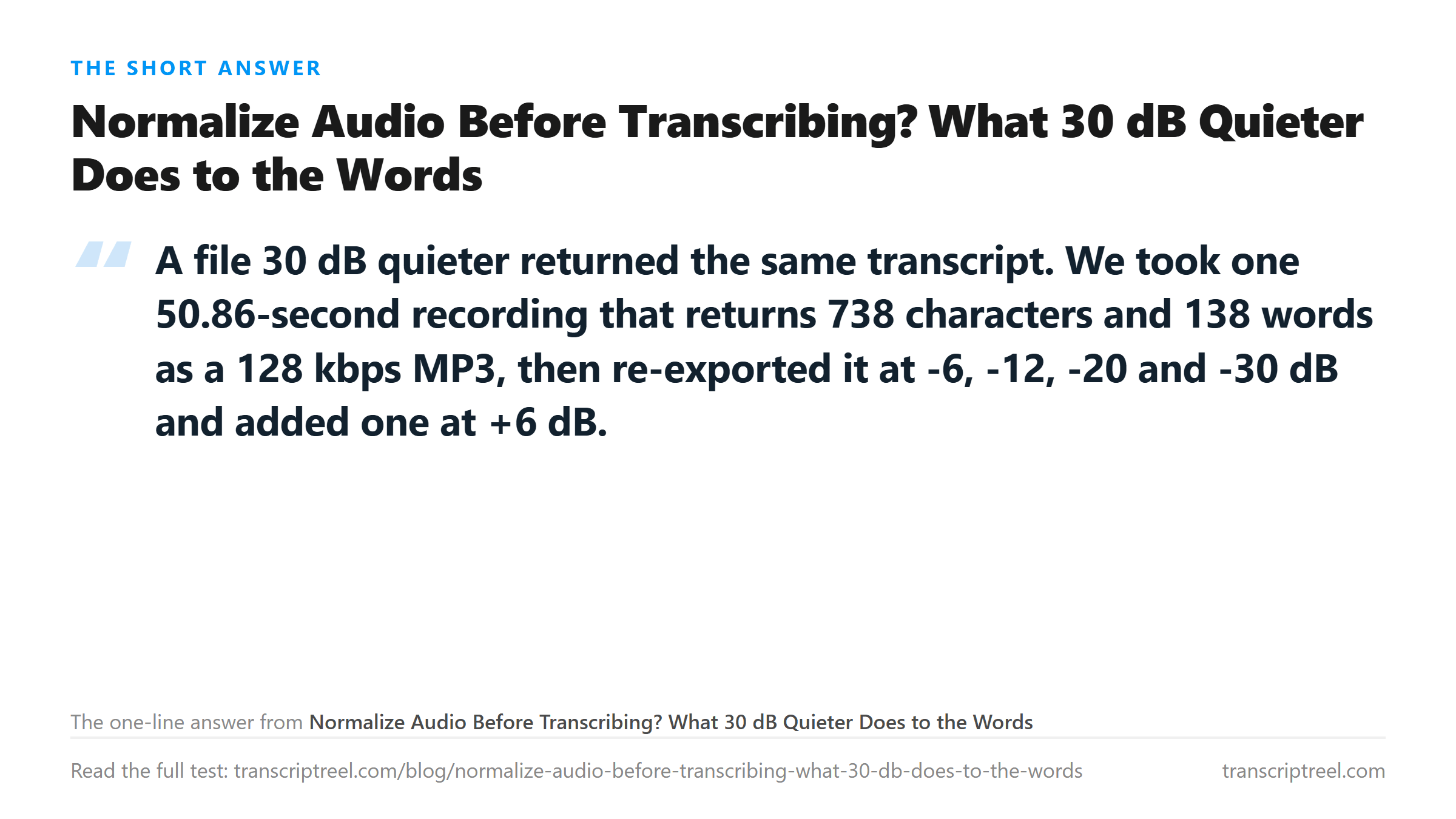
One recording, five gain settings, five uploads. The base file is 50.856 seconds of 44.1 kHz mono speech, exported as a 128 kbps MP3 at 407,344 bytes. We re-encoded it at -6, -12, -20 and -30 dB with ffmpeg's volume filter, and once at +6 dB, then sent each file to the same endpoint.
The measured table
Every quiet version returned the same characters and the same words. This is the whole result.
- base 128 kbps MP3 - 738 characters - 138 words - 5.44 s to process at -6 dB
- -6 dB - 738 characters - 138 words
- -12 dB - 739 characters - 138 words
- -20 dB - 739 characters - 138 words
- -30 dB - 739 characters - 138 words
- +6 dB - 738 characters - 138 words
The -20 and -30 dB runs both began "This is a Test Voice Memo recorded on a phone" with capitals on Test, Voice and Memo, where the louder runs began in lower case. That is the same formatting variation we see between repeat uploads of an untouched file, so it does not point at the gain.
Why this contradicts the usual advice
The usual advice is that a quiet file transcribes badly and normalising fixes it. Our runs say the model handled a 30 dB cut without losing a word. The likely reason is that the model normalises internally before it starts decoding, so a uniformly quiet file arrives at the same place as a loud one. A file where the voice is quiet and the noise is loud is a different problem, and gain does not change that ratio.
What gain does change
Two things that matter and are not accuracy. First, whether you can hear the file - 30 dB is roughly a thousandfold drop in power, and on laptop speakers that is the difference between audible and not. Second, whether the peaks clip: adding gain to a file that already peaks near full scale wraps the loudest samples, and that damage is real and permanent.
So the order is: find out the peak first, then decide. If the peak is at -1 dBFS and the file sounds quiet, the problem is the crest factor, not the level, and boosting it will only push the peaks into the limiter.
What normalising cannot do
It cannot separate a voice from the noise around it. Both scale by the same factor. If a recording has a fan at -35 dBFS and a voice at -20 dBFS, normalising raises the fan and the voice together and the gap stays 15 dB. Removing noise is a different operation and this page does not do it.
The limits of this test
One voice, one script, one quiet room, 50.86 seconds, and gain applied to an already-compressed MP3. Encoding at each step adds its own generation loss, which is present in all five files and therefore cancels out of the comparison. We did not test a file with a poor signal-to-noise ratio, and we did not test speech under music.
What happens to your file
Each version was sent to the endpoint, transcribed in memory and not stored. The gain was applied locally with ffmpeg before the upload.
Got a Reel you want as text? Download the Instagram transcript as TXT, SRT, or VTT →
Gain is one number and it is worth setting on purpose rather than by ear. Wondershare UniConverter writes a normalised export at a target peak you choose and shows the measured peak before and after, so a file already sitting at -1 dBFS is not pushed into the limiter by habit. It does not transcribe - the words come back from this page.
FAQ
Should I normalize audio before transcribing?
Do it if the file is hard to hear, but do not expect it to change the transcript. Our four quieter versions, down to 30 dB below the original, all returned 138 words - the same as the base file.
How quiet is too quiet for speech-to-text?
We do not know where the line is, and we did not find it. A 30 dB cut still returned a full transcript, so the limit is below that on this file. What we can say is that a uniform reduction of level did not hurt, and that a bad signal-to-noise ratio is the case worth worrying about.
Does boosting volume make a recording clearer?
It makes it louder. Whether it is clearer depends on whether the peaks and the noise floor move with it, which they do. If the voice sits close to the noise, boosting raises both and the gap between them stays the same.
What is the risk of adding gain?
Clipping. Any sample pushed past full scale wraps around and produces a crackle you cannot undo. Check the peak first: a file already at -1 dBFS has no headroom left, and the fix there is limiting, not gain.