Meeting Notes From a Transcript: Six Items, Four Owners Right
Six items, four voices
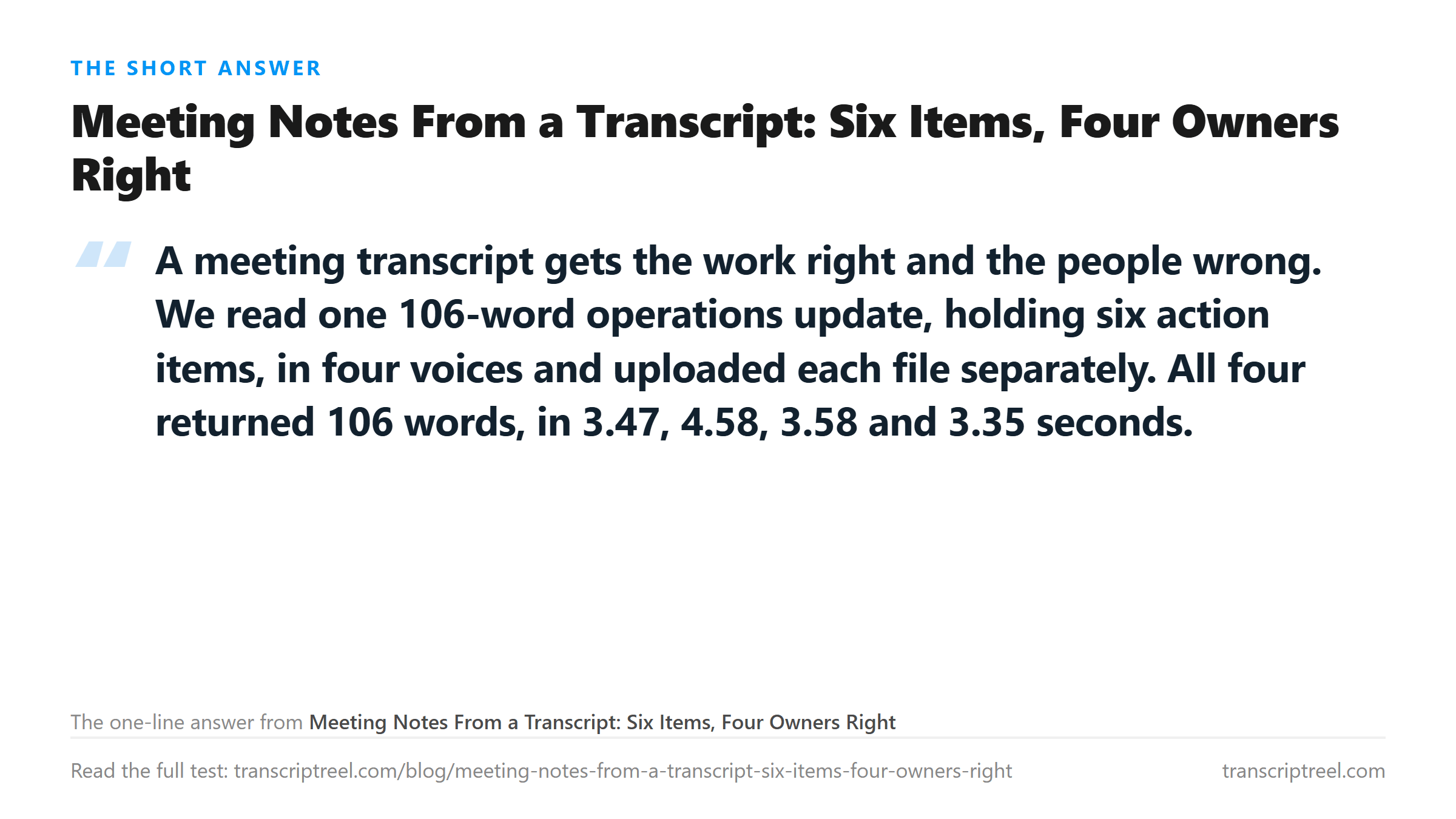
The clip is a 106-word weekly operations update, 39.67 seconds long. Six owners, six tasks, six deadlines, and one line about parking that nobody decided anything about. We read it in four different voices and uploaded each file on its own.
Each action item was scored three ways. Is the owner right, is the task right, is the deadline right. A single wrong letter in a name counts as wrong, because that letter is how you would search for the person.
- Priya, send the revised forecast, by Wednesday: owner 4 of 4, task 4 of 4, deadline 4 of 4.
- Marcus, call the freight broker, Thursday morning: 4 of 4, 4 of 4, 4 of 4.
- Quality team, recheck the Des Moines batch, before the 19th: 4 of 4, 4 of 4, 4 of 4.
- Elena, update the supplier list, tonight: owner 1 of 4, task 4 of 4, deadline 4 of 4.
- Devin, book the conference room, by Friday noon: owner 0 of 4, task 4 of 4, deadline 4 of 4.
- Kenji, resend the customs paperwork, after the holiday: owner 4 of 4, task 3 of 4, deadline 4 of 4.
Every task came back, two people did not
Read the right-hand columns first. Task and deadline are perfect, 36 of 36 across six items and four voices. The owner column is 21 of 24, and the three misses are two names.
Devin is the one to remember. All four files wrote Devon. Elena survived once, in the voice that read fastest, and arrived as Alaina in the other three. Kenji held its spelling in every file. One of those files still turned resend into rescind, which is the opposite instruction.

The failure is consistent and quiet. Nothing in the response marks a name as uncertain. You get a clean paragraph with a plausible colleague in it, and the colleague is somebody else.
106 words in, 106 words out, four times
All four uploads returned HTTP 200 with exactly 106 words. Character counts were 617, 617, 615 and 617. Wall time ran from 3.35 to 4.58 seconds on a 39.67-second clip, so speed varied by more than a third while the text did not vary in length at all.
That is the trap in auditing this kind of output. A length check passes all four files while two of them name the wrong person. The only check that catches it is reading the owner column against the invite list.
The two-character spread came from punctuation and from shared against share. Neither changes meaning. The name changes do.
Split it into three and the room gets booked
Long calls get cut into parts, either by the recorder or by you. We cut this one at sentence boundaries into three files and uploaded them separately. They returned 28, 48 and 30 words, which adds to 106. They also returned 172, 264 and 180 characters, which adds to 616.
The arithmetic holds. One sentence does not. Nobody has booked the conference room for the client visit came back as Melody has booked the conference room for the client visit.
That is not a typo you can hear. The original says the room is unbooked and someone still has to fix it before Friday noon. The transcript says a person called Melody already took care of it. The second version is a reason to stop worrying.
- Owner moves kept happening: Elena became Alaina again, Devin became Devon again.
- Des Moines survived all three parts, and so did the 19th.
- Kenji survived, and resend arrived hyphenated as re-send.
- The parking line survived intact, including the part where nothing was decided.
Why nobody becomes a name
Nobody has booked is a negative statement dressed as a common word. The model has to decide whether it heard a pronoun-like subject or a person. Melody sits close to Nobody in acoustic terms. Once it commits to a person, the rest of the sentence follows without a flicker.
Negation is the part of a transcript that fails in the direction of agreement. We ran a separate set of sixteen sentences, eight with a negation and eight without. The negations themselves held. What broke was one control sentence, which came back with an extra But in front of it.
So the risk is not that the model drops a not. The risk is that it rewrites the clause into something that means the opposite while keeping perfect grammar.
What the numbers in the notes look like
The meeting clip carries three numbers a person would act on. The 19th for the audit, Friday noon for the room, and 10 minutes spent on parking. All three survived in all four voices and in all three split parts.
Dates and times are the strongest part of this output. November twelfth arrived as November 12, the nineteenth as the 19th, and both forms are correct. Nothing there needs a human pass.
That is worth knowing before you budget attention. The hour you would spend checking digits is an hour you should spend on the owner column instead, where the errors actually live.
What to fix before the notes go anywhere
Check owners first, tasks second, deadlines last. Deadlines came back perfect in every test here, so they are the cheapest thing to skim and the least likely to be wrong.
Run the attendee list as a search over the text. Every hit you correct is a name that will not mislead someone later. Then search for not and no and read each of those sentences in full, because a reversed decision hides in ordinary-looking prose.
If the recorder splits the file, keep the parts together and read them in order before you trust the sequence of events. A part boundary is where a decision can flip, and the flip reads as normal English.
Your file does leave the browser here. It posts to /api/transcribe over an encrypted connection. It gets processed once in memory and dropped the moment the text comes back. No account, no stored copy, no training on it.
Got a Reel you want as text? Get an Instagram transcript as TXT, SRT, or VTT →
Reading a call is one job, re-cutting it into parts is another, and only the second one is a file operation. Wondershare UniConverter trims and joins on your own machine without resampling the speech, so the three parts that produced 616 characters stay at the rate they were recorded. It does not transcribe - the text comes back from this page.
FAQ
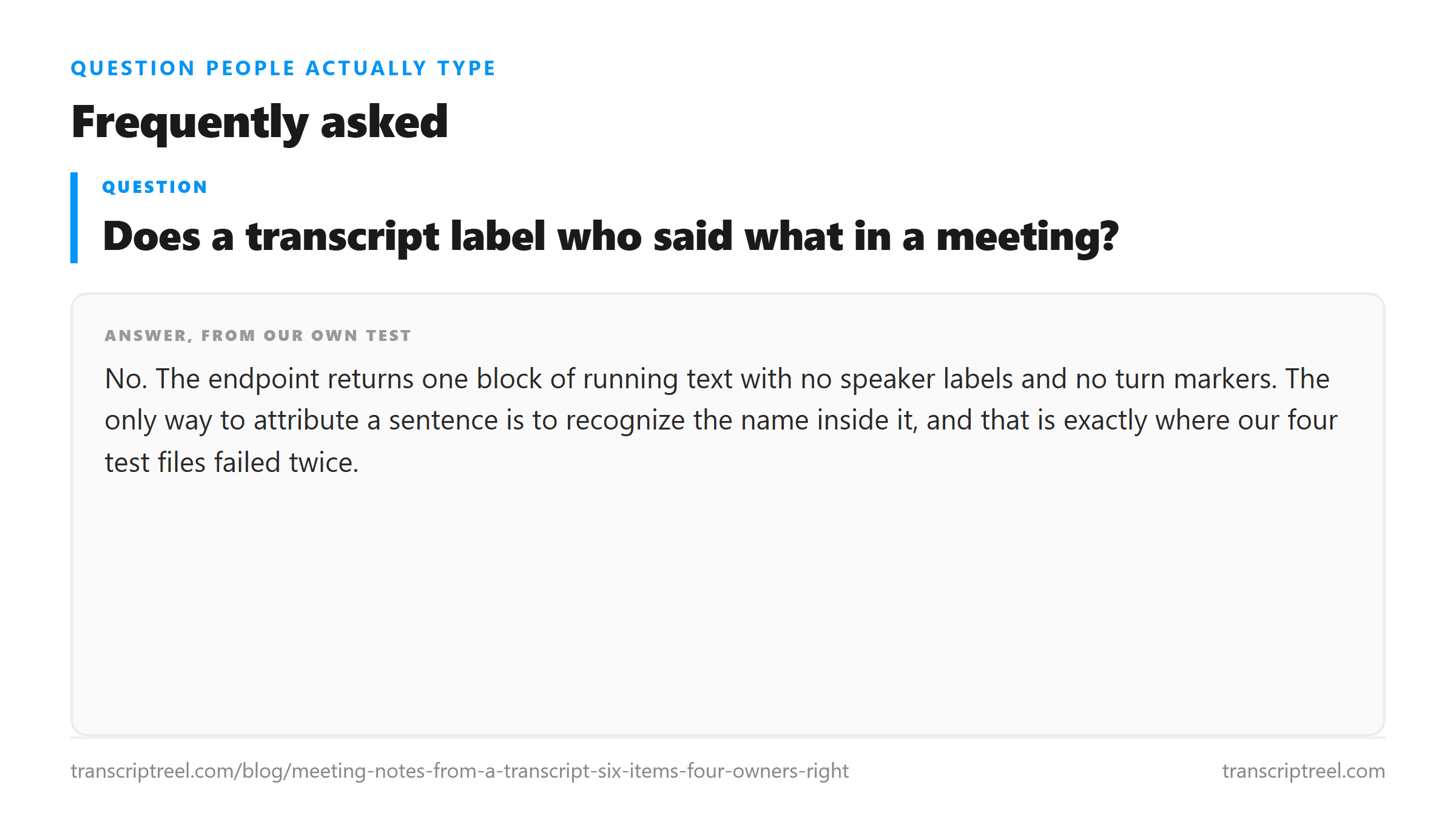
Does a transcript label who said what in a meeting?
No. The endpoint returns one block of running text with no speaker labels and no turn markers. The only way to attribute a sentence is to recognize the name inside it, and that is exactly where our four test files failed twice.
Why did the same owner name come back differently in different voices?
Each mention is resolved independently, and the spelling the model picks depends on how common that spelling is in its training data. Devon is more common than Devin, so all four voices chose Devon. Elena came back as Alaina in three voices and stayed correct in one.
Is it safe to split a long meeting into several uploads?
Word totals survive a split. Meaning does not always. Our three-part upload added up to 106 words against a 106-word script and still turned Nobody has booked into Melody has booked, which reverses who is responsible for the room.
Can I fix the names after the transcript comes back?
Yes, and it is the fastest correction available. Search the text for each name on the invite, fix the spelling, and leave the rest alone. Editing a name does not disturb the sentence around it.