Transcribe a Meeting Recording: What Two Mics at Different Levels Do
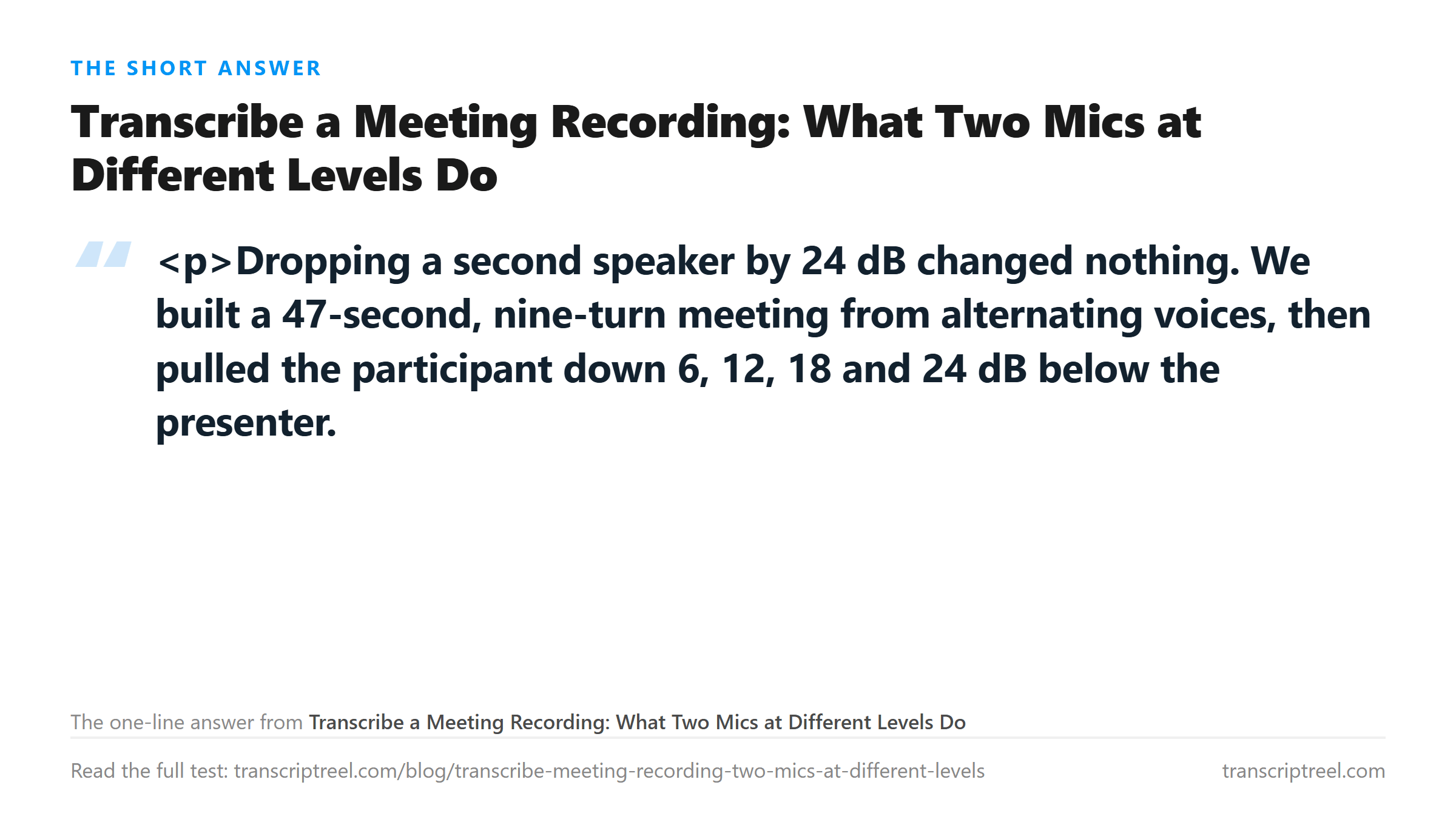
Dropping a second speaker by 24 dB changed nothing. We built a 47-second, nine-turn meeting from alternating voices, then pulled the participant down 6, 12, 18 and 24 dB below the presenter. All five files came back byte-identical: 628 characters, 117 words, same sha256. What did break the transcript was a second conversation in the same room - not the level of your second mic.
The test file, and what it is not
We rendered each role through its own text-to-speech voice. Then we concatenated the turns in order and converted the result to 44.1 kHz mono. Only the turn-taking could differ between versions.
The spoken script is 124 words. The clean transcript is 117. Seven words never made it into text, and none of them were the participant's. That gap is the baseline for everything below, so it goes first: even a clean two-voice file does not land at 100% of the words you spoke.
This is a synthetic meeting, not a recorded Zoom. There is no room, no keyboard, no notification chime. That makes it a clean measurement of level and turn-taking, and a poor measurement of a real conference room. We test the room separately, further down.
Five files, one transcript
We pulled every participant segment down by a fixed gain, left the presenter at 0 dB, and rejoined. Nothing else changed - same turns, same order, same sentences.
- Participant at 0 dB: 47.02 s, 4,146,896 bytes, 628 characters, 117 words.
- Participant at -6 dB: 628 characters, 117 words.
- Participant at -12 dB: 628 characters, 117 words.
- Participant at -18 dB: 628 characters, 117 words.
- Participant at -24 dB: 628 characters, 117 words.
All five returned the same sha256 over the transcript field: 0a7e0258780fbd60. Not a reworded sentence, not a punctuation change, not a dropped comma. The identical string, five times.
That is a stronger result than "the words survived." It means the model did not even hedge. A 24 dB drop is a sixteenth of the amplitude, which is quiet enough that a person listening on a laptop would miss half of it in a noisy room. The model read it as if nothing had happened.
Why the quiet mic is not your problem
This endpoint hands the whole file to a speech model in one call. There is no per-channel gain riding, no voice activity gate, no automatic level matching between speakers that you can see from outside. What the model gets is one mono stream, and it works from the audio itself rather than from a loudness assumption.
The words are still in the waveform. A 16-bit sample at a sixteenth of full scale keeps about 12 bits of usable resolution, and speech needs far less than that. The model is not reading a meter. It is reading the pattern.
The practical version: if your second speaker sounds faint to you, that is an annoyance for your ears. It is not a reason to re-record, and it is not a reason to re-process the file before uploading.
What actually lost words: a second conversation
We took the same five presenter sentences as a solo file and mixed a different two-person conversation underneath at -6, -12, -18 and -24 dB. Same voices, same length, deliberately unrelated content - a landlord, keys, a parking permit. If the model picks up the wrong speaker, you will see the wrong subjects in the text.
- Presenter alone, no second conversation: 25.80 s, 330 characters, 62 words.
- Second conversation at -6 dB: 403 characters, 77 words.
- Second conversation at -12 dB: 359 characters, 69 words.
- Second conversation at -18 dB: 334 characters, 63 words.
- Second conversation at -24 dB: 342 characters, 65 words.
Read the character counts against the control and they are all wrong in the same direction: longer, not shorter. At -6 dB the file returns 73 more characters than the clean version. That is not the presenter getting more verbose. That is a second speaker being admitted into the text.
At -6 dB the failure is obvious. The clean opening survives, then a line about keys lands in the middle of a revenue sentence. The text reads: “the numbers from last quarter. No, and the revenue came in at $412,000.”
Further down, the cost line picks up a stranger's detail. The text reads: “the shortfall was in the support line, not in sales for the parking permit from February.” Two conversations braided into one paragraph. Nothing in the text marks where one ends.
At -12 dB the intrusion thins to a single orphan phrase - "Did you ever get the keys?" - dropped between two presenter sentences. At -18 dB it disappears completely and the text is clean again. At -24 dB one fragment returns. That last point is the interesting one, and it is not noise in the measurement.
Why -24 dB is worse than -18 dB
The -24 dB file is 8 characters longer than the -18 dB file and its text holds one extra "No," at the front of a sentence. Both files carry the same content at the same gain difference, so the difference is not level. It is where the syllables landed.
When two voices sit 24 dB apart, a single loud consonant from the quiet speaker can briefly outrank the loud one at that exact moment. A plosive at the start of "No" is a sharp transient; the presenter's vowel underneath it is comparatively smooth. For that one slice, the quiet speaker is the loudest thing in the file. Whether that slice gets admitted depends on where it falls relative to a word boundary, and that is not something you control with a fader.
So the curve is not monotonic. Louder intrusion is not always more intrusion, and a quieter mix is not always cleaner. What holds is the direction: a competing conversation is a real risk, and its level predicts the risk only loosely.
The shape of the damage tells you which problem you have
This is the part worth carrying into your own file. Two different failures produce two opposite text shapes, and you can tell them apart without listening.
- Text shorter than the speech you remember: something covered the voice. Loud noise on top of a speaker is the usual cause, and words vanish from inside phrases.
- Text much longer than the speech you remember, with subjects that do not belong: something competed with the voice. The model transcribed whatever won each slice.
- Text the right length but wrong in places, with plausible neighbouring words: level was fine and the model misheard. Re-processing will not help; you need a cleaner source.
The meeting files here are all in the second category. Every one is longer than its clean control, and every extra word belongs to the other conversation. If you upload a meeting and the transcript contains a topic nobody raised, stop looking at your gain settings.
What this means for the file you upload
Send the mix you have. Do not normalize a two-mic recording so both speakers sit at the same level. And do not re-export at a higher bitrate to protect the quiet track. A bitrate ladder on one clip moved the text by a single character across nine versions, which matches what level did here.
Do spend time on separation. If a second conversation was happening in the room, that is the thing to fix, and no amount of gain staging fixes it. A door, a corridor, or a second take is worth more than any processing.
One caveat on the numbers above. Nine turns and 47 seconds is a short meeting, and a real hour has far more chances for an unlucky overlap. Treat the word-loss rate here as optimistic. What carries over is the direction and the diagnosis, not the percentage.
The file does leave your browser. It is posted to the transcription endpoint over an encrypted connection, processed in memory once, and discarded when the text comes back. Nothing is stored, nothing trains a model, and no account is involved.
Got a Reel you want as text? Get an Instagram transcript as TXT, SRT, or VTT →
Mic level is the wrong thing to fix first. A participant 24 dB down still transcribed word for word, so the quiet track in your meeting recording is not what costs you text. Wondershare UniConverter opens that recording on your own machine and splits or re-levels the room without re-encoding the parts you leave alone, which is the only edit that keeps the clean track clean. It does not transcribe - the words come back from this page.
FAQ
Does a quiet second mic ruin a meeting transcript?
No. We dropped one participant 6, 12, 18 and 24 dB below the presenter and all five files returned the identical 628 characters and 117 words. A level difference between two speakers in the same recording is not what costs you text.
Why does my meeting transcript contain words nobody said?
Usually a second conversation in the room. Our clean presenter file returned 330 characters; with an unrelated two-person conversation mixed in at -6 dB it returned 403, with the other topic spliced into the middle of a revenue sentence. Text that is longer than the speech, with subjects that do not belong, points at overlap, not level.
Should I normalize each speaker before uploading a meeting?
Not for the transcript. Level did not move a single character across a 24 dB range in our test. Normalize if it helps you listen back, and spend the time you save on making sure only one conversation is in the recording.