Change Pitch Without Changing Speed: What the Transcript Does
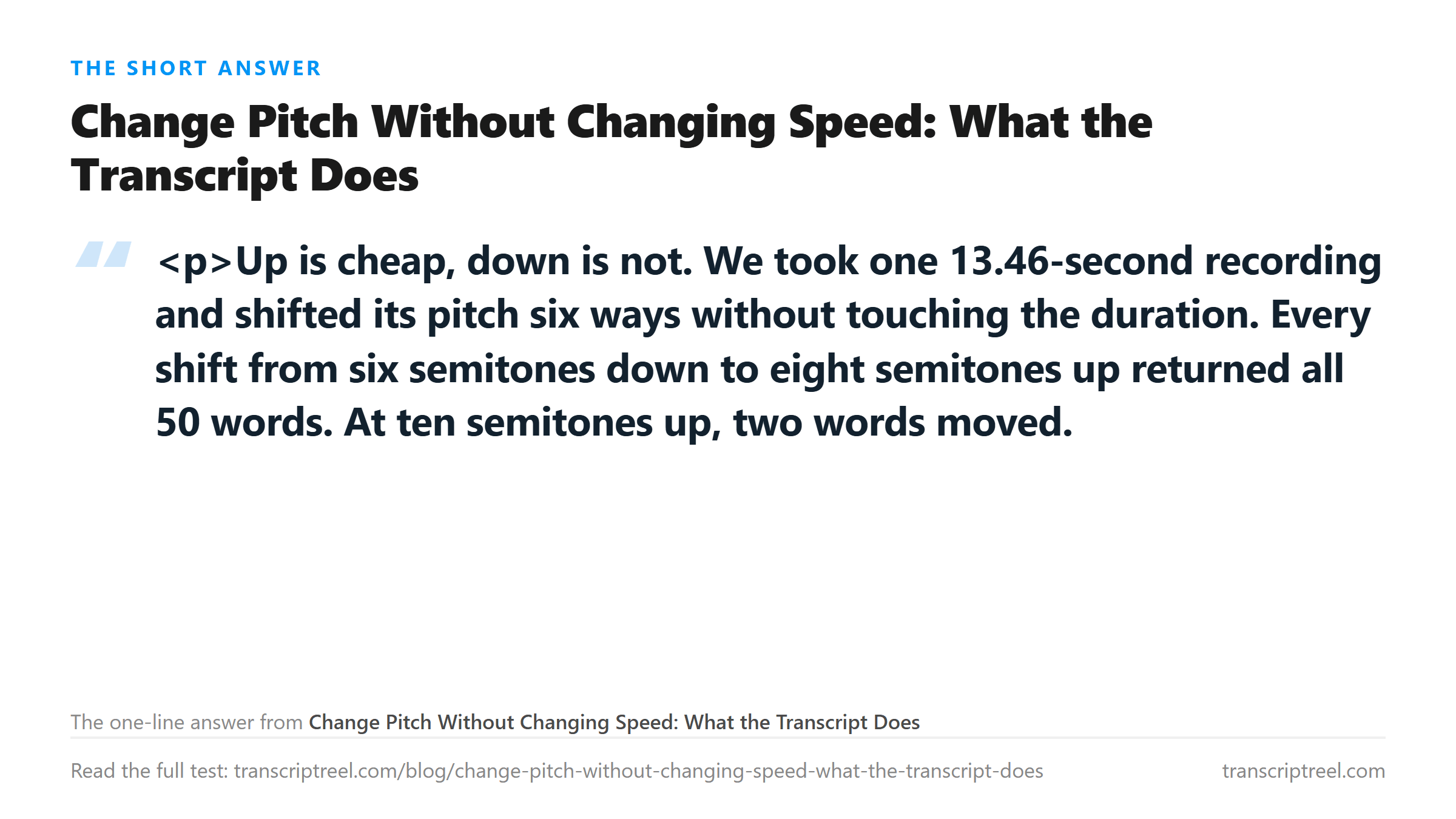
Up is cheap, down is not. We took one 13.46-second recording and shifted its pitch six ways without touching the duration. Every shift from six semitones down to eight semitones up returned all 50 words. At ten semitones up, two words moved. At twelve semitones up - a full octave - 49 of 50 still matched. Then the file fell off a cliff: at sixteen semitones up, 25 of 50 words survived and the model started writing new sentences. Downward it broke earlier. At twelve semitones down the transcript collapsed to 740 characters of “aki, aki, aki”, and only one word in fifty survived.
Pitch alone, with the clock left running
Most advice about pitch gets mixed up with speed, because the tools people reach for move both at once. Slowing a clip by dropping its sample rate lowers the pitch and stretches it. Speeding one up raises the pitch and shortens it. This test does neither. The output is 13.46 seconds in every single case, byte-identical in size at 1,187,604 bytes, and only the pitch moves.
The source is a 50-word paragraph read at a normal pace, 44.1 kHz mono, peaking at -1 dBFS. The control returns 248 characters and 50 words.
- Control: 13.46 s, 1,187,604 bytes, 248 characters, 50 words.
- Shifts: -6, -4, -2, +2, +4, +6 semitones, then +8, +10, +12, +16, +20, then -8, -12, -16, -20.
- Duration check on every file: 13.46 s, unchanged, so speed is not a variable here.
- Word match measured with an edit-distance pass against the control.
- Same endpoint, same day, one upload per file.
Six semitones each way, nothing moves
Every shift inside a tritone returned 248 characters, 50 words and 50 of 50 matches. Zero edits, in both directions. That covers the entire range you would use to nudge a voice into a different register for a podcast, a character read or a key change under music.
It also covers a mistake people make constantly. If you transcribe a clip and the voice sounds wrong to you, the pitch being off by a few semitones is not the reason the transcript is bad. Look somewhere else.
An octave up still works
At +8 semitones the transcript was byte for byte the control, 50 of 50, zero edits. That is a voice moved from a low male register into a high female one and the model did not blink.
- +8 semitones: 248 characters, 50 words, 50 of 50 matched, zero edits.
- +10 semitones: 247 characters, 50 words, 48 of 50 - “stays” became “stayed” and “the” became “a”.
- +12 semitones: 246 characters, 50 words, 49 of 50 - one “the” became “a”.
The two errors at ten semitones are both tense and article changes, not missing words. Compare that against a speed-up test at a similar ratio and the two are not on the same planet. Moving the pitch up leaves the shape of every vowel intact. Moving the speed up cuts slices out of it.
An octave down wipes the file
The downward side does not degrade, it fails. At -8 semitones the transcript was still perfect: 245 characters, 48 words, 46 of 50, the misses being contractions that came back expanded. One more octave down and the output is not a transcript any more.
- -8 semitones: 245 characters, 48 words, 46 of 50 matched.
- -12 semitones: 740 characters, 149 words, 1 of 50 matched.
- -16 semitones: 887 characters, 148 words, 0 of 50 matched.
- -20 semitones: 449 characters, 3 words, 0 of 50 matched.
The -12 file came back as “Raube, a wai, aki, aki, aki” and then kept repeating “aki” for the rest of the audio. The -16 file returned “Lada, lada, lada” 148 times. The -20 file returned “Lairo, la p'n'n'n'n”. Those are the same failure mode every time: the model finds a syllable it can almost hear and then locks onto it.
Notice the character count going up while the word count stays flat or drops. 740 characters is three times the control. A longer transcript is almost always a worse one. That single signal tells you the file broke without listening to it.
Why the two directions are not symmetric
A voice shifted up by an octave still has its formants in roughly the range a human voice occupies. The spacing between them scales, but the pattern stays voice-shaped. Shift it down an octave and the formants drop below the range the model reads as speech. What is left sounds like a low drone with syllables on top.
That is also why the -20 case produced three words while the +20 case produced 50. The upward ladder pushes into a range that is unusual but still speech. The downward ladder walks out of speech entirely.
The sample-rate route is a different animal
One more upload to separate two things people call pitch shifting. We raised the sample rate inside the file by 1.5x and resampled back to 44.1 kHz. That is the trick editors use to make a voice chipmunky, and it changes pitch and duration at the same time. The output was 8.98 seconds against 13.46, so the file got faster too.
It returned all 50 words. A 1.5x speed-up is about seven semitones, which lands inside the range this test says is safe on both counts. The route that broke things was never the speed. It was the direction and the size of the pitch shift.
The edge sits one semitone past the octave
I expected a soft decline between +12 and +16 and got a step instead. One semitone past the octave, five to seven words go at once, and the errors are consistent: “time” stops being heard as a word.
- +12 semitones: 246 characters, 50 words, 49 of 50 matched - one “the” became “a”.
- +13 semitones: 244 characters, 48 words, 43 of 50 matched.
- +14 semitones: 245 characters, 49 words, 45 of 50 matched.
- +15 semitones: 246 characters, 49 words, 44 of 50 matched.
Look at what changed. At +13, “the notes one more time” came back as “the notes and announce one more time”, and “move the date” became “move the dead”. At +14 the same two errors appeared, plus “time” turned into “turn”. At +15, “report out loud” became “report out there”.
Every one of those is a word being replaced by a near neighbour, not a sentence being invented. The transcript still reads like English and still follows the argument. That is a different failure than the downward side, where the text stops being language at all.
What to do with your own clip
Read the word count before you read the text. If a shift produced a transcript that is noticeably longer than the source should be, the file broke and no amount of staring at it will fix that. Shift it back and upload again.
- A few semitones either way: ignore it, the transcript will be identical.
- Up to an octave up: expect a stray article or a changed tense, nothing more.
- Past an octave up, or an octave down: expect a loop. Check the character count first.
- If the count tripled, delete the text, do not edit it.
- Keep the duration untouched if you want to compare two versions fairly.
Got a Reel you want as text? Turn the Reel into an Instagram transcript you can download →
Pitch is safe in one direction and lethal in the other: an octave up kept 49 of 50 words, an octave down kept one. If you shifted a clip to make a voice fit and the text came back as a loop, Wondershare UniConverter exports a fresh copy at a pitch you set without changing the duration, so you can put the voice back where the model expects it. It does not transcribe - the words come back from this page.
FAQ
Does changing the pitch affect transcription?
Only past about an octave. Every shift from six semitones down to eight semitones up returned all 50 words in our test. At twelve semitones up, 49 of 50 matched. At twelve semitones down the transcript collapsed to 740 characters of a repeated syllable and one word survived.
Why did my shifted audio transcribe as a repeated word?
That is what happens when the pitch drops out of the range the model reads as speech. Our -12 semitone file returned “aki, aki, aki” for the rest of the clip and the -16 file returned “lada, lada, lada”. The character count tripled, which is the clearest warning sign.
Is pitch shifting the same as speeding audio up?
No, and they fail differently. Our pitch-shifted files all stayed at 13.46 seconds. A speed change shortens the file and slices audio out of it, which costs words much sooner. A 1.5x sample-rate speed-up still returned all 50 words, while a drop of one octave in pitch kept one.
How much can I pitch a voice up before the transcript suffers?
An octave. At twelve semitones up we still matched 49 of 50 words and the one change was “the” becoming “a”. At sixteen semitones up, 25 of 50 survived and the model began writing sentences that were never spoken.