Slow Down Audio: What Half Speed Does to the Transcript
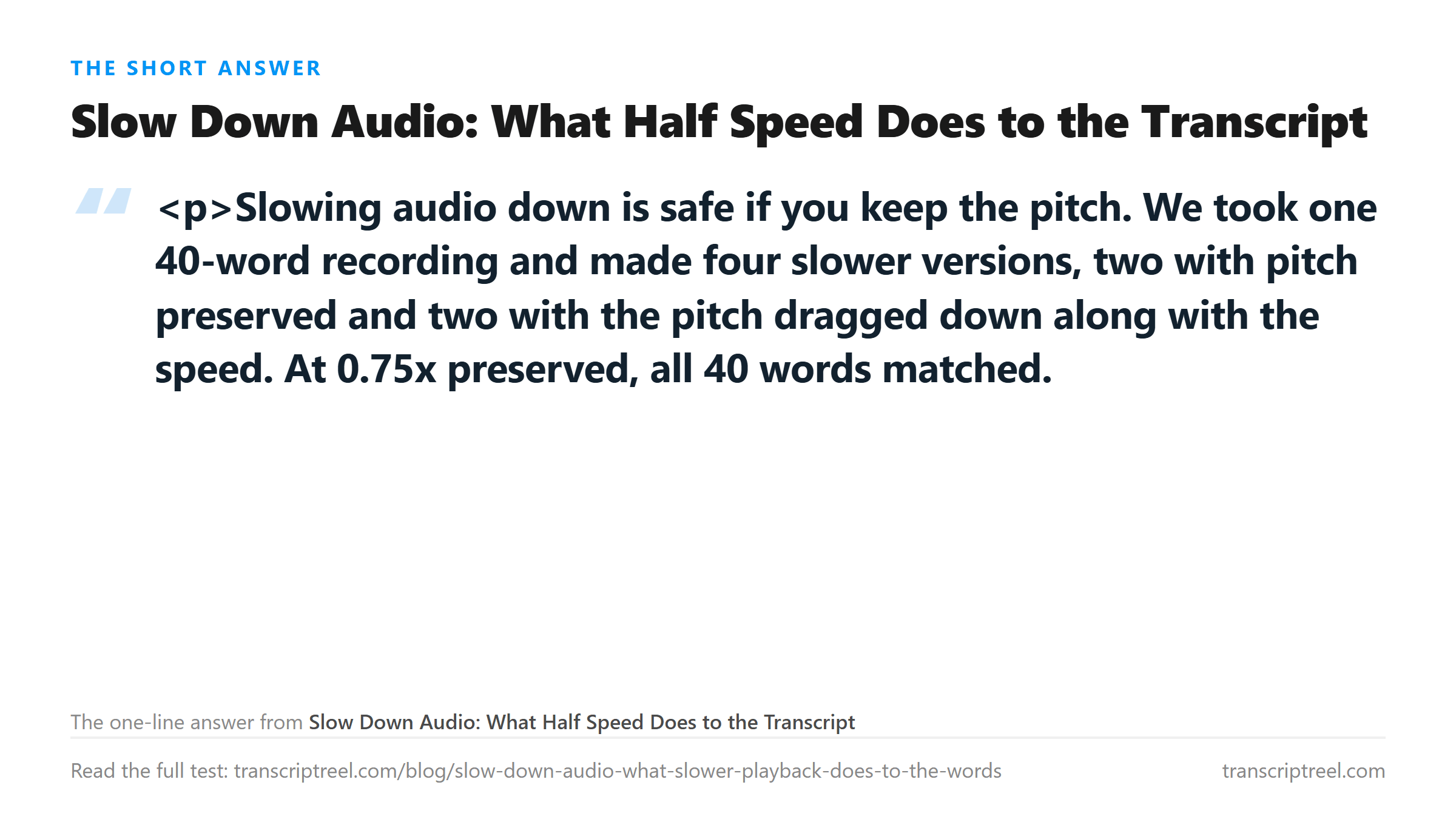
Slowing audio down is safe if you keep the pitch. We took one 40-word recording and made four slower versions, two with pitch preserved and two with the pitch dragged down along with the speed. At 0.75x preserved, all 40 words matched. At 0.5x preserved, 36 of 40 matched. The sample-rate route did worse at both settings: 32 of 40 at 0.75x, and 21 of 40 at 0.5x, where "building 7, room 2.12" came back as "dub in 7.22" and the dollar total turned from dollars into hours.
Two different ways to slow audio, and they are not equal
Every editor has a speed slider and every slider does one of two things. It either stretches the audio and keeps the pitch where it was, or it plays the samples slower and lets the pitch fall with it. The second one is what happens when you change a file's sample rate without resampling, and it is what makes a voice sound like it is underwater.
- Pitch preserved: ffmpeg -af atempo=0.5 - duration doubles, pitch unchanged.
- Pitch follows: ffmpeg -af asetrate=44100*0.5,aresample=44100 - duration doubles, pitch drops one octave.
- Both were run on the same 22.2-second 128 kbps mono file.
- Baseline: 40 words, 249 characters, all 40 correct.
At 0.75x with pitch kept, nothing breaks
The preserved-pitch version at 0.75x came back word for word identical to the baseline. It was 29.6 seconds long against 22.2, and the text was the same 40 words.
- Duration: 22.205 s becomes 29.593 s.
- Words: 40, same as baseline.
- Matched against baseline: 40 of 40, zero substitutions.
- Punctuation: 8 periods and 4 commas at baseline became 5 periods and 6 commas - three sentence breaks softened into commas.
That comma shift is the only thing that changed, and it does not affect the words. If you slow a lecture to 0.75x so you can follow it, the transcript you get is as good as the one from full speed.
At 0.5x with pitch kept, four words go
Half speed is where the pitch-preserved route starts to cost something. The text was still 40 words long but only 36 of them matched the baseline.
- Room: "room 2.12" became "Room 212" - the decimal went away.
- Spelled name: W-H-I-D-F-I-L-E became W-H-I-D-F-I-L-E-L-E, with the last two letters doubled.
- Number: "invoice number is 4,471-88" became "in voice number is 4,471-88" - the word invoice split.
- Duration: 44.397 s, exactly double the original.
The interesting damage is the doubled letters at the end of the spelled surname. A time-stretch has to duplicate or drop tiny slices of audio to make the new length fit. On a repeated letter, a duplicated slice sounds like an extra letter, and the model transcribes what it hears.
The sample-rate route breaks much sooner
Slowing by lowering the sample rate gives you the same duration but a much lower voice. At 0.75x the pitch drops five and a half semitones. The transcript lost eight of forty words even at that mild setting.
- 0.75x, pitch follows: 41 words, 253 characters, 32 of 40 matched.
- Name: "Dana Woodfield" survived, but the spelled surname became W-H-I-D-F-I-L-E-L-E.
- Invoice: "invoice number is 4,471-88" became "in voice numbers 4.471-88" - the comma became a period.
- Phone: "555-123-4567" became "5.551-23, for 5.67".
At 0.5x the same route is close to unusable. The voice sits an octave down and the model starts hearing words that are not there.
- 0.5x, pitch follows: 52 words, 276 characters, 21 of 40 matched.
- "The quarterly review" became "De quarterly review".
- "Bring the revised budget for building 7, room 2.12" became "Ben you revised budget for dub in 7.22".
- "Our contact is Dana Woodfield" became "Our contact is game over field".
- The dollar total: "came to 12,406 dollars" became "came to 12,406 hours".
Fifty-two words out against forty in means the model inserted more than it dropped. Its output got longer while the content got thinner, which is the signature of a decoder that has stopped tracking the waveform.
Undoing the slow-down does not recover the damage
We took both 0.5x files and sped them back up to the original duration, then uploaded again. The pitch-preserved one came back almost clean. The sample-rate one came back perfect, which sounds impossible until you look at what the transform actually did.
- 0.5x preserved, then sped back to 1.0x: 40 words, 39 matched - one word, "room" came back as "Rune".
- 0.5x sample-rate, then restored to 1.0x: 40 words, all 40 matched.
- Same duration both ways: 22.197 s and 22.205 s.
The sample-rate route is lossless in the arithmetic sense. Dropping the rate and raising it back is a linear operation on the same samples, so the restored file is close to the original waveform. It just sounds wrong in the middle. Time-stretching is not reversible in the same way: it throws away and duplicates slices, and some of that never comes back.
What to use when
If you are slowing audio for a human to follow - a language learner, a fast talker, a dense interview - keep the pitch and stay at 0.75x or above. That setting cost nothing in our test. If you must go to 0.5x, keep the pitch and expect a few proper nouns and decimal points to need a second pass.
- 0.75x, pitch kept: safe, 40 of 40.
- 0.5x, pitch kept: usable, 36 of 40, watch names and decimals.
- 0.75x, pitch dropped: 32 of 40, not worth it.
- 0.5x, pitch dropped: 21 of 40, worse than uploading the original.
One more thing worth knowing: if your source is already slow - a language lesson recorded at a deliberate pace - slowing it further pushes the model into the same territory as our 0.5x case. The absolute speed at the model's input is what matters, not the number on your slider.
The one case where slowing helps
Slowing helps when the original is too fast for the model, not when it is too fast for you. Our earlier speed tests on this site found that a 44-word reading stayed word-perfect up to 2.2x and broke at 2.5x. If a file is above that ceiling, a preserved-pitch slow-down to 1.5x is a repair, not a degradation.
For everything below that ceiling, slowing is cosmetic. You are changing how it sounds to you, not what the model can read. That is the honest summary of the numbers above: at 0.75x it costs nothing, at 0.5x it costs a little, and the way you slow it matters more than how much.
Short version
Preserved-pitch slow-down is nearly free: 40 of 40 words at 0.75x, 36 of 40 at 0.5x. Sample-rate slow-down is not: 32 of 40 at 0.75x, 21 of 40 at 0.5x, with names and numbers going first. Use atempo, not a rate change, and stay at 0.75x unless you have a reason.
Got a Reel you want as text? Download the Instagram transcript as TXT, SRT, or VTT →
Slowing audio is free if you keep the pitch and expensive if you drop it: 40 of 40 words at 0.75x preserved against 32 of 40 with the rate lowered. Wondershare UniConverter changes speed without moving the pitch and exports the result, which is the only version of this edit that does not cost you words. It does not transcribe - the words come back from this page.
FAQ
Does slowing down audio hurt transcription accuracy?
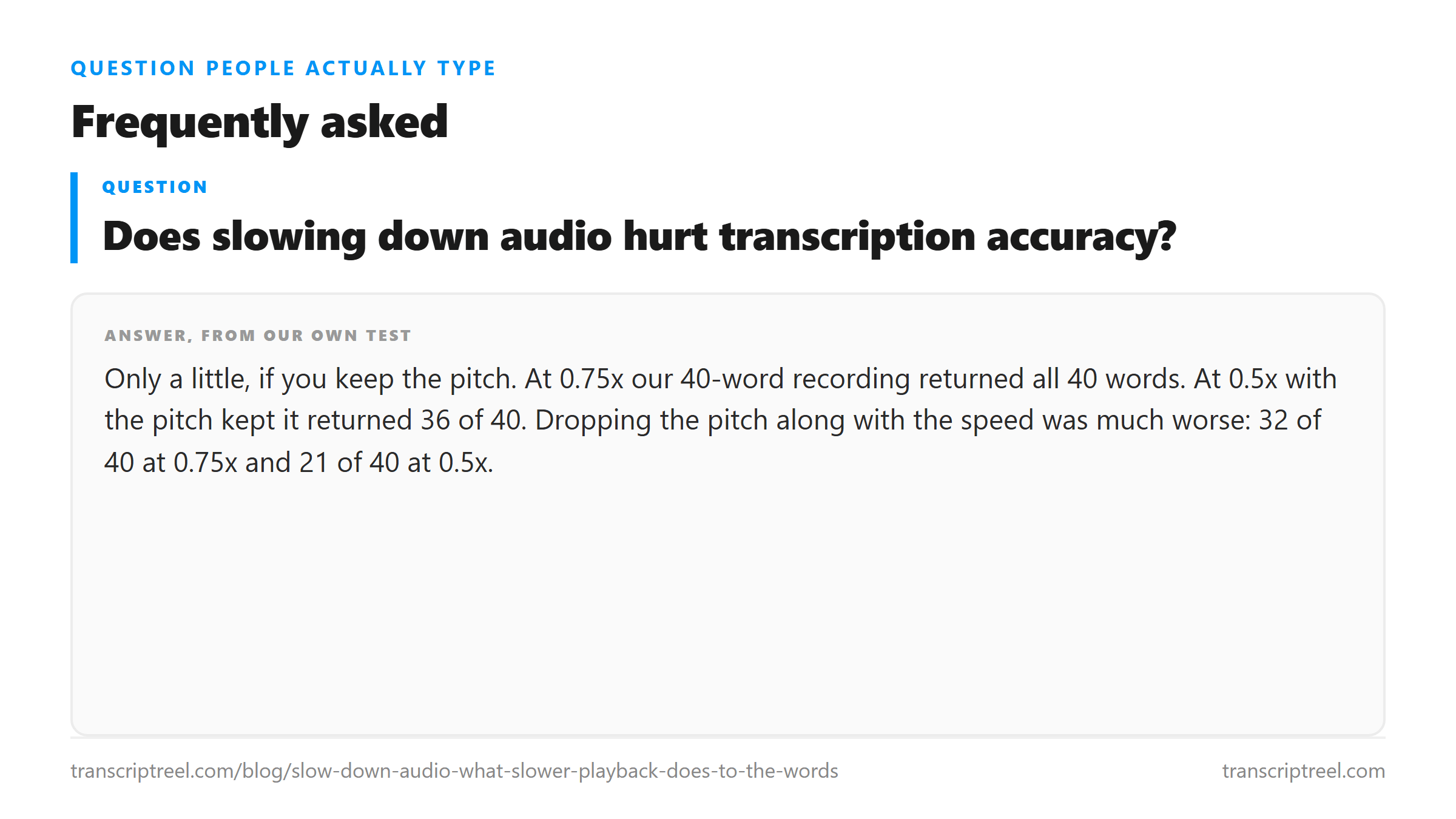
Only a little, if you keep the pitch. At 0.75x our 40-word recording returned all 40 words. At 0.5x with the pitch kept it returned 36 of 40. Dropping the pitch along with the speed was much worse: 32 of 40 at 0.75x and 21 of 40 at 0.5x.
Why does my slowed-down audio transcribe with wrong names?
Time-stretching duplicates and drops tiny slices of audio, and repeated letters are where that shows up. Our spelled surname went from W-H-I-D-F-I-L-E to W-H-I-D-F-I-L-E-L-E at both 0.75x and 0.5x. Proper nouns and decimal points are the other casualties.
What is the best way to slow audio for transcription?
Use a pitch-preserving time stretch, which in ffmpeg is atempo. Changing the sample rate gives the same duration but drags the pitch down an octave at 0.5x, and that route matched only 21 of 40 words against 36 for the pitch-preserved version.
Can I slow audio and then speed it back up to fix a transcript?
It depends on the method. A sample-rate slow-down restored to the original rate returned all 40 words, because the arithmetic is reversible. A pitch-preserved stretch sped back up returned 39 of 40 - one word stayed wrong, because a stretch discards audio that no round trip can bring back.