Chipmunk Voice: Where a Sped-Up Transcript Starts Losing Words
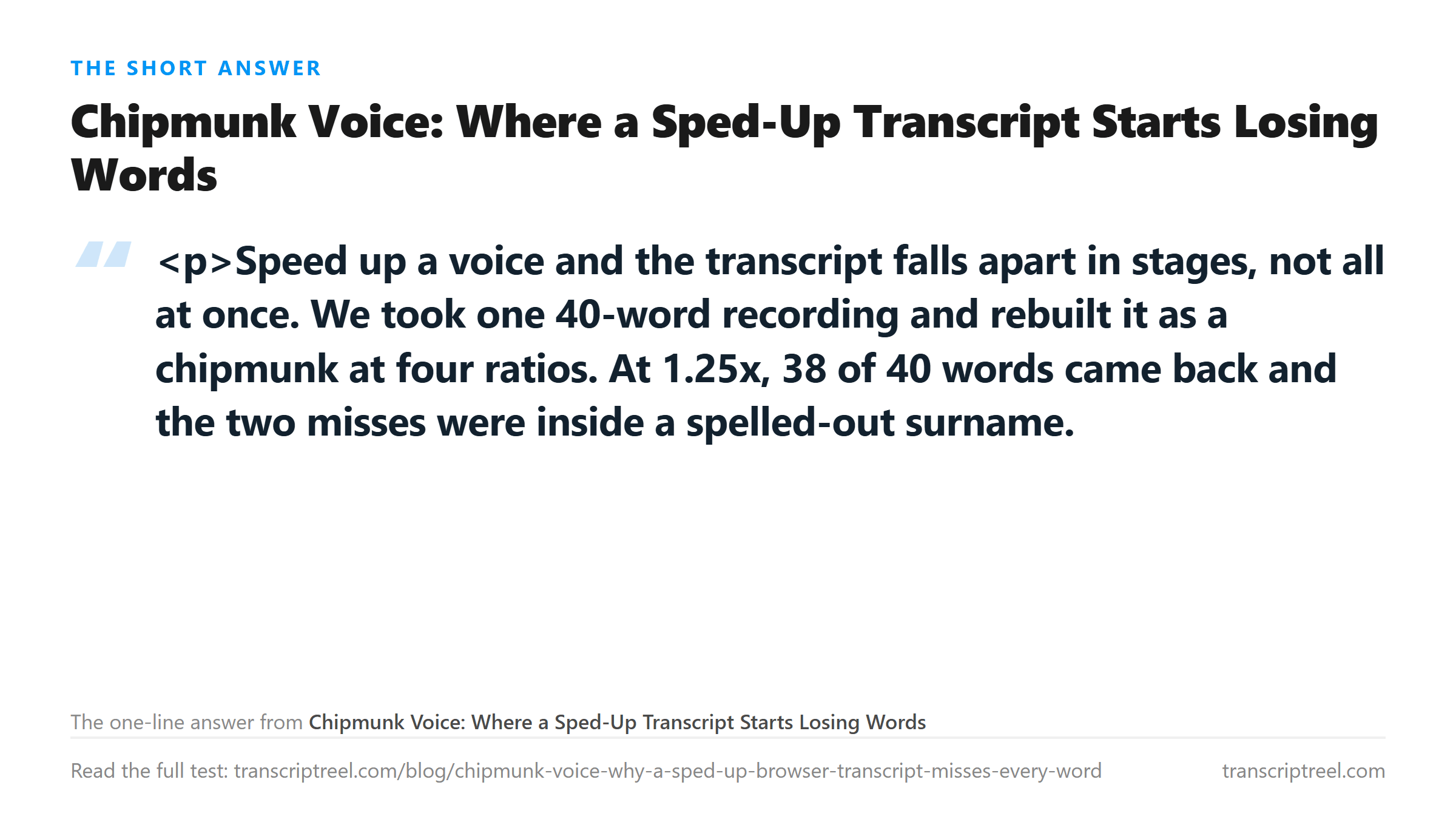
Speed up a voice and the transcript falls apart in stages, not all at once. We took one 40-word recording and rebuilt it as a chipmunk at four ratios. At 1.25x, 38 of 40 words came back and the two misses were inside a spelled-out surname. At 1.4x, 28 of 40 survived - the dollar amount, the phone number and the proper name all broke. At 1.6x, 15 of 40 survived. At 2.0x, none survived: the endpoint returned 389 words of looping "thank you very much for your attention". Slowing the 1.4x file back to normal speed restored all 40 words exactly.
What a chipmunk voice actually is
The chipmunk effect is one operation: you play the samples faster than they were recorded, without changing the pitch back. In ffmpeg that is asetrate. Everything about the audio scales at once - pitch rises by the same ratio the duration falls, so the words get higher and shorter together.

- 1.25x: 22.2 s becomes 17.8 s, pitch up 4 semitones.
- 1.4x: 15.9 s, pitch up 5.6 semitones.
- 1.6x: 13.9 s, pitch up 8.1 semitones.
- 2.0x: 11.1 s, pitch up a full octave.
This is not the same as speeding up playback with the pitch preserved. A pitch-preserving speed change is a different filter and it behaves very differently, which we measured separately on the same recording.
Four ratios, one clean recording
The source is a 22.2-second synthesized read of six sentences with a date, a room number, a spelled surname, an invoice number, a dollar total and a phone number. We used a synthesized voice, not a human one, so the baseline is known word for word and nothing is lost to accent or room noise. The baseline came back as 40 words.
- Baseline, normal speed: 40 words, 249 characters, all 40 matched.
- 1.25x: 40 words, 250 characters, 38 matched.
- 1.4x: 37 words, 250 characters, 28 matched.
- 1.6x: 41 words, 229 characters, 15 matched.
- 2.0x: 389 words, 2,219 characters, 0 matched.
1.25x: two words, both in the spelled name
At 1.25x the transcript is still usable. The date, the room number, the invoice number, the dollar total and the phone number all came back correctly formatted. The only damage is inside the spelled-out surname.
- Baseline: spelled W-H-I-D-F-I-L-E.
- 1.25x: spelled W-H-I-D-F-I-D-L-E, one letter swapped.
- Baseline: Dana Woodfield.
- 1.25x: Dana Woodfield - the name itself survived.
Spelling is the first thing to go because the model has no context to lean on. It hears isolated letters at a raised pitch and has to commit to each one. A normal word gets corrected by the sentence around it. A letter does not.
1.4x: numbers and names break
At 1.4x the sentence structure is still there but the specific facts are gone. Compare the two outputs word by word and the failures cluster in exactly the places you cannot guess.
- Date: "Thursday at 3.45" became "Thursday at 345" - the decimal point vanished.
- Room: "room 2.12" became "Room 212" - same three digits, different number.
- Name: "Dana Woodfield" became "Daniel Whitfield" - two invented syllables.
- Spelled name: collapsed into "W-H-I-D-F-I-D-L-U-V-N-V-R-S-4-4-171-S-8-8", which runs the invoice number into the spelling.
- Phone: "Call me back at 555-123-4567" became "Follow me back at 555-1-2-3 for 567" - first words and last digits wrong.
The invoice number survived as 4,471-88. Everything else numeric did not. That is not a gradual decay; it is selective. The model can still parse the rhythm of a number but loses the exact digits when they are compressed in time.
1.6x: sentence-level collapse
At 1.6x whole clauses fall apart. The output is 41 words against 40 in, so it is not padding - it is losing material and inventing replacements for what it lost.
- "The quarterly review is on Thursday at 3.45" became "To go all you need is 1.345".
- "building 7" became "dolding 742".
- "Our contact is Dana Whitfield" became "out contract, as they know it for you".
- "The invoice number is 4,471-88" became "I'll give you an invoice, number is 4,4171-shaded".
- "Total spend came to 12,406 dollars" became "total spam came to 12,416 hours" - dollars became hours.
The phone number at the end survived intact, 555-123-4567. That is worth noting: at 1.6x the model recovered the one item with the most rigid internal pattern and lost the prose around it.
2.0x: zero words, 389 invented
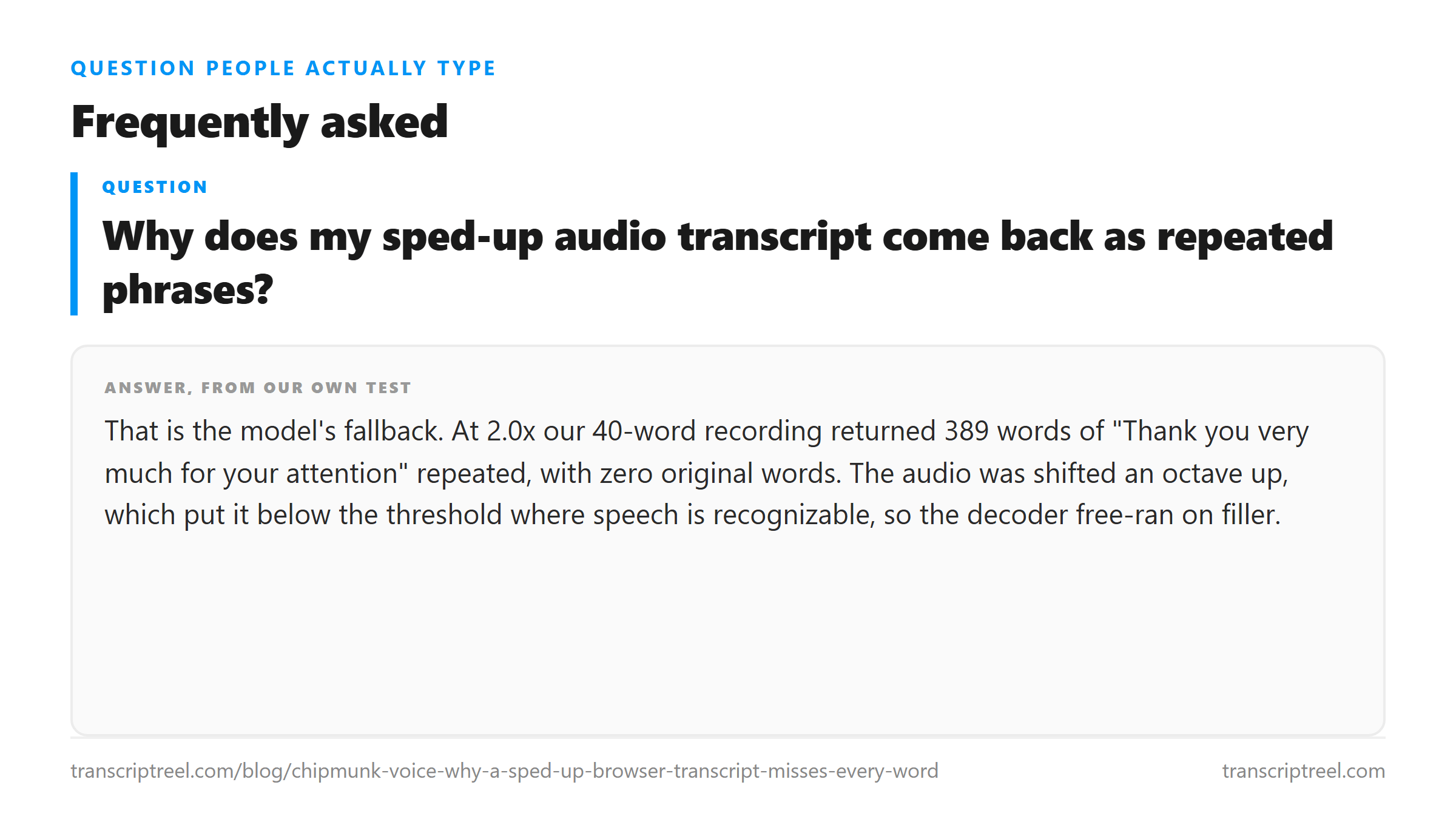
At a full octave up, the endpoint returned HTTP 200 and success: true. The transcript was 389 words, all of them the same sentence: "Thank you very much for your attention", repeated to the end of the output. Not one word of the recording appeared.
This is the same failure we see on silent files. When the model cannot resolve speech from the waveform, it does not return an error. It falls back to the most common closing phrase in its training data and repeats it until the output budget runs out. A chipmunk-shifted voice sits below the threshold where speech is recognizable, so it lands in the same bucket as silence.
Slowing it back down restores every word
We took the 1.4x file and divided the sample rate by 1.4, which undoes the pitch and duration shift exactly. That file returned 40 words and all 40 matched the baseline - zero substitutions, zero insertions.
- 1.4x as uploaded: 28 of 40 words matched.
- 1.4x after undoing the shift: 40 of 40 matched.
- The undone file is 22.205 s, the same duration as the original.
So the damage is entirely in the transform, not in any information the model failed to use. Nothing is lost from the audio itself - the words were there the whole time, just at a pitch the model could not decode reliably. If you have a chipmunked file and no original, applying the inverse ratio gets the words back.
How to undo it yourself
You need the ratio you sped up by. If you do not know it, measure the duration against a known reference - a file you sped up from 22.2 s to 15.9 s was multiplied by 1.4, so divide by 1.4 to reverse it.
- Reverse a known ratio: ffmpeg -i chipmunk.mp3 -af "asetrate=44100/1.4,aresample=44100" fixed.mp3
- Measure the ratio from durations: original_seconds / current_seconds.
- Check before uploading: the fixed file should return to the original duration within a few milliseconds.
- Do not use atempo to fix this - it changes speed and leaves the pitch high.
Why this is different from speeding up playback
A player that offers 1.5x speed keeps the pitch where it was. That operation is a time-stretch, and on the same recording it cost far less. At 0.75x slow-down with pitch preserved, all 40 words matched the baseline exactly. The chipmunk transform at a comparable ratio, 1.4x, lost twelve.
The lesson is that pitch is the thing that breaks decoding, not speed. A voice at normal pitch and double length is fine. A voice at double pitch and half length is unrecoverable without an inverse transform.
Short version
Chipmunk audio degrades in three stages: at 1.25x you lose letters inside spelled names, at 1.4x you lose numbers and proper nouns, at 1.6x you lose clauses, and at 2.0x you lose everything and get looping filler instead. Every one of those losses is reversible with a single inverse sample-rate change, which took our worst usable case from 28 of 40 words back to 40 of 40.
Got a Reel you want as text? Get an Instagram transcript as TXT, SRT, or VTT →
A chipmunk file is one sample-rate change away from readable: undoing our 1.4x shift took the transcript from 28 of 40 words to 40 of 40. Wondershare UniConverter opens the clip on your own machine, lets you set the exact rate, and exports a fresh file without touching the words. It does not transcribe - the words come back from this page.
FAQ
Why does my sped-up audio transcript come back as repeated phrases?
That is the model's fallback. At 2.0x our 40-word recording returned 389 words of "Thank you very much for your attention" repeated, with zero original words. The audio was shifted an octave up, which put it below the threshold where speech is recognizable, so the decoder free-ran on filler.
How much speed-up can a transcript survive?
In our test, 1.25x kept 38 of 40 words and 1.4x kept 28 of 40. The losses at 1.25x were single letters inside a spelled-out surname. At 1.4x the dollar amount, the phone number and the proper name all broke.
Can I fix a chipmunked recording before transcribing?
Yes, if you know the ratio. We undid a 1.4x shift with asetrate=44100/1.4 and the file returned all 40 words with zero errors, up from 28 of 40. The fixed file has to come back to the original duration, in our case 22.205 seconds.
Does speeding up playback break a transcript the same way?
No. Pitch-preserving speed changes are far gentler. A 0.75x slow-down with pitch kept returned all 40 words exactly. The chipmunk effect at a similar ratio lost twelve, because raising the pitch is what breaks decoding.