Voice Typing: What Happens When You Say the Punctuation Out Loud
Twelve sentences, one question
We wanted to know what a dictation tool does when you speak the name of a mark. So we made twelve clips and said comma, period, colon, new line, open quote, close quote, question mark, exclamation mark, semicolon and capital out loud. Each clip went up on its own. Here's the setup.
- Voice: one synthetic English voice, one speaker per clip, no background noise.
- Endpoint: this page's /api/transcribe, one file per POST, 12 uploads total.
- We recorded the exact returned string, its character count, its word count, and how long the call took.
- We publish no accuracy percentage. Twelve clips aren't a test set, so you get the strings instead.
All twelve, said and returned
- 'We need milk comma eggs comma bread and coffee period' came back 'We need milk comma eggs, comma bread, and coffee period.' - 56 characters, 10 words, 1.16 s.
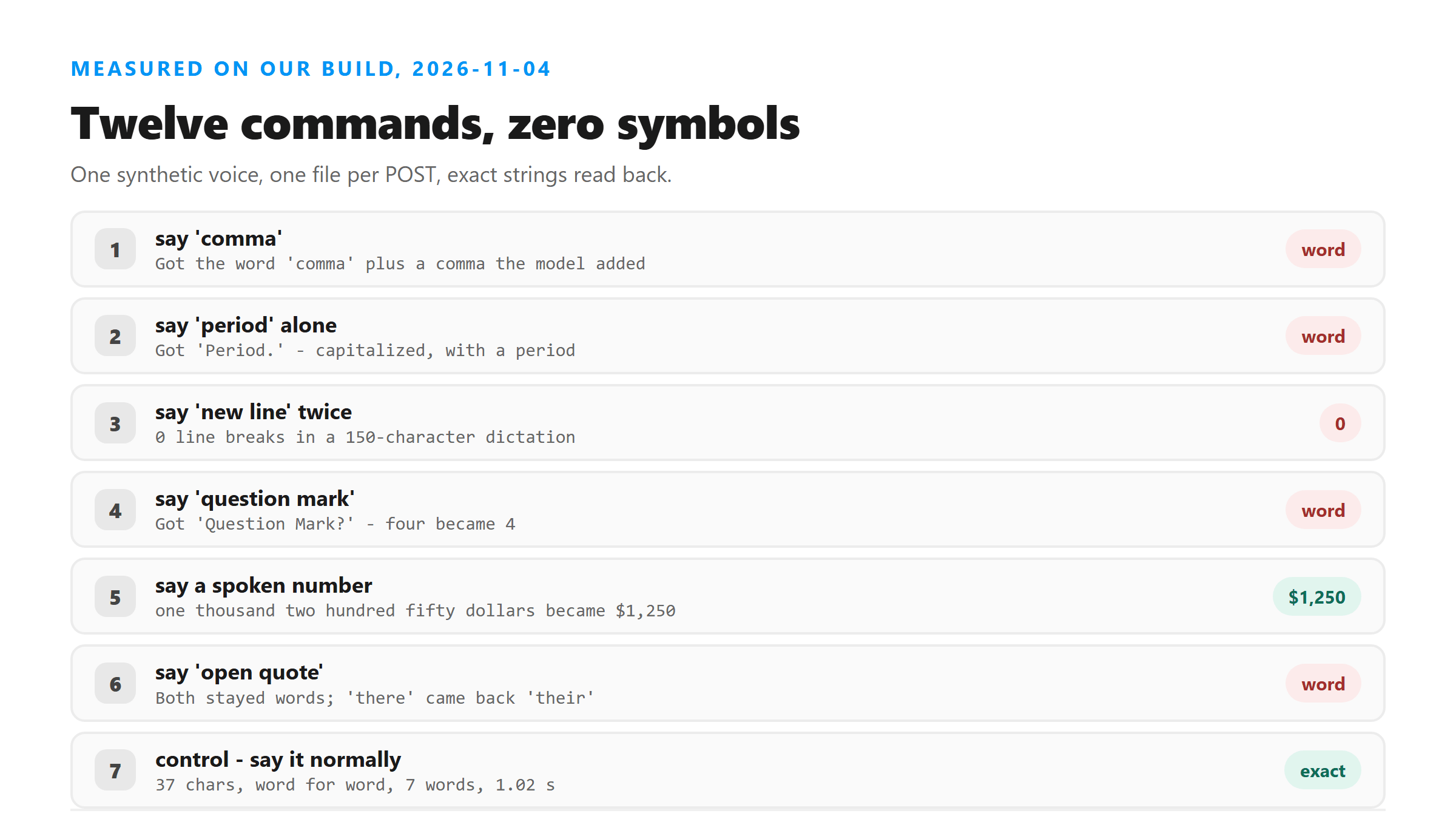
- 'Is the meeting at four question mark' came back 'Is the meeting at 4 Question Mark?' - 34 characters, 7 words, 0.84 s.
- 'First item colon two cups new line second item colon one cup' returned 64 characters and 12 words.
- The string: 'First item colon, two cups, new line second item colon, one cup.' Both colons are still words.
- 'She said open quote hello there close quote' came back 'She said open quote hello their close quote.' - 44 characters, 8 words, 1.33 s.
- 'Watch out exclamation mark' came back 'Watch out, exclamation mark.' - 28 characters, 4 words, 1.88 s.
- 'Capital boston is a city period' came back 'Capital Boston is a city period.' - 32 characters, 6 words, 0.87 s.
- A lone 'comma' came back 'comma' - 5 characters, 1 word, 0.68 s.
- A lone 'period' came back 'Period.' - 7 characters, 1 word, 0.75 s.
- 'One semicolon two semicolon three period' came back '1 semicolon, 2 semicolon, 3 period' - 34 characters, 6 words, 1.28 s.
- 'The total is one thousand two hundred fifty dollars period' came back 'The total is $1,250 period.' - 27 characters, 5 words, 1.49 s.
- The control, 'We need milk, eggs, bread and coffee.', came back word for word - 37 characters, 7 words, 1.02 s.
- A 150-character dictation with two 'new line' commands came back as one unbroken block, 25 words, 2.50 s.
Not one command became a symbol
Count them. Comma, period, colon, new line, open quote, close quote, question mark, exclamation mark, semicolon and capital. Ten command words, spoken across twelve clips. Zero became punctuation. Zero became a line break. Zero became a capital letter on the word that followed. Every single one is sitting in the returned text as an ordinary word.
The only exception is cosmetic. 'Capital Boston' and 'Question Mark' came back capitalized, but that's the model capitalizing what it thinks is a proper noun or a sentence start. It didn't capitalize the next word for you, and it didn't turn 'capital' into an instruction.
The model writes its own marks anyway
Here's the part that trips people up. You said 'comma', so you expected a comma. You got the word 'comma' - and also a comma that the model added on its own. In the first clip, the two spoken commas are still words. The two printed commas after 'eggs' and 'bread' are the model's own. The final period is the model's too. The spoken 'period' is just the word before it.
So a spoken command doesn't replace a mark. It adds a word, and the model still punctuates the sentence by its own rules. If you read the result quickly, it looks like the command half worked. It didn't work at all.
Position changes the answer
A lone 'comma' came back as 'comma' - lowercase, no period, 0.68 s. A lone 'period' came back as 'Period.' - capitalized, with a period, 0.75 s. Same kind of command word, different treatment, because the model treats a one-word clip as a whole sentence and capitalizes its first word.
Put the same word inside a sentence and it stays lowercase. In the first clip, the trailing 'period' is lowercase, and the mark after it is the model's. So you can't even say 'spoken commands always become lowercase words'. Where the word sits changes what you get.
'New line' never made a line break
We said 'new line' twice in a longer dictation. The returned string is 150 characters and 25 words, one paragraph, zero line breaks. That matches what a longer test on this page already showed: even a 180-second clip comes back as one unbroken block. This endpoint returns a paragraph, not a layout. If you want paragraphs, you add them after the text lands.
Numbers still normalize
The commands didn't stop the model from rewriting figures. 'four' became 4. 'one thousand two hundred fifty dollars' became $1,250. A phone number came back as 555-123-4567. 'One semicolon two semicolon three' came back '1 semicolon, 2 semicolon, 3'. Those conversions happen whether or not you name a mark, which is one more reason to check every figure against what you actually said.
One word went wrong for a completely different reason. 'Hello there' came back 'hello their'. That's a homophone, not a punctuation problem. In dictation, the words worth checking twice are the ones that sound like other words, not the command names.
Why it works this way
This page runs @cf/openai/whisper on Cloudflare Workers AI. It reads 16 kHz mono audio and writes the words and the marks together in one pass. There's no separate step that listens for command words. To the model, the sound of the word comma is just an English word that people say in sentences. It has no idea you meant a symbol.
That's also why the model's own punctuation shows up in the same string. It isn't obeying you and it isn't ignoring you. It's doing the one job it was built for: turning the sounds it hears into written English. A command word is a sound like any other.
Why there's no switch
A command mode would need a second decision layer: which stretch of audio is a command, and which is content. That's a language judgment this page doesn't make, and adding it would mean promising behavior we haven't measured. We don't ask you to log in, don't offer a browser extension, and don't paste links for you. One job, one response, then the file is gone. Your bytes leave the browser over an encrypted connection, get read once in memory, and are dropped when the response is written.
So there's no setting to flip, and we won't pretend a converter can add one. The fix lives in your editing step, not in the upload.
What to do instead
- Say the sentence the way you'd say it to a person. Let the model place the commas and periods.
- Don't name the marks. Every name you say becomes a word you'll have to delete later.
- After the text comes back, search for stray 'comma', 'period' and 'new line' and remove them.
- Add your own line breaks and paragraph splits. The export won't have any.
- Read every number and every homophone twice. Those are the errors that survive a quick skim.
Got a Reel you want as text? Upload the file and download the transcript as TXT, SRT, or VTT →
Saying 'comma' leaves a stray word in your text, and there's no setting here to strip it. Wondershare UniConverter isn't a fix for that - it handles the file you hand over: convert a voice memo to mono MP3 or WAV, trim it, and check the size before you save. It does not transcribe, and it won't remove the command words for you.
FAQ
If I say 'comma', do I get a comma?
No. You get the word 'comma' written into the text. The model adds its own comma where it thinks one belongs, so a spoken command usually leaves you with both the word and a mark.
Does 'new line' start a new paragraph?
No. We said it twice in a 150-character dictation and got one unbroken block with zero line breaks. Add paragraphs after the text comes back.
Why did 'period' come back as 'Period.' but 'comma' as 'comma'?
A one-word clip is treated as a whole sentence, so the model capitalizes it and adds a period. Inside a longer sentence the same word stays lowercase. Position changes the result.
Can I turn on a command mode?
No. There's no switch, and we don't offer one. The model writes words and punctuation in a single pass and doesn't listen for instructions. Clean the text after export.
Do spoken commands change how numbers come back?
No. 'four' still became 4 and 'one thousand two hundred fifty dollars' still became $1,250. Check every figure against what you said, commands or not.