Audio Transcription: What a Reversed Clip Returns
Seven reversals, zero errors
We started with one clean 10.2-second WAV, 16 kHz mono, 326,478 bytes. It came back as 160 characters and 29 words in 1.93 seconds. Then we made seven copies with the order of the samples changed and uploaded each one on its own.
- Full reversal - 221 characters, 45 words, 2.75 s.
- Reversed twice - 160 characters, 29 words, 1.96 s. Word for word the control.
- First five seconds reversed - 84 characters, 16 words, 1.75 s.
- Last five seconds reversed - 107 characters, 23 words, 1.75 s.
- Reversed and slowed to half speed - 466 characters, 6 words, 12.41 s.
- Reversed with a 300 ms echo - 887 characters, 222 words, 11.59 s.
- Reversed at 20 percent volume - 192 characters, 36 words, 11.56 s.
No 422, no empty result, no warning
All seven calls returned HTTP 200 with a transcript. That's worth saying plainly, because a lot of people assume a broken file gets rejected. On this page, HTTP 422 is for a file with no audio track or no speech at all. A reversed file has plenty of signal, so it sails through. The model writes something for any signal it's handed.
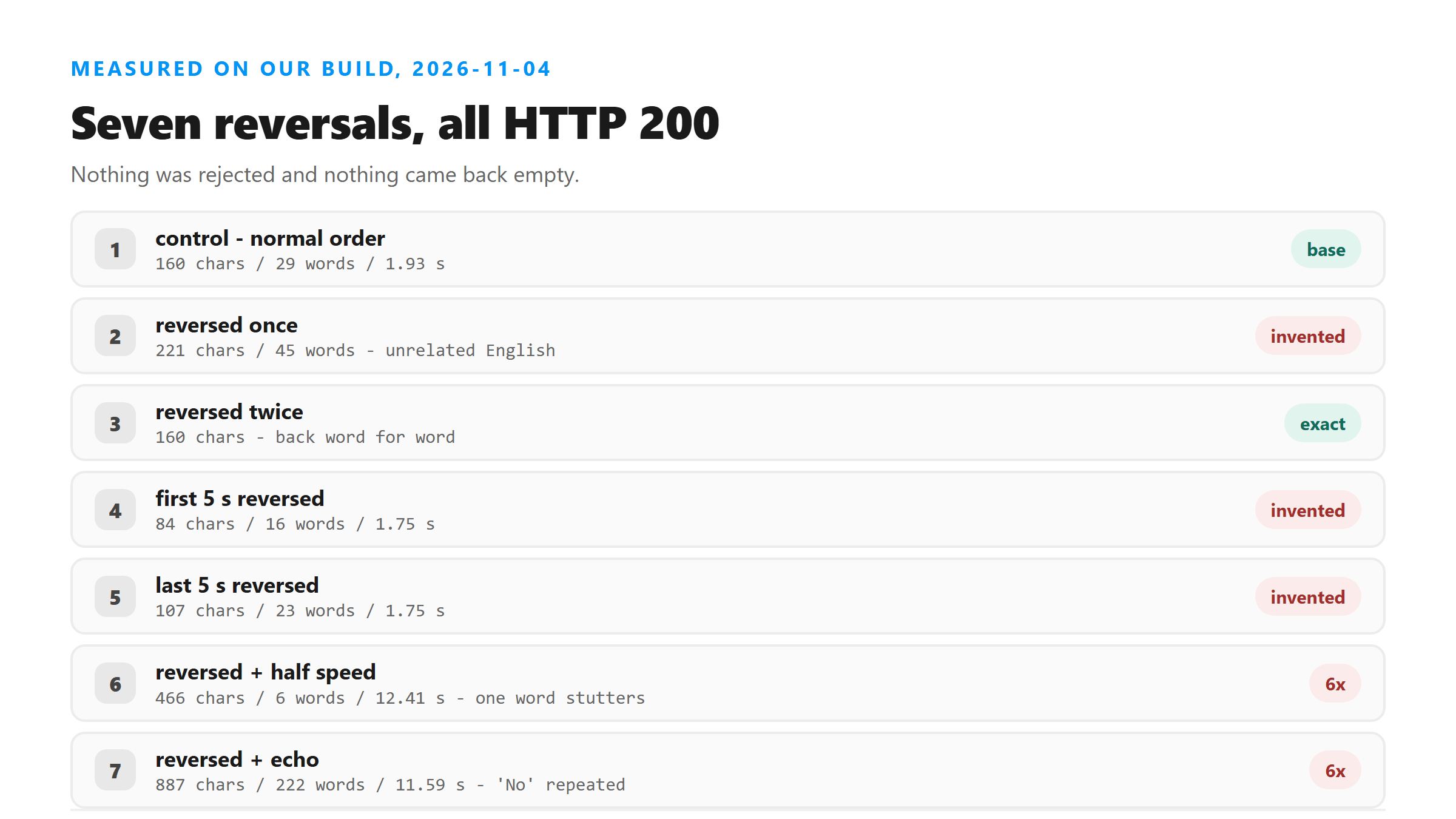
The full reversal opened with 'And it's not worth freaking it' and went on from there. It's grammatical English. It's also completely unrelated to 'The quick brown fox jumps over the lazy dog.' If you only checked that a response arrived, you'd call this a success.
Reversing twice proves it's the order
The second file is the control, reversed and then reversed again. It came back as the original 160 characters and 29 words, character for character, in 1.96 seconds. Nothing was lost in the file and nothing was added. The only thing that changed in the broken files was the order of the samples.
That's a clean check. A corrupted file wouldn't come back perfect on the second flip. So the invented prose isn't damage - it's what this model writes when the time axis runs backward.
Half a reversal still breaks the whole clip
We cut the file at five seconds and reversed one half at a time. The first-half file returned 16 words and the second-half file 23 words. Neither half came back as real speech. The model reads the whole clip as one utterance, so a backwards stretch anywhere in it throws off the text around it too.
The less signal, the longer the call
The three slow files are the interesting ones. A reversed clip slowed to half speed took 12.41 seconds and wrote one stuttering syllable hundreds of times. A reversed clip with echo took 11.59 seconds and wrote 'No, no, no' 222 times over. A reversed clip at low volume took 11.56 seconds and produced 36 words of fresh nonsense. The control took 1.93 seconds. That's roughly six times longer for files with less usable speech.
It fits a pattern we've seen on this page before. Pure silence came back as a long string of filler, and pure noise came back as a short string in another language. The endpoint doesn't have a 'nothing to report' state. Given a signal it can't read, it keeps writing, and the call gets slower, not faster.
Why length is a bad health check
The control is 160 characters. The reversed clip is 221. The slowed one is 466 characters but only 6 words, because one word repeats. The echo file is 887 characters and 222 words, and almost all of them are the same word. You can't rank those four by how healthy the transcript is. A longer string here means the model got stuck, not that it heard more.
Our echo test did the same. A 1,000 ms echo grew a clip from 160 to 248 characters by writing two phrases twice.
What to check before you trust a transcript
- Play the file once. If it sounds backwards or garbled, don't use the text at all.
- Read a sentence out loud. Invented prose usually sounds fine, so this alone won't catch it - compare it to what you remember saying.
- Watch for one word repeating. That's the fingerprint of a file the model couldn't read, not a speaker who stuttered.
- Don't treat a successful HTTP 200 as proof the words are right.
- Keep your own copy. The file leaves your browser, gets read once in memory, and is dropped when the response is written. We don't save it or train on it.
How we made the files
Every variant comes from the same control WAV. Full reversal uses ffmpeg's areverse filter. The double reversal applies it twice. The half files use atrim first. The slow file adds atempo=0.5. The echo file adds aecho=0.8:0.8:300:0.4. The quiet file adds volume=0.2. All stay 16 kHz mono, one upload per POST. We publish no accuracy figure here - seven files aren't a test set. You get the exact counts and times instead.
Got a Reel you want as text? Upload the file and download the transcript as TXT, SRT, or VTT →
A reversed clip comes back as confident, unrelated words, and no setting here detects that. Wondershare UniConverter won't detect it either - what it does is let you open the file on your own machine and re-export a clean copy as mono WAV or MP3 before you upload. It does not transcribe; the words come from this page.
FAQ
Does a reversed file get rejected?
No. All seven reversed uploads returned HTTP 200 with a transcript. HTTP 422 on this page is for a file with no audio track or no speech, not for a broken one.
Why is the reversed transcript fluent English?
The model writes plausible English for any signal it's handed. It has no 'nothing to report' state, so backwards audio becomes confident, unrelated prose rather than an error or an empty string.
Does reversing twice fix it?
Yes. The double-reversed file came back as the original 160 characters and 29 words, word for word. That proves the damage comes from the order of the samples, not from a corrupted file.
Why did some reversed files take 12 seconds?
Files with less usable speech make the call slower, not faster. The slowed, echoed and quiet reversals took 11.56 to 12.41 seconds, against 1.93 for the control, and one repeated a single word over 200 times.
Can I trust a transcript just because it's long?
No. The echo file was 887 characters and 222 words, almost all the same word, and the slowed file was 466 characters but only 6 words. More text meant the model got stuck, not that it heard more.