Speech to Text: What Happens to Um, Uh and Repeated Words
The nine files
One base script, two sentences, read by a synthesized US voice at 16 kHz mono. We recorded it clean, then recorded eight more versions with a different disfluency dropped into each one. Here's what went in and what came out.
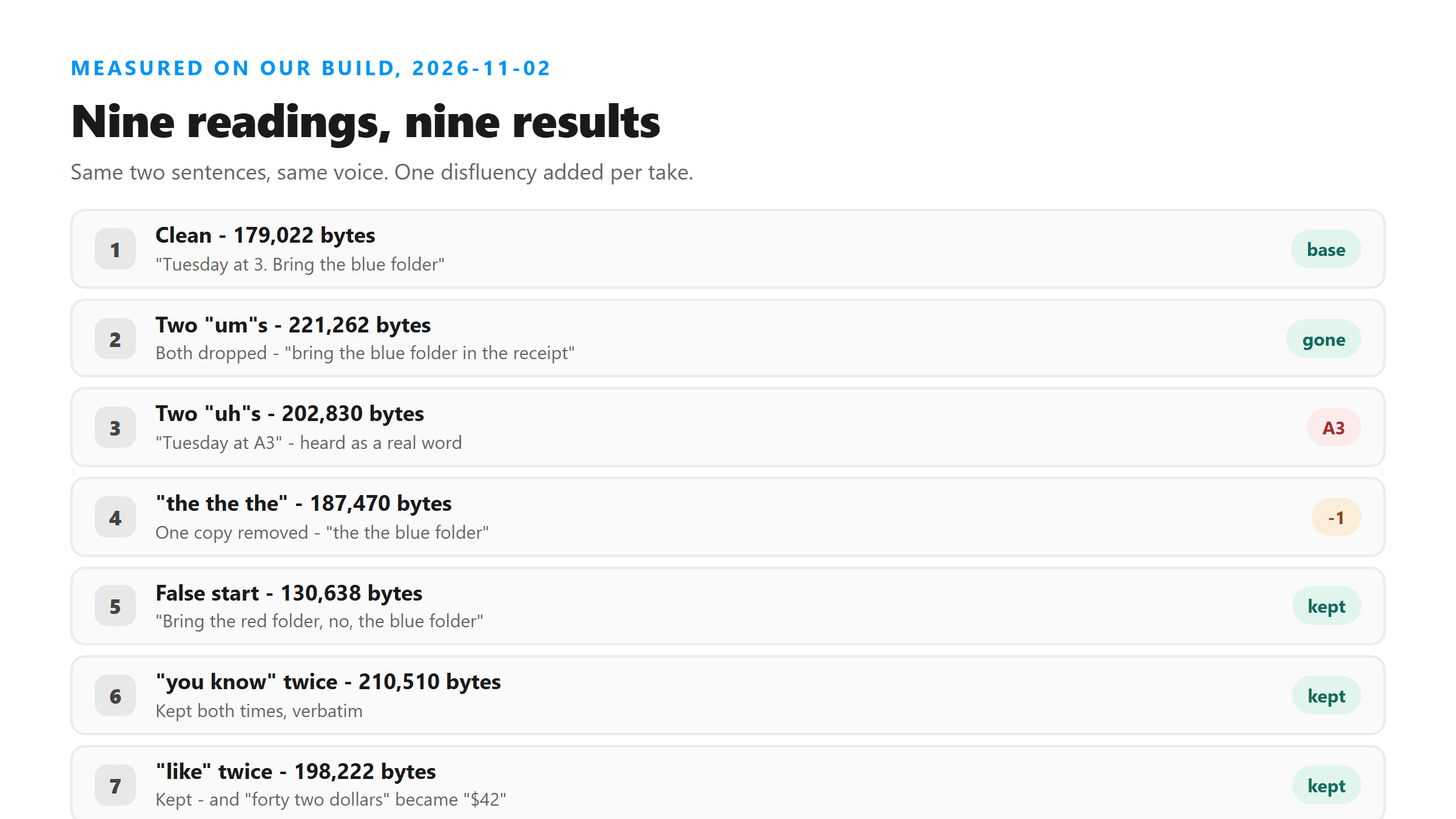
- clean, 179,022 bytes: "The meeting is Tuesday at 3. Bring the blue folder and the receipt."
- two "um"s, 221,262 bytes: "The meeting is on Tuesday at three, bring the blue folder in the receipt."
- two "uh"s, 202,830 bytes: "The meeting is Tuesday at A3. Bring the blue folder and the receipt."
- "the the the", 187,470 bytes: "The meeting is Tuesday at 3. Bring the the blue folder and the receipt."
- false start, 130,638 bytes: "Bring the red folder, no, the blue folder and the receipt."
- two "you know"s, 210,510 bytes: "The meeting is Tuesday at 3, you know. Bring the blue folder, you know, and the receipt."
- two "like"s, 198,222 bytes: "The meeting is, like, Tuesday at 3. It was, like, $42."
- a standalone "Um.", 195,918 bytes: "The meeting is Tuesday at 3, um, bring the blue folder."
- "I mean I mean", 172,110 bytes: "I mean, the meeting is Tuesday. I mean I mean bring the folder."
How we made them
Same voice, same speaking rate, same two sentences every time. The only thing that changed is the disfluency, so every difference in the nine transcripts comes from that one thing.
File sizes landed between 130,638 bytes for the shortest reading - the false start, which drops a whole clause - and 221,262 bytes for the one with two "um"s. Nobody listening to these would call nine takes necessary. We ran them so the pattern would be visible.
The one that turned into a real word
The "uh" file is the one worth knowing about. We said "Tuesday at, uh, three" and the transcript says "Tuesday at A3". The model didn't drop the filler. It heard it, found the nearest real word, and wrote that down instead.
That's worse than dropping it, because the output still reads like a clean sentence. Nothing in "The meeting is Tuesday at A3" looks like an error unless you were in the room. Compare the "um" file, where both fillers simply disappeared and every word that mattered survived.
What gets dropped and what stays
A pattern shows up across the nine runs. A filler sitting alone between two words tends to vanish. A filler the model can map onto a real word gets written as that word. A filler holding its own spot in the sentence tends to survive.
- Dropped: both "um"s in the second file.
- Heard as something else: "uh" became "A3".
- Trimmed by one: "the the the" came back as "the the".
- Kept word for word: "you know" twice, "like" twice, "I mean" three times.
- Kept whole: the false start, "Bring the red folder, no, the blue folder".
How long each upload took
Eight of the nine came back in 1.0 to 1.7 seconds. The ninth took 27.22 seconds - same size range, same endpoint, twenty times slower. We changed nothing about it, and it returned the same text it would have either way.
- clean: 1.31 seconds.
- "like": 1.02 seconds.
- false start: 1.17 seconds.
- standalone "Um.": 1.68 seconds.
- "I mean I mean": 27.22 seconds.
The numbers move around too
Filler isn't the only thing that shifts. The clean file wrote "Tuesday at 3" and the "um" file wrote "Tuesday at three" from the same spoken words. The "like" file turned spoken "forty two dollars" into "$42".
Small stuff, but it means two transcripts of the same meeting won't always match. The stutter is the one case where the output looks like real speech: "Bring the the blue folder" reads exactly the way someone restarting mid-word sounds. Fix that one by hand if you're quoting it.
What to do when the transcript matters
Check any number or proper-sounding noun that follows a pause. That's where "A3" came from. If you only need the content, leave the fillers in - they cost you nothing, and cutting them means editing text you haven't read yet.
Don't re-record to get rid of them. All eight disfluent files came back close enough to the clean one that the extra takes weren't worth the time.
If you need clean text, edit the text
Cutting audio to remove a stutter is slow, and it costs you the surrounding words if you clip too tight. Editing the transcript is faster and reversible.
- Search the transcript for doubled words - "the the" is the usual shape.
- Read every number that sits right after a comma or a pause.
- Leave "you know" and "I mean" alone unless you're publishing the quote.
What happens to your file here
Uploads leave your browser over an encrypted POST to /api/transcribe. The file is held in memory for one pass and dropped as soon as the response goes out. No copy is kept, nothing is used for training, and there's no account involved.
Limits of this test
Nine files, one voice, one script, one disfluency per file. We didn't test accented speech, real recordings with room noise, or a speaker who fills every other word. Treat the pattern as what happened with these nine, not as a rule about every filler.
Got a Reel you want as text? Upload the file and download the transcript as TXT, SRT, or VTT →
No converter cleans up how somebody talks, and today's nine files show why: the filler went missing, came back as "A3", or stayed put. Where Wondershare UniConverter does help is the file around the words - re-encode a recording that won't play into an MP3 this endpoint accepts. It does not transcribe - the words come back from this page.
FAQ
Does a transcript include filler words like um and uh?
Sometimes. Across nine test uploads, "um" was dropped twice and kept once, "uh" came back as "A3", and "you know", "like" and "I mean" survived every time.
Why did uh become A3?
The model heard the sound and matched it to the nearest real word instead of dropping it. "Tuesday at, uh, three" came back as "Tuesday at A3".
Do repeated words get cleaned up?
Partly. A spoken "the the the" came back as "the the" - one copy removed, two kept.
Should I edit my recording to remove fillers before uploading?
No. Our nine runs produced usable text either way, and cutting audio costs more time than deleting a stray word from the text.