Translating Instagram Story Audio Without the Video
What comes back is the language that went in
We built four 15-second story clips with neural voices - Spanish, French, German and English - and sent each one as a 16 kHz mono M4A file. All four came back as text in their own language. The Spanish one opened with "Hola a todos. Hoy quiero contarles algo sobre mi viaje." The French one opened with "Bonjour a tous. Aujourd'hui, je vais vous raconter mon voyage." Neither came back in English.
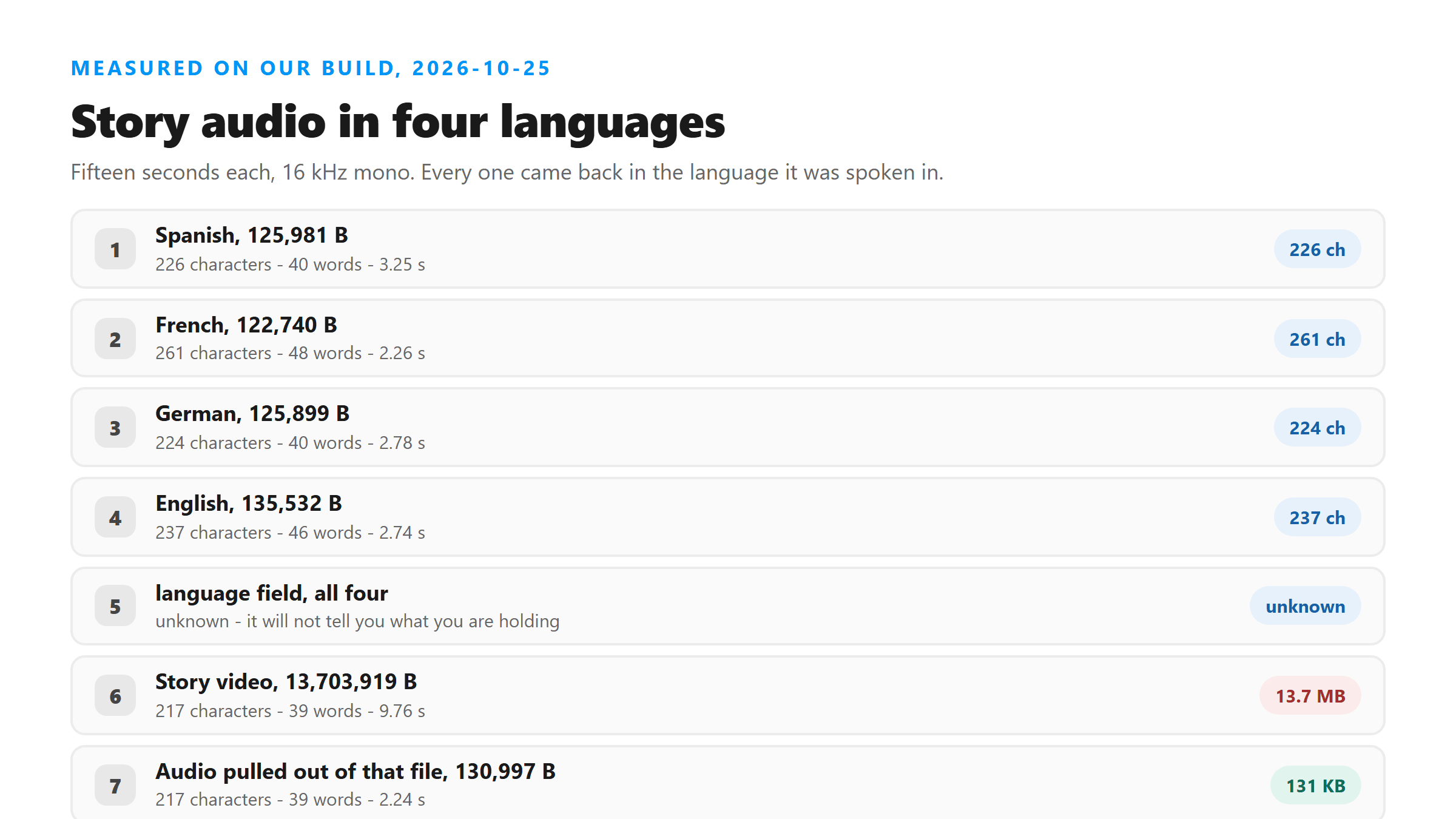
- Spanish, 15 s, 125,981 B: 226 characters, 40 words, 3.25 s
- French, 15 s, 122,740 B: 261 characters, 48 words, 2.26 s
- German, 15 s, 125,899 B: 224 characters, 40 words, 2.78 s
- English, 15 s, 135,532 B: 237 characters, 46 words, 2.74 s
The engine is Cloudflare Workers AI running @cf/openai/whisper, and we call it with the audio and nothing else. No task, no target language, no translate flag. So it writes down what it hears. Accents and tildes survived the trip: "manana" came back as "mañana", "corria" as "corría", "arboles" as "árboles".
Run it twice and you get the same string
We uploaded the 15-second Spanish file a second time. Second run: 226 characters, 40 words, 2.46 seconds, character for character the same. The wall clock moved by 0.79 seconds while the words did not. If you are checking a transcript for typos, re-running the same file will not surface anything new.
Story length: 15, 30 and 60 seconds
One story segment caps at 15 seconds, so anything longer is a chain of them. We looped the same Spanish narration out to 30 and 60 seconds and sent all three.
- 15 s, 125,981 B: 226 characters, 40 words, 3.25 s
- 30 s, 244,675 B: 434 characters, 77 words, 5.22 s
- 60 s, 482,463 B: 593 characters, 103 words, 5.75 s
Character counts grow with length, and the wall clock grows much slower than the audio does: 60 seconds of audio was done in 5.75 seconds. These files are one voice reading one script on a loop, so treat the word counts as a shape and not as a natural-speech benchmark.
What the video adds: 105 times the bytes, none of the words
This is the part that matters if the words are all you want. We muxed the same 15 seconds of Spanish into a 1080x1920 story video at 6 Mbps, which produced 13,703,919 bytes. Then we pulled the audio track out of that exact file with ffmpeg and got 130,997 bytes. Both went to the same endpoint.
- MP4 video, 13,703,919 B: 217 characters, 39 words, 9.76 s
- Audio track from that MP4, 130,997 B: 217 characters, 39 words, 2.24 s
Identical text. The video was 105 times larger and took 4.4 times as long to process. The picture never reaches the model at all - the endpoint decodes the audio track and works from that. A story frame you recorded yourself is exactly this kind of file, so the picture is dead weight from the first byte.
The one thing the container does change
Muxing cost us two words. The M4A ran 15.04 seconds and finished with "...comimos en un pequeño momento." - 226 characters, 40 words. The MP4 ran 15.00 seconds and finished with "...comimos en un pequeño" - 217 characters, 39 words. A 0.04-second trim at the tail took the last two words with it. If you cut your own clips, leave the final sentence some room.
So how do you get English?
Take the text out and translate the text. Put the Spanish transcript into a translation tool rather than feeding the audio anywhere a second time. Text is the better input here: the transcript already settled the punctuation, the sentence breaks and the accents, and a translator working on clean sentences beats a second pass over noisy audio.
One thing to watch: our output has no timestamps, no speaker labels and no paragraph breaks. A 60-second story comes back as one block of 593 characters. If you need to know which sentence happened in which story segment, split the audio by segment before you upload, not after.
What we could not test today
Every clip here is one synthetic voice reading a script. Real story audio carries music stickers, street noise and people talking over each other, and none of that is in these files. We also did not measure any translation tool - we only measured what our own endpoint returns.
Got a Reel you want as text? Upload the file and download the transcript as TXT, SRT, or VTT →
The numbers on this page are all about one step: the picture costs 13.7 MB and buys no words. Wondershare UniConverter strips the audio out of a story recording on your own machine and writes it small enough to clear the size wall — 131 KB instead of 13.7 MB, same 217 characters back. It does not translate, and neither do we.
FAQ
Does the transcript come back in English?
No. It comes back in the language that was spoken. We sent Spanish, French, German and English story audio today and each returned its own language. The endpoint calls the model with the audio only - no target language is passed - so nothing in the pipeline translates.
Why does the language field say unknown?
The response carries six fields: success, transcript, language, engine, fileSize and fileName. Today the language field read unknown on every upload, including the Spanish ones that came back with tildes and accents in them. The text is right; the label is not filled in.
Do I need the video file at all?
No. A 13,703,919-byte MP4 and the 130,997-byte audio track pulled out of it returned the same 217 characters today. The audio took 2.24 seconds against the video's 9.76 seconds. Pull the audio out first if the words are what you came for.
Will the Spanish text keep its accents?
Yes. Today's Spanish output kept "mañana", "corría", "árboles" and "Después" intact. Capitalization is less reliable - the MP4 version of the same clip returned "después" in lowercase at the start of a sentence.