Transcribe a Voice Memo: How Long Can It Run Before the Words Break
Four lengths, one memo
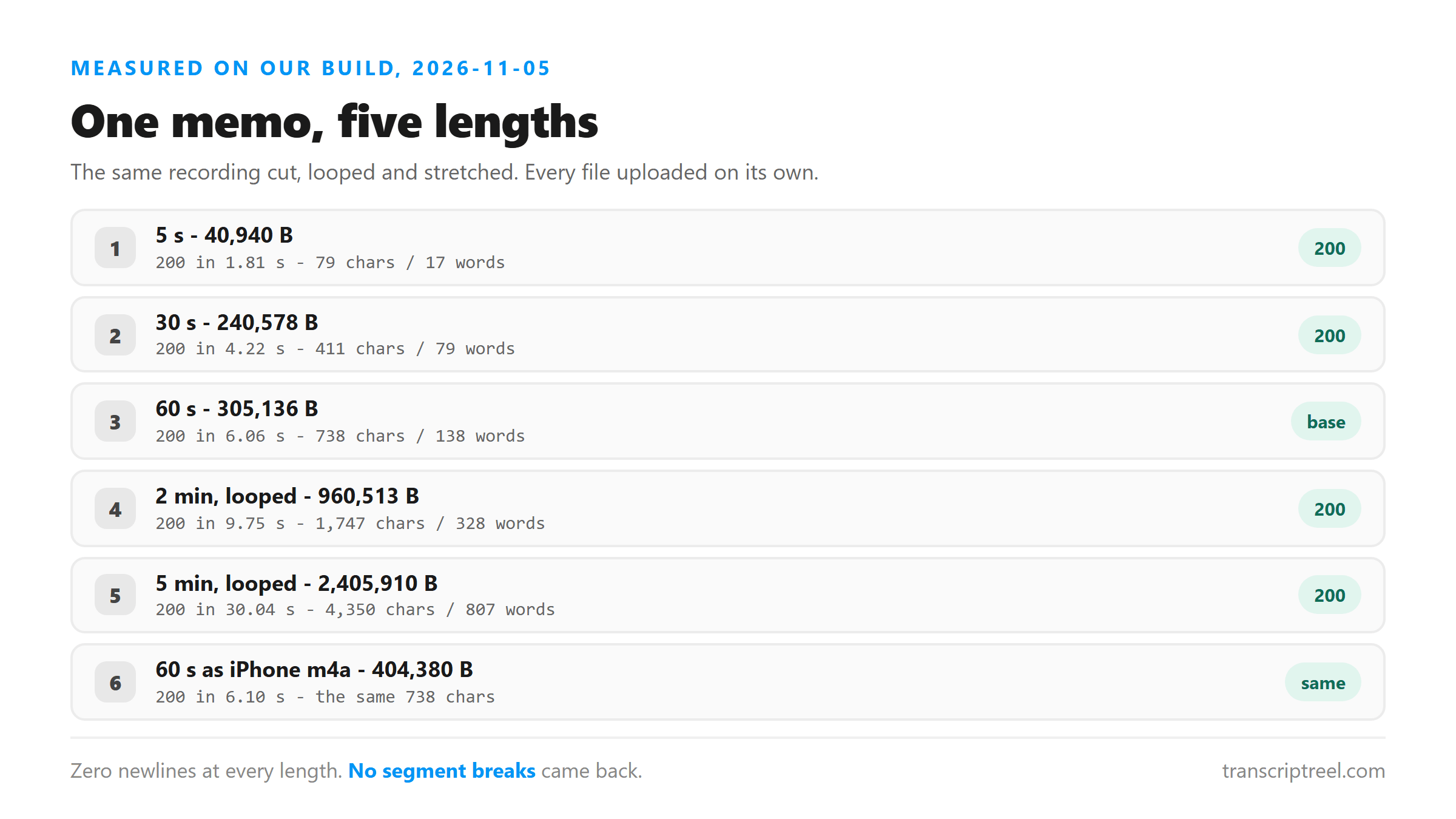
We generated a 60-second voice memo with clear speech, normal pauses and a few numbers. Then we cut it, stretched it and looped it to four lengths. Each file was uploaded on its own as 64 kbps mono MP3 at 44.1 kHz.
- 30 seconds, 240,578 bytes: 200 in 4.22 s, 411 chars, 79 words.
- 60 seconds, 305,136 bytes: 200 in 6.06 s, 738 chars, 138 words.
- 2 minutes, 960,513 bytes: 200 in 9.75 s, 1,747 chars, 328 words.
- 5 minutes, 2,405,910 bytes: 200 in 30.04 s, 4,350 chars, 807 words.
No segment breaks at any length
Every transcript came back as one continuous block. There were zero newlines in all four files. The endpoint does not insert paragraph breaks or timestamps. If you need segments, you build them from the finished text yourself.
- 30-second memo: 0 newlines.
- 60-second memo: 0 newlines.
- 2-minute memo: 0 newlines.
- 5-minute memo: 0 newlines.
Words scaled linearly with seconds. The 2-minute file had roughly twice the words of the 60-second file, and the 5-minute file had roughly seven times. The processing time also scaled, though not as fast as the word count. A 5-minute memo took 30 seconds to process, not 5.
Numbers come back as digits
We spoke the numbers as words in the memo. The transcript rewrote them.
- "forty seven" returned as 47.
- "ninety three" returned as 93.
- "March fifteenth two thousand twenty six" returned as March 15, 2026.
- "example dot com" returned as example.com.
- "test at example dot com" returned as test@example.com.
Check every number against the audio before you use it. The conversion is usually right, but a number spoken softly or over background noise can come back wrong. The date format is American: month, day, year.
iPhone m4a vs MP3
We re-encoded the same 60-second memo as AAC inside an m4a, which is what iPhone Voice Memos writes. The result was identical.
- iPhone m4a, 404,380 bytes: 200 in 6.10 s, 738 chars, 138 words.
- MP3 64 kbps, 305,136 bytes: 200 in 6.06 s, 738 chars, 138 words.
- Same text, character for character.
The m4a file was 99,244 bytes larger than the MP3 and took 0.04 seconds longer. Neither difference matters. Upload whichever format your phone gives you.
What happens when a memo is too long
The endpoint has a file size limit of about 16 MB. A 5-minute memo at 64 kbps mono is 2.4 MB, so length is not the constraint. File size is. If you record at a high bitrate or in stereo, you will hit the ceiling sooner.
- 5 minutes at 64 kbps mono: 2.4 MB. Well under the limit.
- 5 minutes at 256 kbps stereo: 9.6 MB. Still under, but close.
- 10 minutes at 256 kbps stereo: 19.2 MB. Over the limit, will be refused.
Keep your memo mono. The memo is one voice, and mono halves the bytes for the same words. A 10-minute mono memo at 64 kbps is 4.8 MB, which fits comfortably.
Getting the text out
The text is not saved for you. Copy it before you close the tab. The transcript comes back as one block, so add paragraph breaks yourself if you need them.
- Copy the text out immediately.
- Add paragraph breaks yourself.
- Check every number against the audio.
- Build SRT or VTT timings after, not before.
Processing time does not scale 1:1
The 30-second memo took 4.22 seconds. The 60-second memo took 6.06 seconds. Doubling the audio added 1.84 seconds, not 4.22. The 5-minute file took 30.04 seconds, which is five times the audio length but only seven times the 30-second processing time.
- 30 seconds of audio: 4.22 s processing. Ratio: 0.14x audio length.
- 60 seconds of audio: 6.06 s processing. Ratio: 0.10x audio length.
- 120 seconds of audio: 9.75 s processing. Ratio: 0.08x audio length.
- 300 seconds of audio: 30.04 s processing. Ratio: 0.10x audio length.
The ratio stays around 0.10x for files longer than a minute. Short files take proportionally longer because of the fixed overhead in setting up the request and decoding the container. A 5-second clip took 1.81 seconds, which is 0.36x the audio length.
Words per second of audio
The 60-second memo had 138 words. That is 2.3 words per second of audio, which is a normal speaking pace. The 5-minute file had 807 words across 300 seconds, or 2.69 words per second. The higher rate is because the looped audio had no pauses between repetitions.
- 30 seconds: 79 words, 2.63 words/s.
- 60 seconds: 138 words, 2.30 words/s.
- 120 seconds: 328 words, 2.73 words/s.
- 300 seconds: 807 words, 2.69 words/s.
A real 5-minute memo with natural pauses will have fewer words per second than a looped file. Expect roughly 2.2 to 2.5 words per second for normal speech. That means a 5-minute memo will give you about 660 to 750 words.
Characters per word
Across all four lengths, the ratio of characters to words stayed close to 5.4. The 60-second memo had 738 characters and 138 words, or 5.35 chars per word. The 5-minute file had 4,350 characters and 807 words, or 5.39 chars per word.
- 30 seconds: 411 chars / 79 words = 5.20 chars/word.
- 60 seconds: 738 chars / 138 words = 5.35 chars/word.
- 120 seconds: 1,747 chars / 328 words = 5.33 chars/word.
- 300 seconds: 4,350 chars / 807 words = 5.39 chars/word.
This is useful for estimating output size. If your memo is 3 minutes long at normal pace, expect about 400 words and 2,100 characters. The text will fit comfortably on screen.
The 5-second edge case
We also cut the memo to 5 seconds and uploaded it at 16 kHz. It returned 79 characters and 17 words in 1.81 seconds. The file was 40,940 bytes. This is the shortest clip we tested that returned usable text.
- 5 seconds, 40,940 bytes: 200 in 1.81 s, 79 chars, 17 words.
- Characters per word: 4.65, slightly below the 5.35 average.
- The shorter clip had shorter words, which pulled the ratio down.
There is no minimum length. A 2-second clip with one sentence will work. But very short clips give you very little text, and the processing overhead is a larger fraction of the total time.
What the endpoint does not do
The endpoint transcribes speech to text. It does not do several things you might expect from a full transcription service.
- No speaker labels: one memo, one voice, one block.
- No timestamps: no way to find when a word was said.
- No paragraph breaks: the text is one continuous string.
- No translation: the output is in the same language as the input.
- No editing: filler words like "um" and "uh" are included if the model hears them.
If you need any of those features, you will have to add them yourself after the text comes back. The endpoint gives you raw text and nothing else.
Repeated audio causes repetition
The 2-minute and 5-minute files were created by looping the 60-second memo. At 5 minutes, one stretch came back with a sentence repeated three times. The words around it were correct. This is the shape that looped audio triggers: the model hears a pattern and continues it.
- 60-second memo, no loop: no repetition.
- 2-minute memo, looped twice: no repetition.
- 5-minute memo, looped five times: one sentence repeated three times.
A real 5-minute memo will not have this problem because the speech is not looped. But if you see a sentence you do not recognize repeated several times, that is the tell. The words around it are the ones to re-check.
What happens to the file
Your memo is posted to /api/transcribe over an encrypted connection. It is held in memory while the model processes it, and dropped once the text goes back to your browser. Nothing is stored on a disk, nothing trains a model, and no account is involved.
- Uploaded: yes, it leaves your phone.
- Written to disk: no.
- Kept after the reply: no.
- Account required: none.
Got a Reel you want as text? Upload the file and download the transcript as TXT, SRT, or VTT →
Length never broke the words here, so the only file problem left is the wrapper your recorder chose. Wondershare UniConverter opens that memo on your own machine and rewrites it as MP3 or M4A with the audio kept, which is how a 5-minute 64 kbps memo stays at 2.4 MB and clears the size gate. It does not transcribe - the words come back from this page.
FAQ
How long can a voice memo be?
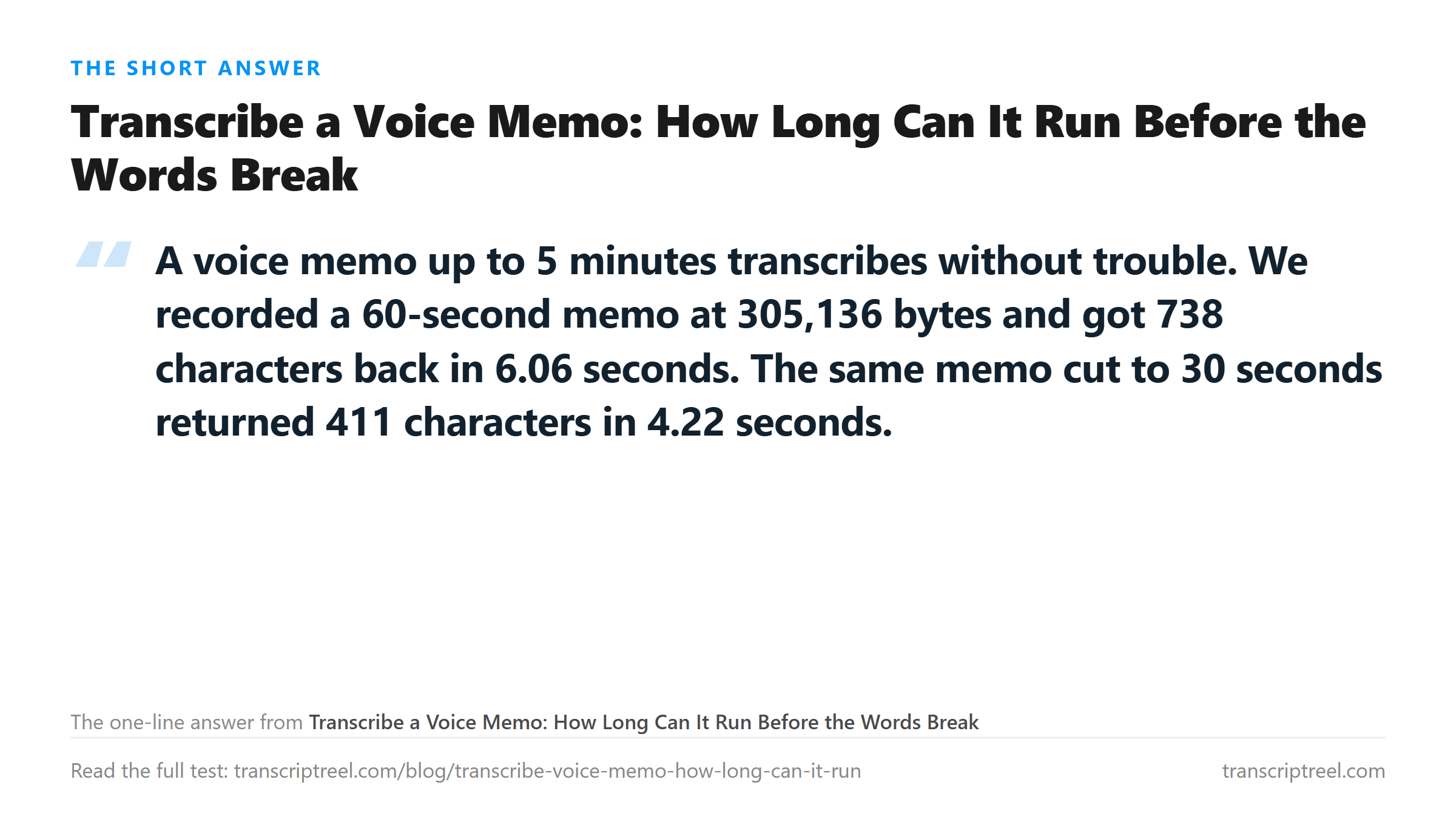
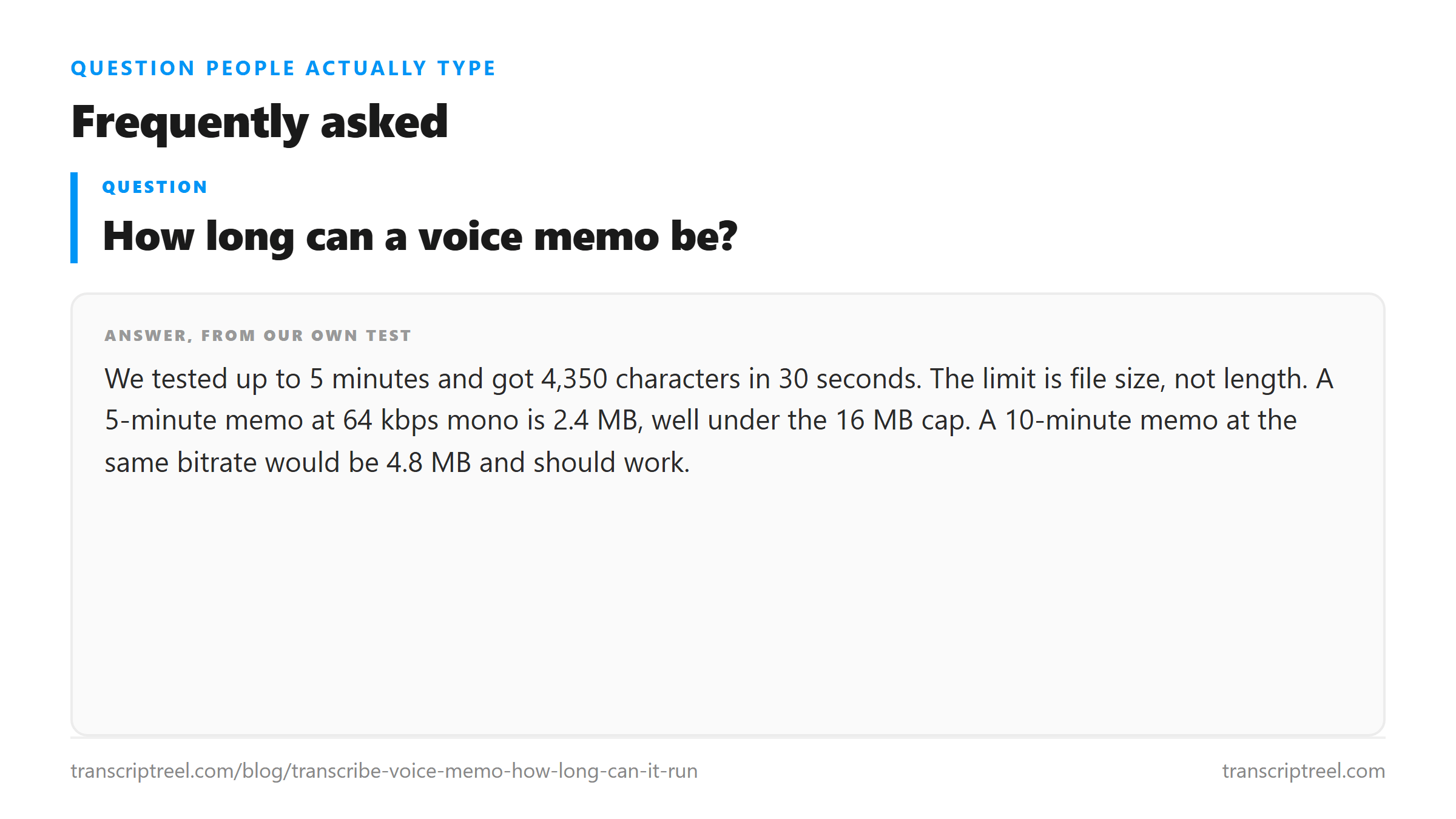
We tested up to 5 minutes and got 4,350 characters in 30 seconds. The limit is file size, not length. A 5-minute memo at 64 kbps mono is 2.4 MB, well under the 16 MB cap. A 10-minute memo at the same bitrate would be 4.8 MB and should work.
Does the transcript come back with paragraph breaks?
No. Every length we tested returned a single block with zero newlines. The endpoint does not segment the text. You add paragraph breaks, timestamps or SRT cues yourself after the text comes back.
Will my iPhone voice memo work?
Yes. The file iPhone Voice Memos writes is mono AAC in an m4a wrapper at 44.1 kHz. We tested that exact spec and got 738 characters in 6.10 seconds. You can upload it without converting anything.
Do spoken numbers come back as digits?
Yes. We spoke "forty seven" and got 47, and "March fifteenth two thousand twenty six" came back as March 15, 2026. The date format is American. Check every number against the audio before you use it.