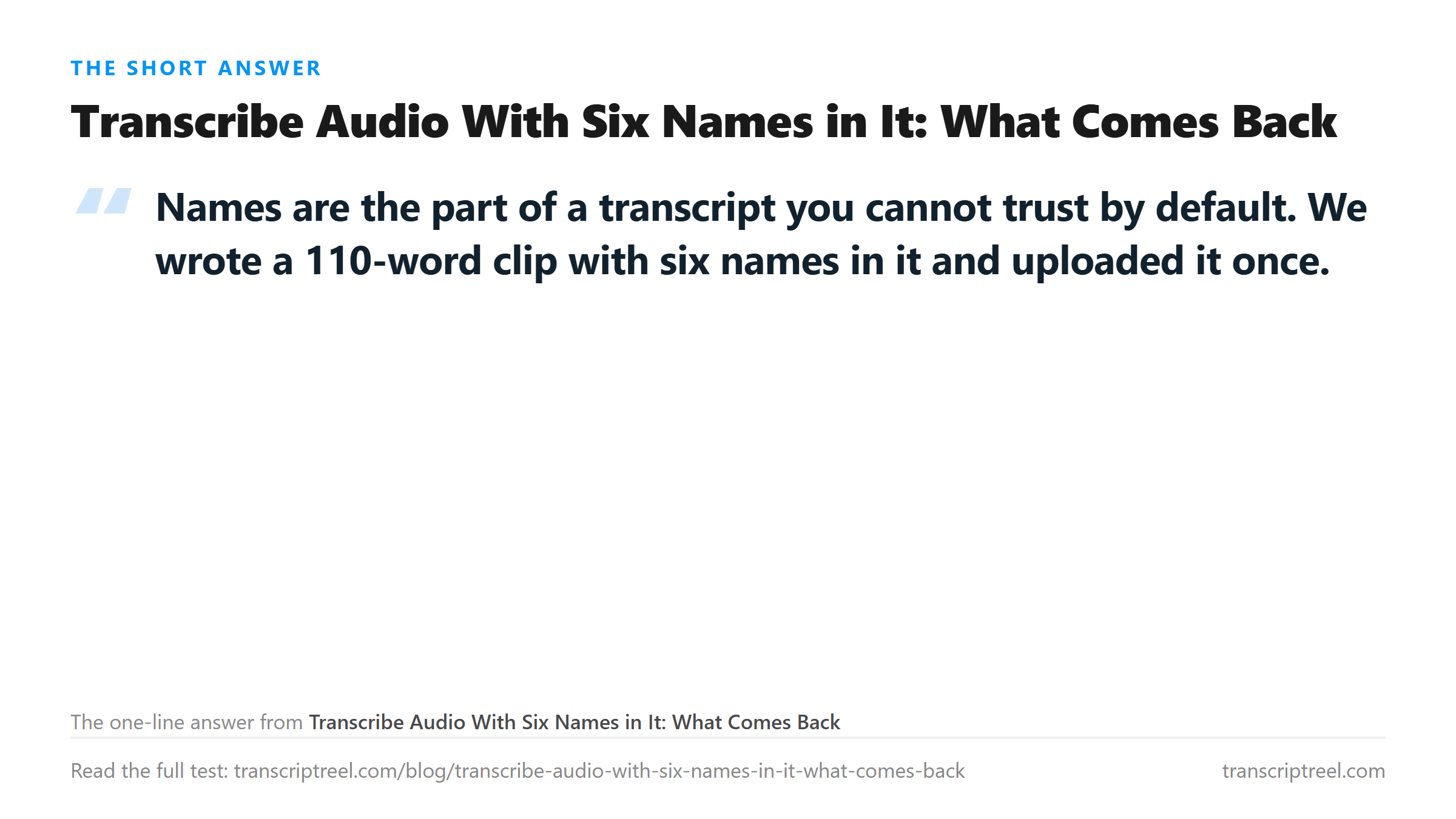
Transcribe Audio With Six Names in It: What Comes Back
Six names, one file
The clip is a set of vendor-review minutes. It runs 42.53 seconds and carries 110 words written out. Six names sit inside it, each said two or three times, because that is how people talk about colleagues. A full name goes out once, then the short form carries the rest of the call.
- Sarah Fischer, then Fischer on its own.
- Stephen, three times, no surname.
- Amara Okonkwo, then Okonkwo.
- South Bend, twice.
- Kalamazoo, twice.
- Pretoria, twice, plus one short reference.
We uploaded it once and read every character that came back. The response was HTTP 200, 3.77 seconds of wall time, 137 words and 789 characters.
A bigger count is not a better count
The script has 110 words. The transcript has 137. That is not extra detail. Numbers written out as words push the count up. A repetition loop near the end added a sentence that was already in the file.
The loop is worth knowing about. Two sentences came back twice, and a later clause arrived as a garbled echo: Both Ben will ship 30 next month. Skim a transcript for length and that looks like thoroughness.
- Sarah Fischer came back as Sarah Fisher twice, and the short form as Fisher.
- Stephen came back as Steven twice, then as Stephen on the third mention.
- Okonkwo came back as Akonko, both times, consistently wrong.
- South Bend, Kalamazoo and Pretoria all survived as written.
- One damaged crate arrived once as one damaged Great.
Two spellings of one person inside one paragraph is the detail to sit with. The model did not pick a wrong answer and stay with it. It picked twice, differently, in the same file.
Say it once, twice, three times
One long clip with everything in it is not a controlled test, so we built a second one. Six names, one sentence each, in three versions. Every name once, every name twice, every name three times. Same voice, same encoding, uploaded separately.
- Once each, 46 words written: 46 words back, 276 characters, five of six names correct.
- Twice each, 83 words written: 83 words back, 501 characters, and South Bend lost its last letter on the second mention.
- Three times each, 120 words written: 83 words back, 502 characters, and the last third of the recording is missing.
At one mention per name the text is close to perfect. The single miss is Okonkwo, which is the hardest name in the set and the only one with an unusual cluster in the middle.
That is the best result in this article, and it came from saying less. Six names once each, 46 words, five correct.
Three repeats cost 37 words
The three-repeat version deserves a close read. It returned 83 words against a 120-word script, so 37 words never made it into the text. The missing words are not scattered. They are the tail.
The Okonkwo line and the Kalamazoo line also merged into a name that does not exist. The output reads: Amara Akonko spoke about the backlog. Akamazoo said the numbers were fine. Two people became one word, and the sentence around it still reads perfectly well.
That is what makes this expensive. A dropped word looks like a typo. A merged name looks like a person you forgot was on the call.
It also explains why the twice-each file was fine. The third pass adds duration without adding information, and the model already had its answer. What it does with the extra seconds is not predictable.
A second voice moves the mistakes, it does not remove them
We read the two-repeat version in a different voice. It returned 85 words and 505 characters against the same 83-word script, so it added two words instead of losing them.
- Stephen became Steven in this voice, where the first voice had it right.
- Okonkwo became Akon Quo, split into two words.
- Fischer, South Bend, Kalamazoo and Pretoria all came back correct.
Swap the voice and the errors swap places. That is why one clean test proves nothing about the next file you upload, and why a second attempt on the same audio is worth the minute it costs.
Why a name is harder than a sentence
A sentence carries its own context. If one word is misheard, the grammar still points at the meaning, and the model can correct itself from the shape of the clause. A name has none of that.
Fischer and Fisher are one letter apart and sound identical. Nothing in the audio can tell the model which spelling belongs to this person, because the audio holds no spelling at all. It holds a guess about a word that is not in the dictionary.
So the correct output depends on how common the spelling is, not on how clearly the name was said. Fisher is a common US surname and Fischer is not. The model picks the one it has seen more often.
The same logic explains Akonko. Okonkwo has a consonant cluster that most English text does not contain, so the decoder lands on the nearest string it does know. It is not a hearing problem. It is a vocabulary problem.
What to do with a name you need right
Keep the name out of the audio and put it in the text. If you record for someone else, read the attendee list aloud once at the very start. Say it slowly, with no other words around it, and treat those first ten seconds as the names section.
Then check the output against that list before you read anything else. Search the text for each surname, confirm the spelling, and correct it. A name fix does not disturb the sentence around it, which is the one edit that is always safe.
Do not repeat a name hoping it will stick. Three repeats returned 83 words where 120 were written, and the collapse took out the end of the recording rather than the middle.
One more habit pays for itself. Always confirm the single most important name in a separate sentence, far from any other name, so a merged token cannot swallow it.
Your file does leave the browser here. It posts to /api/transcribe over an encrypted connection. It gets processed once in memory and dropped the moment the text comes back. No account, no stored copy, no training on it.
The order to check a transcript in
Read it in this order and the wrong parts surface first. Names, then numbers, then anything with a negation in it, then the rest.
- Names: every one of the twenty-four name mentions across our four files was worth checking, because three of them were wrong.
- Numbers: all six deadlines held in the meeting test, so numbers are a quick pass rather than a slow one.
- Negations: the sentence Nobody has booked is the one that flipped, and it carries no warning sign.
- Everything else: skim, because the prose held up in every file we sent.
The point of an order is that it makes the check finite. You are not proofreading 137 words. You are confirming six strings and reading four sentences closely.
What we did not test
Every name here is a US-English name read by a synthetic voice at a steady pace. A real call has crosstalk, laughter and people talking over each other, and none of that is in these files. Treat the numbers as a floor for what a clean recording can do, not as a promise about a noisy one.
We also did not test a name list read before the content, which is the fix we recommend. That test needs a different design, and it is the next thing worth running.
One more limit worth stating. All four voices here are North American, and both of the names that failed are names with two common spellings or an uncommon cluster. A name with one spelling and a plain sound is a different case, and it probably does better than these numbers suggest.
Got a Reel you want as text? Download the Instagram transcript as TXT, SRT, or VTT →
A name you can hear and a name you can spell are two different jobs, and the second one is a file edit. Wondershare UniConverter opens the recording on your own machine and writes a copy at the sample rate you pick. That way the six names here did not have to survive a converter as well as a model. It does not transcribe - the words come back from this page.
FAQ
Why does the same name come back spelled two ways in one transcript?
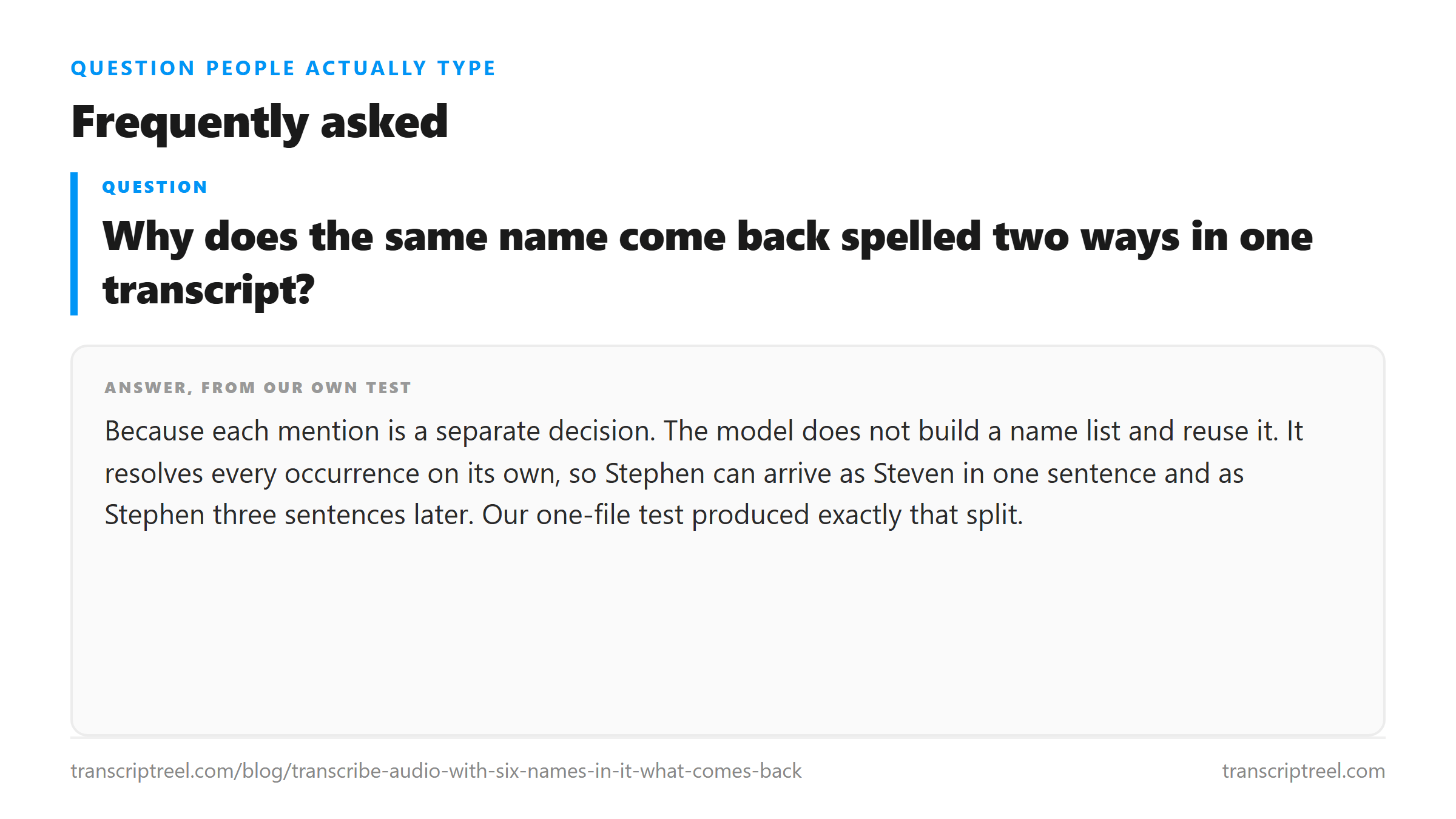
Because each mention is a separate decision. The model does not build a name list and reuse it. It resolves every occurrence on its own, so Stephen can arrive as Steven in one sentence and as Stephen three sentences later. Our one-file test produced exactly that split.
Does saying a name more often make it more accurate?
Not in our tests, and the third repeat actively hurt. One mention per name returned 46 of 46 words with five of six names correct. Three mentions per name returned 83 words against a 120-word script, and two names merged into one invented word.
Is a longer transcript more accurate?
No. Our 110-word script returned 137 words, and most of the surplus came from digits written out as words plus a repeated sentence near the end. Length is a poor proxy for fidelity, so check the names instead of the count.
What happens to the audio I upload?
It leaves your browser. The file posts to /api/transcribe over an encrypted connection, is processed once in memory, and is discarded once the text is returned. There is no account and no stored copy.