Instagram Transcript for Non-Native Speakers
What we ran to get these numbers
Fifty uploads to /api/transcribe, the same endpoint this page uses, on 2026-10-17. Every response carried success: true and the engine string Cloudflare Workers AI (@cf/openai/whisper). Every response also carried language: "unknown" - the tool never reports a language, which matters more here than anywhere else on the site, because the first thing a non-native listener wants to know is what language the model thinks it heard. We built the audio with a text-to-speech voice (flite, US English, female), which means we know the reference text word for word and can score each run as words matched out of that reference. That is also the honest limit: this is synthetic speech, not recordings of real non-native speakers, and we hold no labelled set of learner speech, so there is no percentage anywhere on this page.
Spoken numbers come back as digits - and not always the right ones
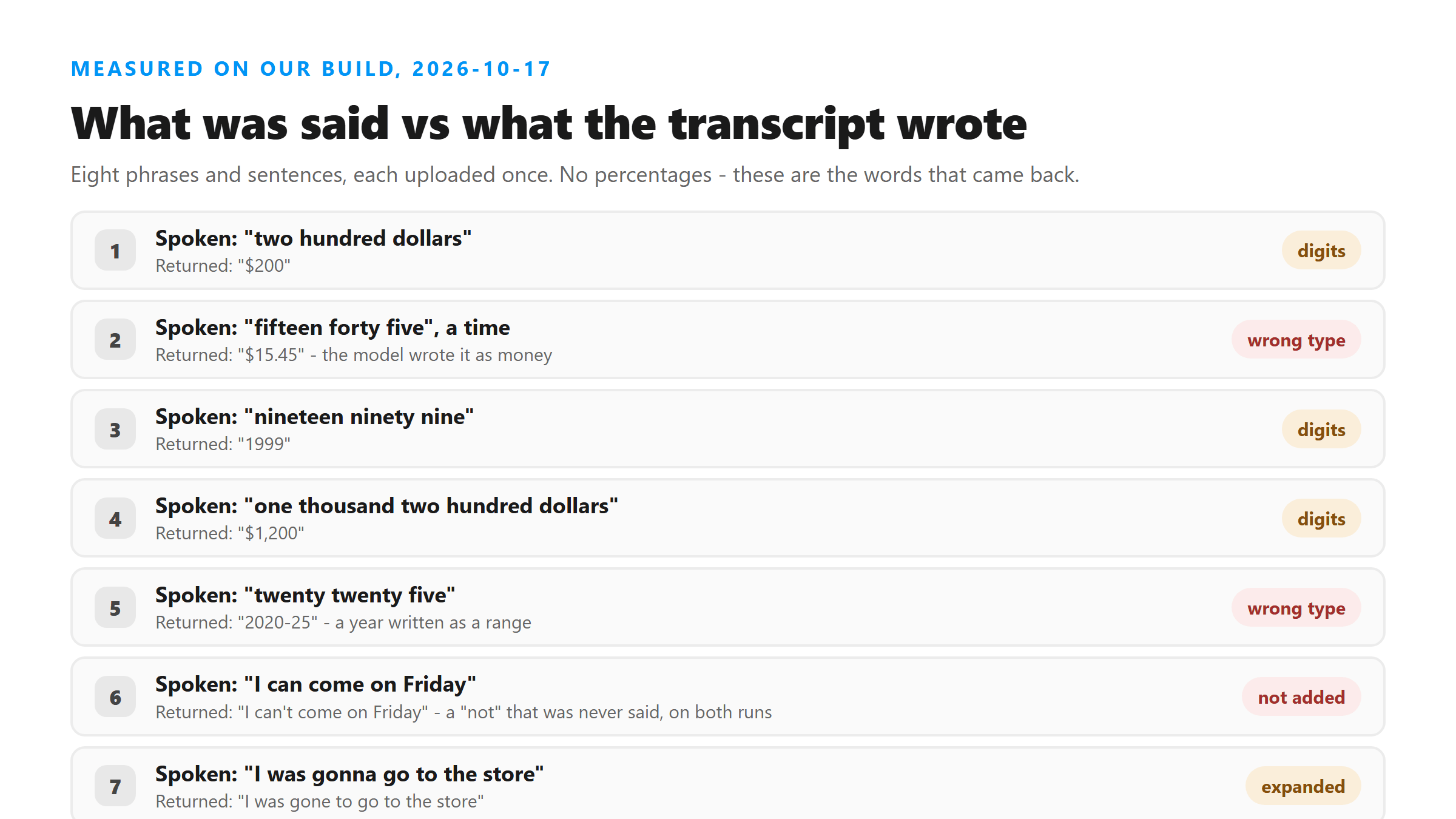
We read each sentence aloud and compared it with what came back. "The ticket costs two hundred dollars and the train leaves at fifteen forty five" returned as "The ticket costs $200 and the train leaves at $15.45". The second number was a time; the model wrote it as money. Six of the eight number phrases we tested came back in a form you cannot read aloud against the audio. If you are following a Reel to catch a price, a date or a time, this is the single most likely place to be quietly misled.
- "two hundred dollars" returned as "$200"
- "fifteen forty five", spoken as a time, returned as "$15.45"
- "nineteen ninety nine" returned as "1999"
- "one thousand two hundred dollars" returned as "$1,200"
- "three point five percent" returned as "3.5%"
- "twenty twenty five" returned as "2020-25" - a year turned into a range
- "fifteen" and "fifty" returned as "15" and "50"
- "a quarter past nine" survived as spoken, the only one of the eight that did
It expands what you said
Reduced forms get written out. "I wanna know what you're gonna do about it" came back as "I want to know what you're going to do about it", which is usually a help if you are reading along. But "I was gonna go to the store" came back as "I was gone to go to the store", and "they're ready to go" came back as "they were ready to go" - the expansion moved the meaning, not just the spelling.
And once it added a "not" that nobody said
"I can come on Friday but I can't come on Saturday" came back as "I can't come on Friday but I can't come on Saturday". A negation appeared in the first clause where none was spoken, and the second run of the same file returned the identical sentence. That run scores 10 words out of 11. Nothing in the response flagged it. Four other sentences built on the same trap - can/can't, do/don't, is/isn't, have/haven't - came back word for word, so you cannot simply distrust every negative either. You have to check the ones that carry the meaning.
It will not correct your grammar
Learners often hope a transcript doubles as a grammar check, so we read five sentences aloud of the kind a teacher would mark. Four came back with the mistake still in them, and the fifth came back with a different mistake.
- "She don't like coffee" returned unchanged
- "He go to school yesterday" returned unchanged
- "We was late for the class" returned unchanged
- "I has three brother" returned as "I has three, brother" - a comma appeared, the error stayed
- "I am agree with you" returned as "Hi, and agree with you"
- We ran the set twice; both runs produced the same text
Words from other languages come back spelled by sound
"We ate a croissant and then watched karaoke in Barcelona" came back as "We ate a kwasan and then watched karaoke in Barcelona". The city name and the borrowed Japanese word survived; the French word was respelled the way it sounds. If you use a transcript to look up vocabulary, this is the failure mode to watch: a word outside the model's English vocabulary gets written phonetically, and it arrives looking like a word you do not know rather than a word the tool misheard.
What the response does not give you
All 50 responses today had the same six keys - success, transcript, language, engine, fileName, fileSize. There is no field for timing, no field for confidence and no field for a warning.
- No timestamps. The 54-second narration came back as one paragraph of 114 words with zero line breaks, both times we ran it.
- No language. The language field read "unknown" on every one of the 50 uploads, so the tool will not confirm what it heard.
- No speaker labels and no confidence score, so there is nothing that separates a confident guess from a safe one.
- No marking of rewrites. The digits, the expanded contractions and the added "not" all arrive in the same plain paragraph as the words that were really spoken.
Silence is not empty
We uploaded six seconds of digital silence. It came back with 338 words - "Thank you very much" repeated until the model stopped - success: true, in 19.66 seconds. A Reel with a silent intro, or a screen recording whose audio track never came along, does not produce an empty transcript. It produces a confident one. If the text you get back is fluent and has nothing to do with the video, suspect the audio track before you suspect your English.
What did not change the output
We also tried the fixes people reach for, on the same clean files. Speaking rate 0.80x, 0.90x and 1.15x returned exactly the same 16 words out of 19 as the original; 1.30x lost one more ("closed" became "blows"). Recording level at -20 dB and at -30 dB returned the same 10 out of 12. Low-pass filtering at 1.5 kHz, and a round trip down to 8 kHz and back, also returned the same 10 out of 12 - and we checked that those files really were different, the band above 3 kHz measured 35 dB down. So the errors above are not hearing errors you can clean up; they are made after the audio is heard. One observation we are drawing no conclusion from: a file with everything below 4 kHz filtered out still returned the right words on two different sentences. We cannot explain that, so we are leaving it as an observation.
How long it takes
The 54-second narration, 1.74 MB of WAV, came back in 29.15 s and 20.50 s on two runs. The same narration as 64 kbps MP3 - 436 KB instead of 1.74 MB - came back in 19.66 s with identical text. Short five- and six-second clips took 0.84 s to 3.34 s once the model was warm; the first upload of a session took 19.41 s. None of this is per-minute arithmetic: the wait is set by upload size and by whether the model is already warm.
How to use a transcript when English is not your first language
Everything below follows from the measurements above, not from general advice.
- Use the transcript to find the part of the audio to replay, then trust your ears for the exact words - numbers, times and prices above all.
- Check every "not". A negation that appears or disappears changes the meaning and is never flagged.
- Do not use it as a grammar checker. Your errors come back as your errors, and occasionally as new ones.
- Upload the same file twice and diff the two transcripts. The words that move between runs are the ones to replay. Today's files were stable - both runs of the 54-second narration were word for word identical - which is exactly why stability is not the same thing as correctness.
- If the text is fluent but unrelated to the video, check whether the audio track actually came along before you doubt your own listening.
Where this page is honest about its limits
The voice behind every file here is a US English text-to-speech voice, not a real non-native speaker, and we hold no scored set of learner recordings, so we publish no accuracy figure - the same rule we apply on every page of this site. What the numbers do cover is the writing layer: what the model does to words after it has heard them. That is the part which bites a reader who is checking their own understanding against the text, and it is the part no tool page tells you about.
Got a Reel you want as text? Upload the file and download the transcript as TXT, SRT, or VTT →
Every file on this page was one this tool could read. If your Reel arrives in a container it refuses, Wondershare UniConverter converts it to MP3 or M4A on your own machine, 16 kHz or higher and single channel. Our 54-second test narration came back identical from a 436 KB MP3 and from a 1.74 MB WAV.
FAQ
Will a transcript help me understand an Instagram Reel in English?
Yes, as a map. It tells you where you are in the audio and what the sentence was about, so you know which five seconds to replay. It is not a reliable copy of the exact words: spoken numbers come back as digits (a time of "fifteen forty five" returned to us as $15.45), contractions get expanded, and a negation can appear that was never spoken. Replay the parts that carry the information.
Does the transcript show the exact words that were spoken?
Not always. Six of the eight number phrases we tested came back rewritten as digits or currency. "gonna" came back as "gone to" in one sentence and "going to" in another. "they're" came back as "they were". One sentence gained a "can't" that was never said, and it did so on both runs of the same file. The response has no field that marks any of this.
Can I use a transcript to check my English grammar?
No. We read five ungrammatical sentences aloud; four came back with the mistake intact ("She don't like coffee", "He go to school yesterday", "We was late for the class", "I has three brother"), and the fifth came back with a different error - "I am agree with you" returned as "Hi, and agree with you". A transcript is not a teacher.
Can it handle a Reel that mixes two languages?
We could not build a true mixed-language sample on the day we wrote this - there is no non-English text-to-speech voice available on this machine - so we are not going to guess. What we did measure: the language field is "unknown" on every response, so the tool never tells you what it heard; there is one flat paragraph with no speaker labels; and a non-English word inside an English sentence came back spelled by sound ("croissant" returned as "kwasan").
Does speaking more slowly make the transcript better?
Not in our tests. Rates of 0.80x, 0.90x and 1.15x returned exactly the same words as the original file, and 1.30x lost one more word than the original. Recording level made no difference either: -20 dB and -30 dB returned identical text. The errors on this page are made after the audio is heard, so neither slowing down nor cleaning the audio removes them.
Why is my transcript one long paragraph with no timestamps?
That is the shape of the response. Our 54-second narration came back as 114 words in a single paragraph with zero line breaks, on both runs, and the response carries no timing field at all. If you need approximate positions, run silence detection on the audio yourself and use the gaps as chapter marks - the transcript will not do it for you.