Instagram Transcript for Journalists: Citing and Verifying a Reel
A transcript tells you what a model heard, not what was said. Use it to find the moment, then check every quote against the audio at that timestamp before it goes in the story. Save the file yourself — our pipeline discards it after the response, so the only copy that will exist next month is the one you keep. On a one-minute Reel, the transcription part comes back in under fifteen seconds in our own measurements; the listening is what takes time, and it is not optional.
The transcript is not the record
This is the part that decides everything else, so it goes first. A transcript generated by speech recognition is a claim about an audio file. It is useful precisely because it is searchable and quotable — and dangerous for the same reason. The text looks like a source. It is not one.
- The audio is the source. The text is a derived artifact, produced by a model that had one pass over the sound and no context about the story.
- The text is a finding aid. It tells you where to put your headphones. It does not establish the wording.
- The file you uploaded is the artifact you can keep. That, and your own note of what you heard, is what a desk can actually check.
Four checks before a quote goes in
Transcription errors that change meaning are not evenly distributed. They cluster in four places, and those are the four worth re-reading against the audio:
- Numbers, amounts and dates. Figures are the highest-risk words in any transcript. A model picking between similarly sounding numbers has no way to know which one the sentence needed. Every figure in a quote gets listened to.
- Names and places. Proper nouns are the most common substitution, because a name the model has rarely seen gets replaced with the closest common phrase it has.
- Negations. A dropped or misheard not reverses the meaning of a sentence while leaving it perfectly readable. The cleaned-up version is more publishable and less true.
- Attribution across overlapping speech. When two people talk over each other, the text has to assign the words to someone. It will assign them. That assignment is not evidence of who said them.
Why we publish no accuracy number, and what replaces it
We do not know our own number, so we do not print one. What replaces a number is a step that does not depend on anyone's claim: listen to the quote. If the audio is genuinely ambiguous, that ambiguity belongs in the story rather than being quietly resolved in favour of the cleaner sentence.
Nobody is keeping a copy for you
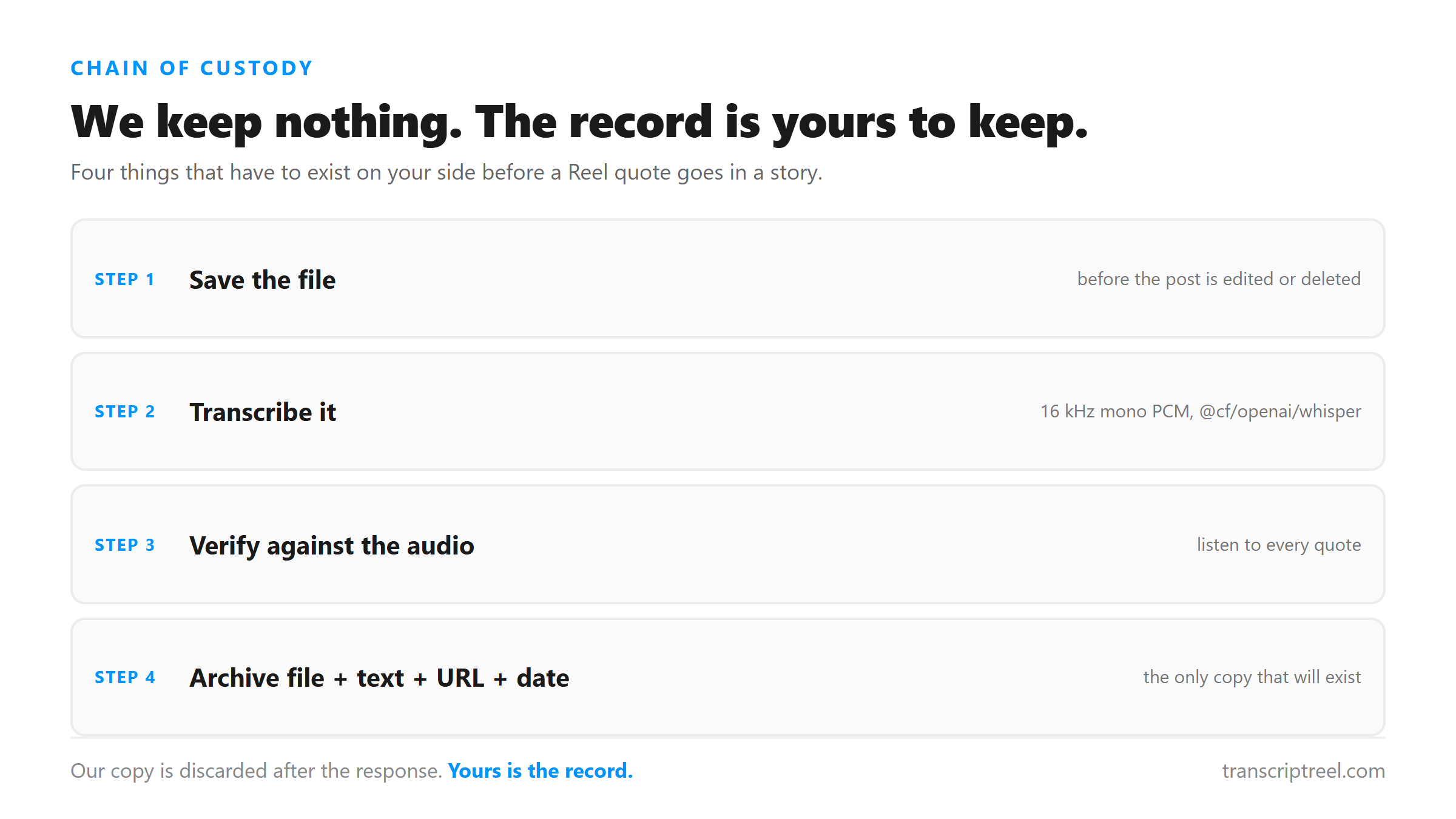
This is the part that catches newsrooms out, because most tools quietly behave like an archive. Ours does not. Being precise about it:
- Your file does leave the browser. It is uploaded to
/api/transcribeover an encrypted connection. There is no local-only processing here, and we do not claim there is. - It is held in memory for that request only, converted to 16 kHz mono PCM WAV, and read by
@cf/openai/whisperrunning on Cloudflare Workers AI. - The text comes back and the file is discarded. No account, no upload history, no saved copy, no reuse, no training.
- So there is nothing to come back to. If the Reel is deleted or the account disappears next week, we cannot hand you a copy, because none exists.
How long the verification loop actually takes
What it does tell you is that the mechanical part is not the bottleneck. A one-minute Reel comes back fast enough that you can transcribe it and check the quote while the source is still on the phone, which is when an ambiguous sentence is easiest to resolve.
- A 10-second clip, 61 KB: returned in 1.5 s, 2.9 s and 1.7 s.
- A 61-second file, 179 KB: 9.1 s, 12.8 s and 9.6 s.
- What this is not: one connection, one afternoon, short synthetic audio. It is not a benchmark, and it says nothing about long recordings or about your network.
Get the file before it disappears
The practical consequence for reporting is timing. The save has to happen on your side, and it has to happen while the post is still up. Reels get edited, deleted and locked to followers without notice, and a URL in your notes is not a recording.
What belongs in your notes, and what a citation has to carry
For the citation itself, styles differ on punctuation and ordering, and you should follow your own house rules rather than a tool's blog post. What does not differ is the set of facts the citation has to carry: who posted it, when it was posted, what kind of thing it is, the day you accessed it, and where it lives now. That last field is where an archived copy of your own goes — because a URL pointing at a deleted Reel is not a citation, it is a dead end with formatting.
- The original file you uploaded, not just the text that came back.
- The transcript, unedited, so a later disagreement is about what you heard rather than what you typed.
- The Reel URL and the date you accessed it.
- Which quotes you verified by listening, and when. This is the line that survives a complaint.
FAQ
Can I cite an Instagram Reel in a published story?
Yes, and the mechanics are ordinary: identify who posted it, when, and where you accessed it. The unusual part is fragility. Reels are removed without notice and URLs stop resolving, so keep your own copy of the media file alongside the citation. A transcript is a useful working document but it is not the thing you cite; the recorded moment is.
Is quoting Instagram's own auto-captions good enough?
No, and not only because you cannot copy them. The captions Instagram generates are a display layer drawn onto the video while it plays — there is no way to select, export or edit that text. If you need the words in a form you can check and keep, run the audio through a transcription tool and verify the result against what you hear.
How long does it take to transcribe a one-minute Reel?
In our own measurement on 2026-09-23, a 61-second file came back in 9.1 s, 12.8 s and 9.6 s across three runs, upload included. A 10-second clip returned in 1.5 s to 2.9 s. That is one machine on one connection and it is not a benchmark. The transcription is not the slow part; checking the quote against the audio is, and that step is not optional.
What happens to my file after I upload it?
It leaves your browser over an encrypted connection, is held in memory for the duration of that request, is read by the Whisper model on Cloudflare Workers AI, and is discarded once the text is returned. We keep no copy, keep no history, and have no account system. That means the only durable record is the one on your own machine.