Dictation: What Comes Back When You Spell a Code Out Loud
Ten items, two readings each
The script names a surname, an email, a coupon code, a street, a part number, an invoice prefix, an airport code, a chemical, a badge number and a warehouse. Each one is spelled out first, then repeated in a normal sentence. That is what most people do when they are not sure they were heard.
We read it in two voices. The first returned 104 words and 630 characters in 22.24 seconds. The second returned 99 words and 627 characters in 4.91 seconds on the same audio.
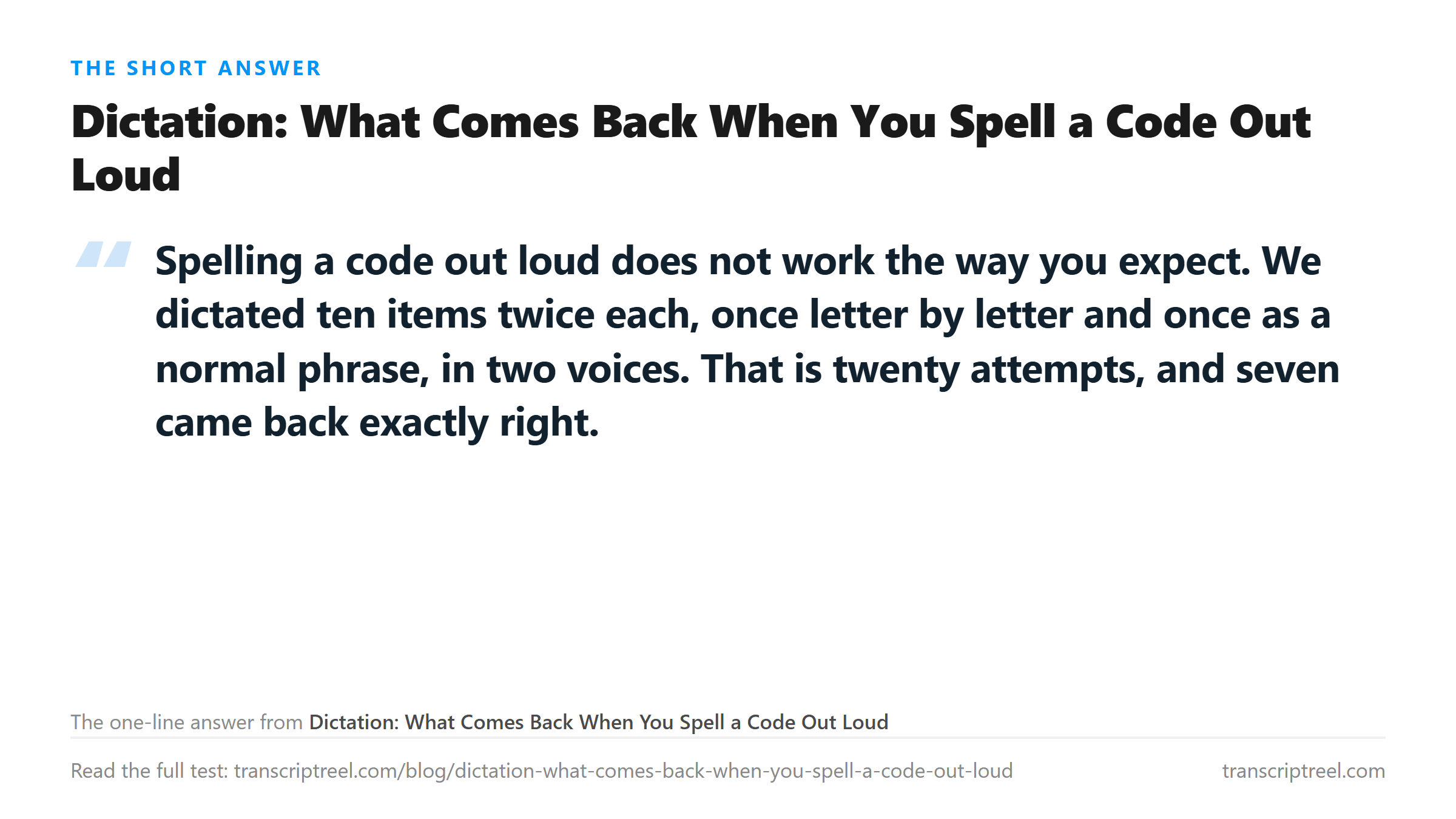
Of the twenty attempts, seven produced the item exactly as written. Thirteen did not.
The two that always worked
- K7Q2M, the coupon code: correct in both voices, both readings.
- 8327, the badge number: correct in both voices, both readings, though one voice called it a batch number instead of a badge.
Both are short and both are dominated by digits. Digits are the part of dictation that holds up, which is the opposite of what most people assume when they slow down and spell out a word.
That is a useful split to carry into your own recordings. Numbers want to be said as numbers. Letters want to be said as words.
Elm became the letter L
The street line was spelled E, L, M, then read as Elm street. Both voices returned E-, ELM street. The street is L.
The spelled letters came through and the word they spell did not. That is the exact inversion of what the speaker was trying to do. The model heard three letters and then a word, and treated the word as a repeat of the last letter.
If you take one thing from these twenty attempts, take this. Spelling a word aloud can replace the word with its own letters.
Foxtrot arrived as FOXTRAT
The surname was dictated as F as in foxtrot, then I, S, C, H, E, R. Both voices returned FOXTRAT for the word foxtrot, with an R where the O belongs.
The letters around it drifted too. One voice produced FOXTRAT-IS-C-H-E-R, which merges the spelling into one token. The other produced FOXTRAT, I, S, C, H, E, R, then read the surname as Fischer, which was right.
A phonetic alphabet assumes the listener knows the alphabet. The model has no such assumption. It transcribes the word you said, and it gets that word wrong at the same time as the letters you actually wanted.
West gate became Westgate
The warehouse was dictated as W, E, S, T, west gate. Both voices capitalized it and closed the gap. The result is Westgate, one word, a proper noun.
That is a small change with a real consequence. A search for the west gate will not find Westgate, and a description has quietly become a place name.
The email line shows a third shape of the same problem. It was dictated as D A N A dot R U double L at northwind dot com. Both voices produced Dana dot Roll at northwind dot com, so the domain survived and the local part did not. An address that looks like an address is worse than a garbled one, because it will be sent.
Two voices, five words apart
The same script read in two voices returned 104 words and 99 words, on the same audio. Five words is a noticeable gap, and the reason is punctuation. One voice wrote the script as separate sentences. The other wrote it as a run of clauses joined by commas, which moves the count without moving the content.
This matters if you audit dictation by word count. A five-word swing between two clean reads of identical audio is larger than most of the errors in this article.
Reading it again sometimes fixes it
The second, natural reading of each item was meant to be a safety net. It recovered nine of the twenty. It also broke two items that the spelled version had right.
- Part number AX4419: one voice wrote AX41419 while spelling, then AX419 while reading, which lost two digits.
- Invoice prefix INV-2026: one voice was right while spelling, then wrote INV-202026 while reading.
- Airport code SBN: correct both times, though the airport name came back as south-bend, hyphenated and lowercase.
- The chemical toluene: spelled correctly as T-O-L-U-E-N-E in both, then read as Talluein in one.
A second reading is still worth doing, because nine recoveries beats two breakages. Just do not assume the plain sentence is the authoritative one.
What to dictate instead
Say the item once, clearly, and say it as a word rather than as letters. Then say it a second time in a full sentence with a frame around it, the way you would confirm a phone number to a stranger.
Skip the phonetic alphabet for anything that goes into a transcript. It introduces a second vocabulary, and that vocabulary is where foxtrot became FOXTRAT in both of our voices.
For anything you will act on, dictate it and then type it. The transcript is a check on what you said, not a replacement for the field where the code has to be exact. That is true of the two items that worked here as well.
Your file does leave the browser here. It posts to /api/transcribe over an encrypted connection. It gets processed once in memory and dropped the moment the text comes back. No account, no stored copy, no training on it.
Got a Reel you want as text? Get an Instagram transcript as TXT, SRT, or VTT →
A code you read out loud is a file you can check before you send it. Wondershare UniConverter opens the recording on your own machine and exports a copy at the level and rate you choose, so the twenty attempts here kept one variable at a time. It does not transcribe - the text comes back from this page.
FAQ
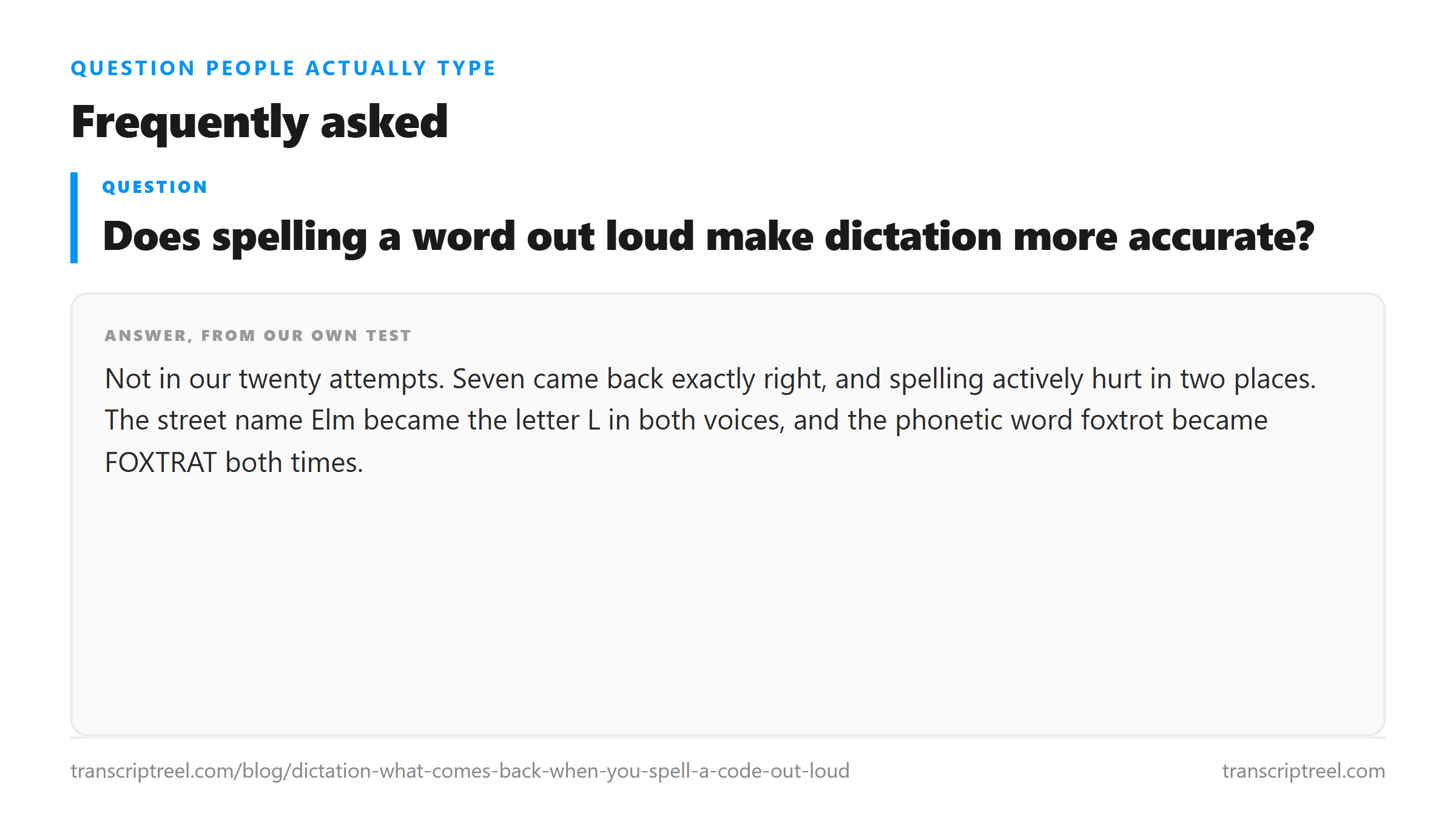
Does spelling a word out loud make dictation more accurate?
Not in our twenty attempts. Seven came back exactly right, and spelling actively hurt in two places. The street name Elm became the letter L in both voices, and the phonetic word foxtrot became FOXTRAT both times.
Which codes survive dictation best?
Short ones made of digits. The coupon K7Q2M and the badge 8327 were the only two items correct in both voices. Long alphanumeric strings lost characters: AX4419 came back as AX41419 and then as AX419.
Is a second reading a reliable fix?
Partly. Reading each item again in a normal sentence recovered nine of the twenty attempts and broke two that had been right. It is worth doing, but check the result rather than assuming the plain sentence won.
What happens to the audio after I dictate it?
It leaves your browser. The file posts to /api/transcribe over an encrypted connection, is processed once in memory, and is discarded when the text comes back. There is no account and no retained copy.