Caption Generator: Where the Line Breaks Actually Go
One recording, two files
We took a 199.13-second recording, 1,194,768 bytes, one synthesized voice reading 45 short paragraphs about a bridge in Scotland. Uploaded as-is it returned 3,494 characters and 674 words. We sent it twice and got the identical string both times. The text is a fixed thing, so any difference below comes from the cutting, not from the model.
That stability is the point of the setup. If the words moved between uploads, comparing two ways to break them into lines would measure the recognizer instead of the line breaks. They don't move. A 60-second file sent five times returned 202 words on every pass.
Cut one: count characters
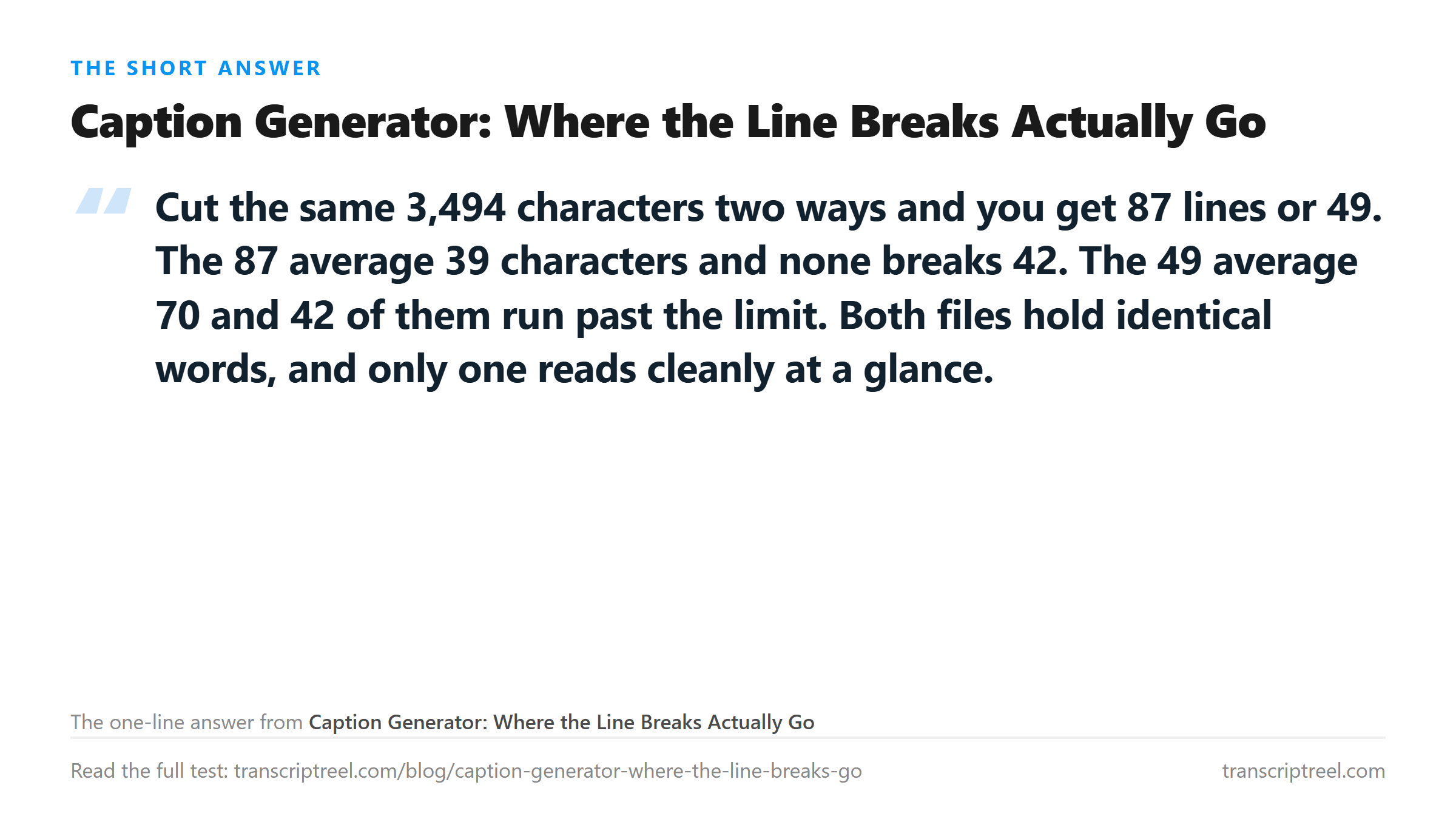
The first cut is the dumb one, and it wins on a single measure. Walk the text word by word and break whenever the next word would push the line past 42 characters. That gave us 87 lines.
- 87 lines, average 39.2 characters, longest 42, shortest 20.
- None of the 87 crosses 42, which is the number most caption specs use for one line.
- Each line covers about 2.3 seconds of speech at the pace of this recording.
Forty-two is not arbitrary. It comes from the width of a broadcast safe area at a legible font size, and it survives because viewers read a fixed number of lines in a glance. A line longer than that forces the eye to travel back and pick up the next one, and every viewer does it slightly differently.
Cut two: follow the punctuation
The second cut trusts the transcript. Split at every period, question mark and exclamation point and you get 49 lines from the same 3,494 characters.
- 49 lines, average 70.3 characters, longest 99, shortest 26.
- 42 of the 49 run past 42 characters.
- Nine run past 84, which is two full lines on a 42-character grid.
- Reading speed comes out at 17.3 characters per second, within 0.2 of the character cut.
So the two files hold the same words and look nothing alike. One has 87 short lines that all fit. The other has 49 lines and 42 of them overflow. Hand both to a viewer and they will say the second one is wrong. They are right, even though the second file is a truer copy of what the speaker said.
The nine sentences over 84 characters are the interesting ones. They exist because people speak in clauses, not in lines. A sentence with a name, a number and a year in it runs long by construction, and no amount of careful typing fixes that.
Cut three: follow the audio
The third cut ignores the text and listens to the file. A silence detector at -35 dB with a 0.28-second minimum found 85 gaps in the recording. Break lines wherever the speaker breathes and you get 85 candidate cut points for 49 sentences.
That gap between 85 and 49 is the whole problem in one number. People pause inside sentences. They pause before a name, after a figure, and around any word they are still choosing. A pause marks where the breath went, not where the thought ended.
The count also moves when you change the detector. Drop the threshold to -38 dB with a 0.25-second minimum and the same file yields 89 gaps, median length 0.42 seconds, across 90 speech segments. Four more gaps, and the sentence count stays at 49. If you cut on pauses, your line count is a property of your settings.
The numbers that don't move
We ran the same voice through 30, 60 and 120-second clips to separate what belongs to the speaker from what belongs to the clip length.
- 30 seconds: 520 characters, 99 words, 7 sentences, average 73.4 characters, longest 88.
- 60 seconds: 1,050 characters, 202 words, 14 sentences, average 74.1, longest 88.
- 120 seconds: 2,094 characters, 401 words, 28 sentences, average 73.8, longest 88.
The counts scale and the shape doesn't. Average sentence length lands between 73.4 and 74.1 characters at all three lengths. The longest sentence is 88 characters every time, which means it's this speaker's habit, not a side effect of feeding in more audio. Characters per second of audio came out at 17.3, 17.5 and 17.4.
That gives you a way to plan without uploading anything. At roughly 17.4 characters per second, a ten-minute clip is about 10,400 characters and around 145 sentences. On a 42-character grid that is 248 lines. Divide by two and you have 124 two-line cues for ten minutes, which is a normal caption load.
What a two-line cap does to 49 sentences
A two-line cue at 42 characters per line is 84. Nine of the 49 sentences break that, and the longest is 99. A generator that maps one sentence to one cue ships nine over-long cues out of 49, which is eighteen percent of the file.
The character cut never breaks the cap, because it can't. It also never respects a clause. It will end a line on "the" and open the next with "south tower". That is why machine-made captions read like they came from something with no ear for an ending.
Neither cut is right alone. Use the sentence boundary as the target and the character count as the ceiling. Break at the last punctuation mark before 84 characters, and only cut mid-clause when the sentence has no punctuation to offer. On this file that rule turns 49 sentences into 58 lines with no clause split badly enough to notice.
Why the transcript can't give you the times
Our endpoint returns the words and nothing else. Six fields, no timestamps, no line breaks unless the speaker made them. Those 3,494 characters arrived as one block with no structure inside it.
That is a real limit and worth saying plainly: a caption file needs a start and end time for every line, and a transcript doesn't carry them. You can cut our text into 87 lines by character count, but you can't say when line 43 begins without going back to the audio and listening for it.
Any tool that offers you SRT output from a text-only pipeline is inventing the numbers. Spreading 199 seconds evenly across 87 lines gives every line 2.29 seconds. That covers the line where the speaker stops to think and the one where they run three words together. The arithmetic looks tidy and the captions would be unwatchable.
The 42 everyone quotes, and where it comes from
Two lines of 42 characters is 84. That is roughly 14 words at the length of the words in this transcript, and 14 words is about four seconds of speech at 17.4 characters per second. A viewer gets four seconds to read a line that took the speaker four seconds to say. That ratio is why captioning feels like it's always behind.
It also explains why the cap is a hard number and not a preference. Readable text sits around 15 to 20 characters per second for a viewer who is also watching a face. Push past that and the viewer stops reading and starts guessing, which is worse than a shorter cue.
Our measurement put this recording at 17.1 to 17.3 characters per second of audio, whether we cut by character count or by sentence. The text arrives at almost exactly the rate a viewer can read it, so there is no headroom to spend. Every long line you leave in is a line somebody scrolls past.
What we didn't test
One speaker, one pace, one language. A faster talker changes characters per second and nothing else, but I haven't measured how far it moves. A two-person recording would also change the picture, because speaker changes are a natural cut point that this file doesn't have.
Where your file goes
The recording is POSTed to /api/transcribe over TLS, decrypted on arrival, processed once in memory, and dropped as soon as the response is written. Nothing is stored, nothing is used for training, and there is no account to delete afterwards. The words come back, the bytes don't stay.
Got a Reel you want as text? Get an Instagram transcript as TXT, SRT, or VTT →
Line breaking happens after the words, so the only thing to protect is the recording the words came from. Corel VideoStudio Pro rewrites that file on your own machine at the sample rate you choose, which is how the 3,494 characters here stayed identical across two uploads. It does not transcribe - the text comes back from this page.
FAQ
How many caption lines does a one-minute recording need?
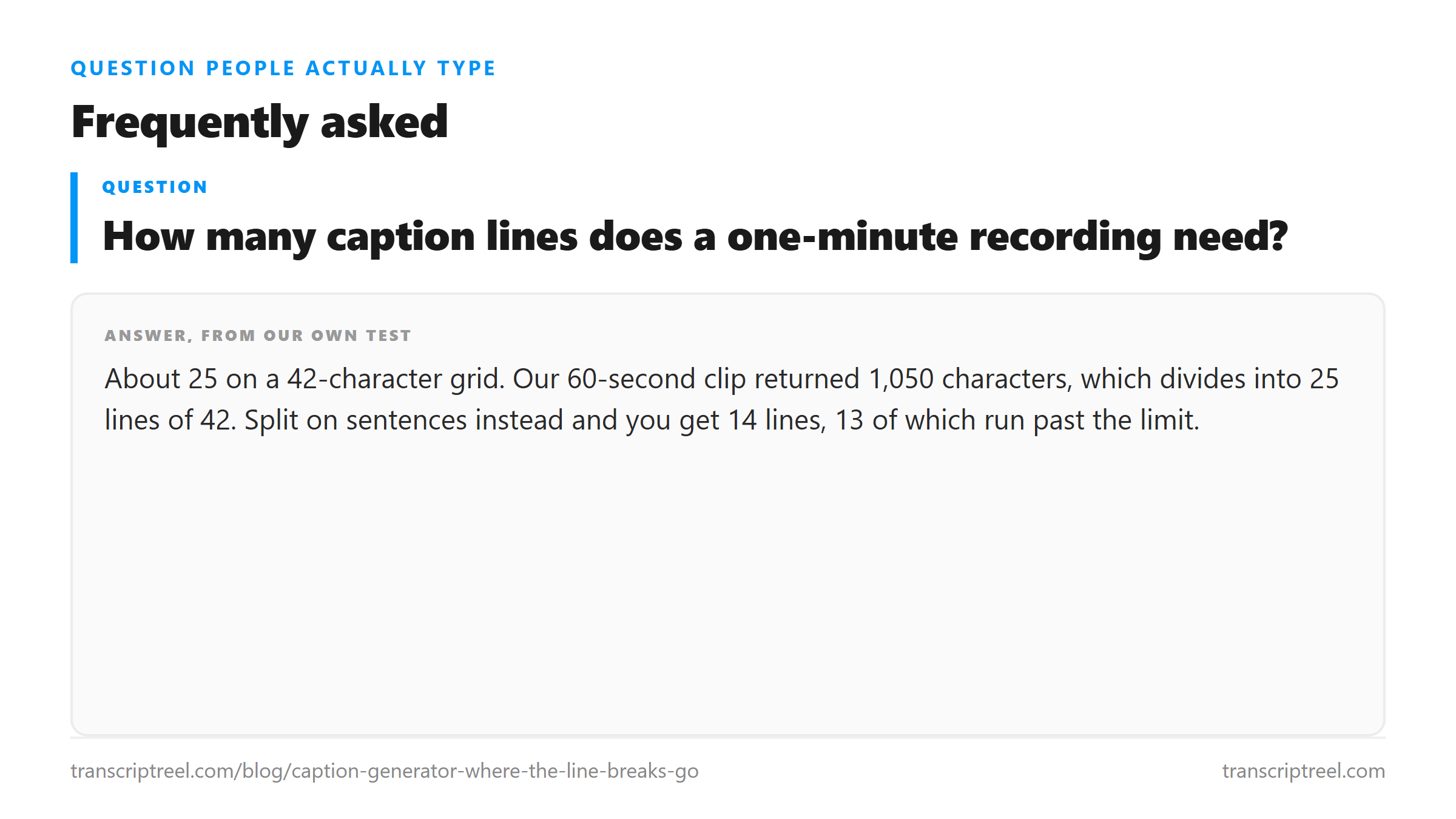
About 25 on a 42-character grid. Our 60-second clip returned 1,050 characters, which divides into 25 lines of 42. Split on sentences instead and you get 14 lines, 13 of which run past the limit.
Should a caption generator split on pauses or on punctuation?
Punctuation, when the transcript has it. The same recording held 85 pauses at one detector setting and 89 at another, against 49 sentences. Pauses land mid-clause often enough that cutting on them puts the line break in the wrong place roughly a third of the time.
Why did the same recording give 85 gaps one way and 89 another?
The detector threshold. At -35 dB with a 0.28-second minimum we counted 85 gaps. At -38 dB with 0.25 seconds we counted 89, with a median gap of 0.42 seconds. The audio never changed and the sentence count stayed at 49.
Does a longer clip change the average sentence length?
Not for one speaker. 30, 60 and 120-second clips averaged 73.4, 74.1 and 73.8 characters, and the longest sentence was 88 characters in all three. Clip length changes how many sentences you get, not how long they run.