Why We Don't Publish an Accuracy Number
Because we have not published a measurement, and a percentage without a measurement is a guess dressed as a fact. Accuracy for speech recognition varies with accent, background noise, music, and recording quality. To publish a number honestly we would have to state the test set, the conditions, and the error metric. We have not done that, so we publish nothing.
What the competing claims actually say
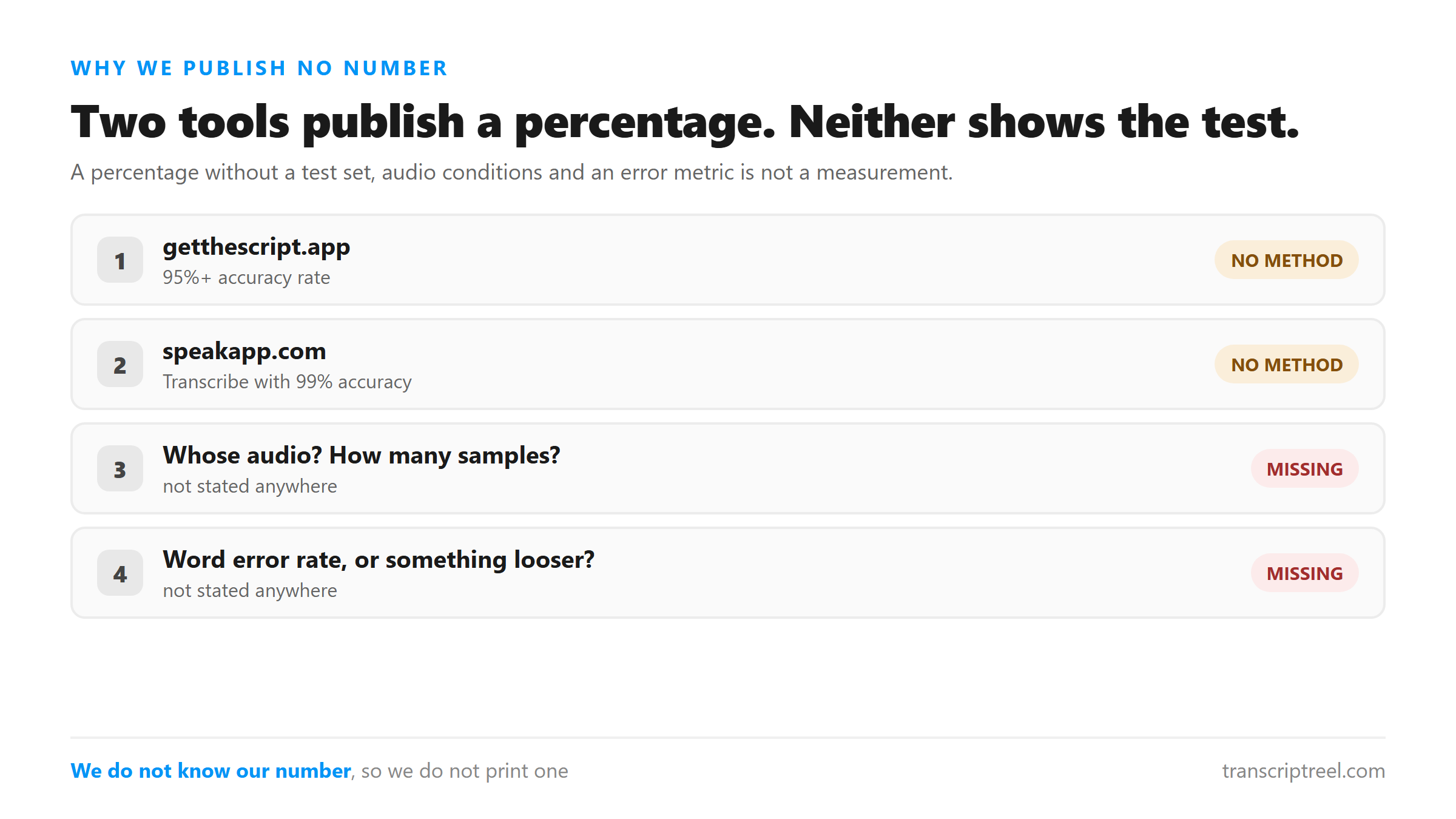
Two tools in this space publish specific numbers. Quoting them exactly:
- getthescript.app states "95%+ accuracy rate with advanced speech recognition technology and noise reduction" on its homepage.
- speakapp.com states "Transcribe with 99% accuracy" on its homepage.
Why those numbers are hard to act on
Both are presented without a test set, sample size, audio conditions, or error metric. That is not a criticism of their engineering — it just means you cannot use the number to predict your own result. "95% accurate" could mean 95% of words correct on clean studio audio, or something much worse on a noisy phone recording.
- No stated test set: whose audio, how many samples?
- No stated conditions: quiet studio, phone in a cafe, music underneath?
- No stated metric: word error rate, or something looser?
What we do instead
- We name the model (
@cf/openai/whisperon Cloudflare Workers AI) so you can look up independent information about it. - We tell you what degrades results: background noise, music, overlapping speakers, heavy accents, low-bitrate audio.
- We tell you the input format we use (16 kHz mono PCM WAV) so you know what the model is hearing.
- We say "we do not know" when we do not, rather than filling the gap with a number.
How to judge a transcript tool without an accuracy number
- Run your own worst-case audio through it — the noisy clip, not the clean one.
- Compare against a transcript you already know is correct.
- Check whether the tool timestamps output, which makes errors easier to find and fix.
- Prefer tools that tell you what they run. A named model is checkable; a percentage is not.
FAQ
So is your tool less accurate than theirs?
We do not know, and we are not going to claim either way. We run Whisper; if they run Whisper too, results will be similar on the same audio. What differs is that they publish a number and we do not.
Will you ever publish one?
Only if we run a stated test and publish the conditions with it. Until then, no number.
What should I ask a tool that advertises 99%?
Ask what test set, what audio conditions, and what error metric. If they cannot answer, the number is marketing.