Translating a Transcript vs Translating Captions
Two different objects
A transcript answers "what was said". A caption file answers "what was said, and when". The second one needs a start and end time for every line, and that information is not something you can recover from a block of text.
Our endpoint returns six fields: success, transcript, language, engine, fileSize and fileName. There is no timing field, no segment list and no word list. Today's 152-character result had 0 newline characters in it, so there is not even a paragraph break to work with.
What the three download buttons actually write
The TXT, SRT and VTT buttons build the file in your browser from the text you already have. Here is what each one produced from the same 152-character transcript today.
- TXT: 152 bytes - the text, nothing added
- SRT: 185 bytes - "1", then 00:00:00,000 --> 00:00:00,000, then the text
- VTT: 191 bytes - "WEBVTT", then 00:00:00.000 --> 00:00:00.000, then the text
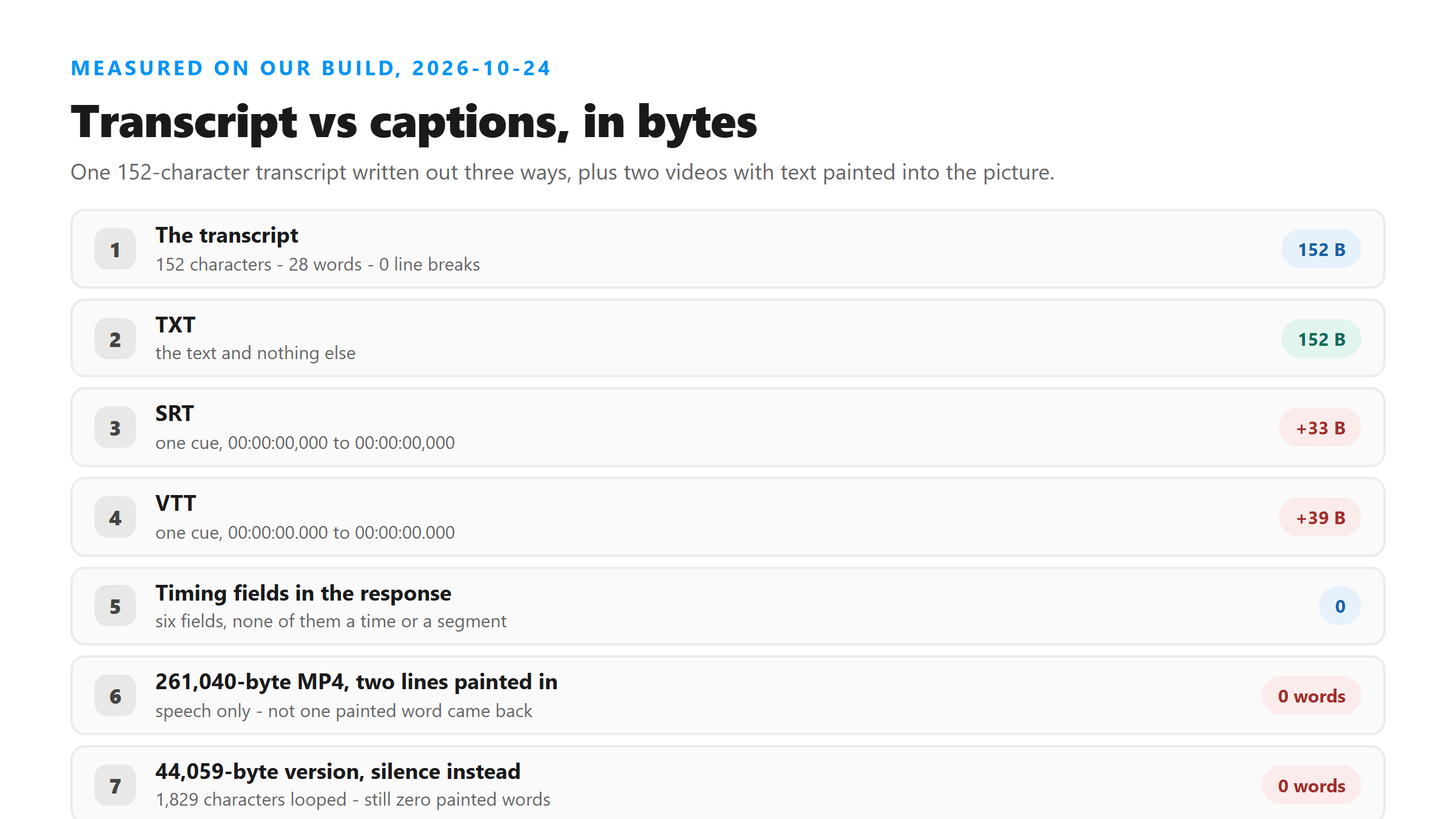
The SRT is 33 bytes bigger than the TXT and the VTT is 39 bytes bigger. That is the wrapper, and it is all you get. Both files carry exactly one cue, and that cue is zero seconds long, because the model never told us when anything was said. We do not invent timings, so the files say so instead.
Burned-in captions are not text
Plenty of reels have the words painted into the picture. We tested whether any of that comes back. We built a 261,040-byte MP4 with "FRESH PASTA IN TEN MINUTES" in 42-point type and "PASTA FRESCA EN DIEZ MINUTOS" in red underneath, with real speech on the audio track.
The transcript came back as the speech only. Neither line appeared - not in English, not in the Spanish one. We then built a 44,059-byte version with the same two lines and silence instead of speech. It returned HTTP 200 with a 1,829-character loop of "Thank you very much", and again, none of the burned-in words.
A caption that is part of the picture is not text anybody can read. If a reel carries its words as an image, no transcription step will see them.
Which one you are translating
If you need the words in another language, take the TXT. It is one block, it is the full text, and a translator - a person or a tool - can work through it in one pass. There is no timing to preserve, because there was never any timing to begin with.
If you need subtitles in another language, the transcript only gets you halfway. You still need to split the text into lines and give each line a start and an end time, and that has to happen in a subtitle editor. Translating our SRT will not help: it has one cue and no duration.
Where the language comes in
The model writes down what it hears, in the language it heard. The response field named language reported "unknown" on every file we ran today, so it will not tell you which language you are holding. Read the first line and decide for yourself before you send it anywhere.
That matters more than it sounds. If a reel is in Spanish and you need English, the transcript arrives in Spanish and stays in Spanish - nothing on this page rewrites it. Translation is a second step you take afterwards, on a single block of text, with no timings to carry over.
The order that works
Get the transcript first, translate that text, and only then decide whether you need a timed file. Going the other way - asking for captions first and trying to translate them - leaves you with one zero-second cue and nothing to hang a translation on.
- Words in another language: translate the TXT
- Subtitles in another language: translate the TXT, then build timings in a subtitle editor
- Words painted into the picture: nothing here can read them, so type them out by hand
Got a Reel you want as text? Upload the file and download the transcript as TXT, SRT, or VTT →
A transcript has no timings, and a caption file is nothing but timings - so the two jobs split here. Wondershare UniConverter is a desktop editor where the translated text goes on a timeline and each cue gets a real start and end time. It does not transcribe, and it does not translate - the words come back from this page, in whatever language they were spoken.
FAQ
Is a transcript the same as a caption file?
No. A transcript is the words with no timing. A caption file pairs each line with a start and end time. Our response carries no timing data, so the SRT and VTT we write hold one cue that is 0.000 seconds long.
How much bigger is an SRT than a TXT?
For today's 152-character transcript: 152 bytes of TXT, 185 of SRT and 191 of VTT. The difference is the header and the one cue line, not extra content.
Will a transcription pick up captions burned into the video?
No. We painted two lines of text into a 261,040-byte MP4 and ran it; none of it came back. A silent version of the same file returned a looped guess instead, and still none of the painted words.
Can I make translated subtitles from the transcript?
You get the words, not the timing. Translate the TXT, then build the timings in a subtitle editor. Our SRT and VTT have no real timings to work from.