Spanish Audio to Text: What Comes Back When the Clip Isn't English
One Spanish clip, five uploads
We built the audio with a Spanish text-to-speech voice so we'd know exactly what was said, then trimmed and mixed it into five files. Here's what each one returned.
- 29.7 seconds, 238,796 bytes: HTTP 200 in 4.49 seconds, 519 characters, 90 words, language reported as unknown.
- First 15 seconds, 121,004 bytes: HTTP 200 in 2.94 seconds, 271 characters, 46 words.
- First 15 seconds with pink noise at equal loudness: HTTP 200 in 2.70 seconds, 266 characters, 47 words.
- First 15 seconds turned down 24 dB: HTTP 200 in 3.02 seconds, 271 characters, 46 words, same text as the clean 15-second cut.
- 15 seconds of Spanish followed by 15 seconds of English, 241,100 bytes: HTTP 200 in 5.45 seconds, 541 characters, 96 words.
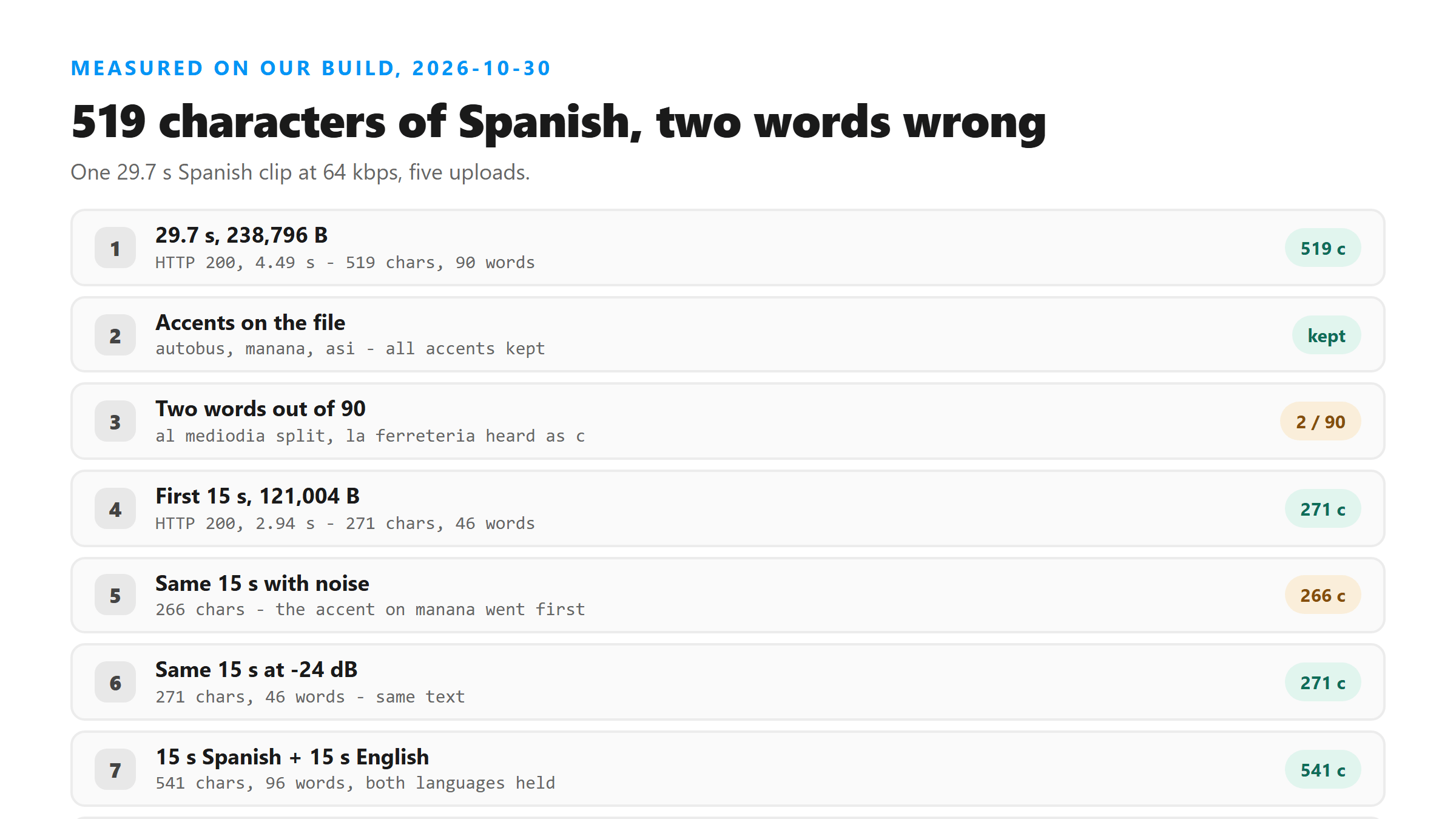
Accents and punctuation survive
It also wrote Spanish numbers the way a Spanish writer would. If you're quoting the transcript in an essay or a report, you can lift the sentences as they are rather than restoring the marks yourself.
Two words out of 90 came back wrong
Both are the kind of thing you fix in one pass with the audio playing. Neither one changes the meaning of the sentence, which is typical: models tend to miss sounds, not sense. Expect a handful of these per minute of Spanish and budget five minutes to read along and fix them.
The language field still says unknown
So don't build anything on top of it. If you need to sort transcripts by language, read the text: a Spanish transcript will have words like "que", "para" and "los" in the first line, and that's a more reliable signal than the field.
Noise costs you the accents first
The sentence still reads as Spanish and still means the same thing. What noise takes first is the small stuff - an accent, a tilde, a short word - and it takes it before it starts changing whole words.
A clip that switches languages holds both
Then it added "¡Tú a dras!" at the very end. Nobody said that. A clip with two languages in it is the case where the model is most likely to pad the ending, so treat the last line of a mixed-language transcript as suspect until you've heard it.
Quiet Spanish came back the same
That's worth knowing if your recording came off a phone across a room. A quiet Spanish clip is usually fine. A loud room behind it is the thing that costs you words.
What a Spanish clip costs you in bytes and words
The words came out at a steady rate too: 90 words from 29.7 seconds and 46 from 15, which is right around three words per second in Spanish. Spanish runs longer than English for the same meaning, so expect more characters per minute than an English clip of the same length would give you.
What we didn't measure
One synthetic voice, one accent - a European Spanish text-to-speech voice, not a real speaker from Mexico, Argentina or Colombia. Regional accents are where accuracy usually drops, and we didn't test any of them today. We also didn't test Portuguese or Catalan, which a model can mistake for Spanish, or a clip with three or more languages in it. These are our files, built this morning, and the numbers are from our endpoint.
What happens to the audio you upload
It goes to /api/transcribe over an encrypted connection, gets decoded in memory, and is gone once the response is written. No copies, no training, no account. You'll want to keep your own file, because we can't replay it for you.
Got a Reel you want as text? Upload the file and download the transcript as TXT, SRT, or VTT →
A Spanish clip arrives as an MP3 or an M4A, and the container decides whether the upload gets past the door at all. Wondershare UniConverter opens the file on your own machine and rewrites it as MP3 with the audio kept, which is the shape that went through in all five of today's tests. It does not translate and it does not transcribe - the words come back from this page.
FAQ
Can this endpoint transcribe Spanish audio?
Yes. Our 29.7-second Spanish clip came back with 519 characters and 90 words in 4.49 seconds, with accents intact on autobús, mañana and estacionamiento. Two words out of 90 came back wrong, and both were one-letter sound mix-ups.
Do Spanish accents survive the transcript?
They did in our test. Words like autobús, mañana, así and estacionamiento came back spelled correctly with their accents. Noise is what costs you accents: with pink noise at equal loudness, "de la mañana" came back as "de la manana".
Why does the language field say unknown?
It reads unknown on every upload we've run today, Spanish and English alike. It's not a failure signal and it doesn't mean the transcription missed. If you need to know what language a transcript is in, read the first line of the text instead.
What happens if a clip changes language halfway through?
Our 15-seconds-Spanish-then-15-seconds-English file came back with 541 characters and 96 words, holding both languages in the right order. It stopped mid-sentence at the switch and added "¡Tú a dras!" at the end, which nobody said. Check the last line of a mixed-language transcript against the audio.