Instagram to Text: Posts, Carousels and Clips With No Speech
A photo post has no audio to read
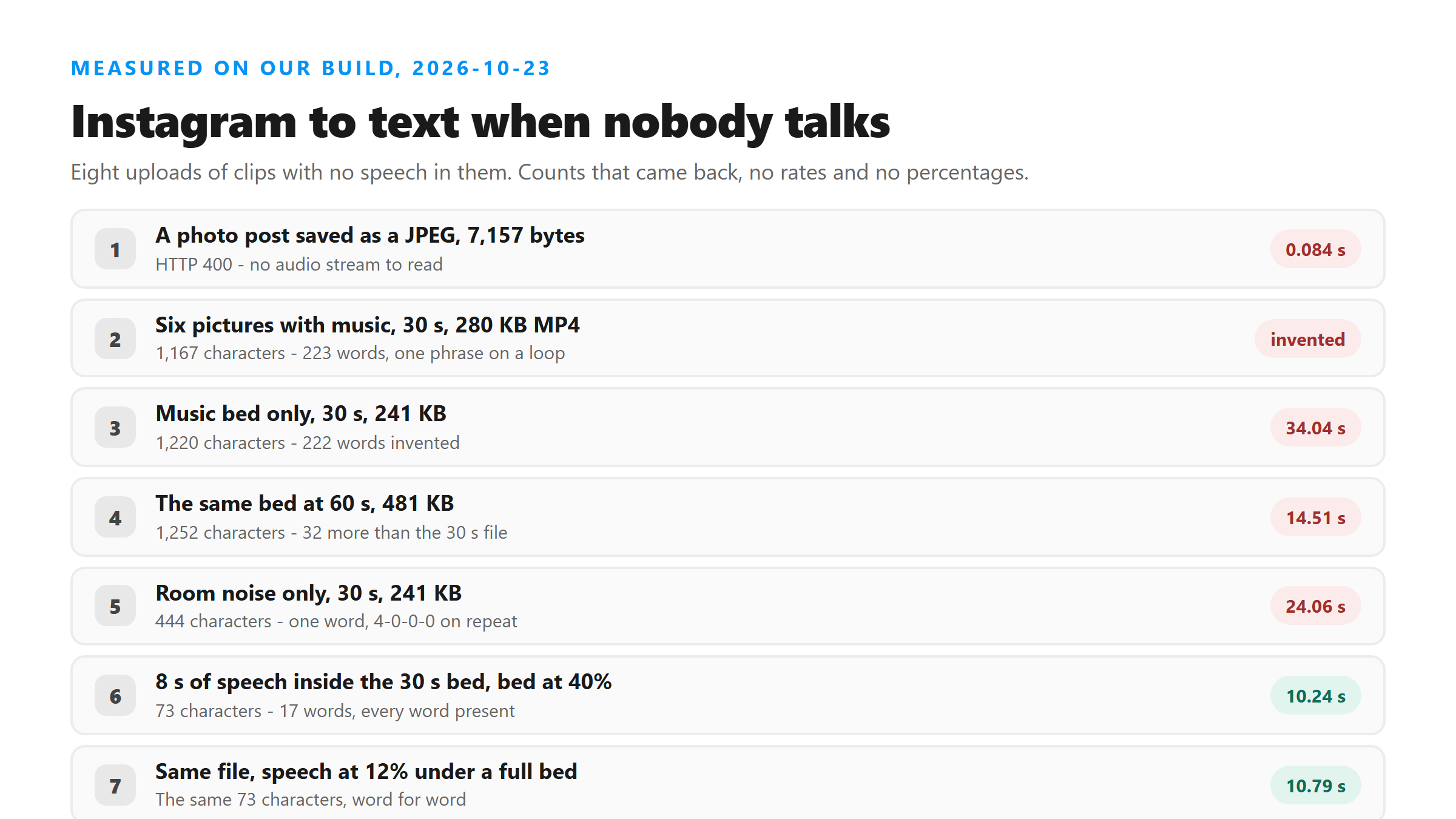
We uploaded a 7,157-byte JPEG - the shape a photo post takes once it's saved to your phone. It came back HTTP 400 in 0.084 seconds. Nothing got decoded, because there is no stream to decode. That speed is the tell: the request died at the door, not in the model.
So turning a photo post into text isn't a transcription job. The words you're after sit in two places. The caption is plain text you can copy. Anything written on the picture is pixels, and no speech model reads pixels. If the text lives only in the image, you need an OCR app, not a transcript tool - and no upload size or file format will change that.
Carousels act like a music clip, not like a document
A carousel is a stack of pictures with a soundtrack. We built one: six 1080x1080 frames, five seconds each, a music bed underneath, no voice anywhere, 280,405 bytes as an MP4. It came back HTTP 200 with 1,167 characters and 223 words. Every word was "I'm sorry", repeated.
That's the failure mode worth knowing about, because it doesn't look like a failure. You get a full page of clean English with correct punctuation. There's no error code, no warning field, and nothing in the response that says the clip had no speech in it. The six pictures contributed nothing, which is expected - the video track gets dropped before the model runs. The music contributed the invented words, which is not.
Sound with no speech still fills the page
We ran three clips that carry audio but no voice, each uploaded once. All three came back HTTP 200:
- 30 seconds of a three-note music bed, 241,100 bytes - 1,220 characters, 222 words, 34.04 s.
- 60 seconds of that same bed, 481,004 bytes - 1,252 characters, 229 words, 14.51 s.
- 30 seconds of low-level pink noise, 241,100 bytes - 444 characters, 1 word, 24.06 s.
Read the first two together. The 60-second file holds twice as much audio and produced 32 more characters. A real transcript grows with the clip; this one didn't, because it isn't a transcript - it's a loop the model settles into. The noise file is the clearest case: 444 characters, one word, "4-0-0-0-0-" repeating. Nobody said it.
The clock tells you nothing here either. The 30-second bed took 34.04 seconds to answer and the 60-second bed took 14.51 - twice the audio, less than half the wait. Long non-speech audio doesn't cost proportionally more time, because there's nothing in it to work through. That's another reason the character count is the better signal.
"No speech" covers more than music. Room noise, traffic, applause, wind over a microphone, a keyboard in the background, an engine - anything with no voice in it lands in the same place. The model was trained to produce words, so it produces them whether or not anyone was talking.
A real voice wins, even buried
So we put one back. Eight seconds of speech - "We open the studio at eight and the first batch of coffee is ready by ten" - placed eight seconds into the same 30-second music bed, with the bed turned down to 40%. The response was 73 characters and 17 words: "We open the studio at 8 a.m. in the first batch of coffee is ready by 10." Every word is accounted for. Two numbers came back as digits instead of words, and one conjunction shifted from "and" to "in". The music added nothing.
Then we flipped the levels: the voice at 12% and the bed at full. Same 73 characters, same 17 words, word for word. A quiet voice under loud music still comes through here, which is worth knowing before you spend time stripping a soundtrack out of a clip.
Here's the practical rule that falls out of it. Music doesn't overwrite speech in these tests - it only fills the silence when there is no speech to find. Two minutes of music with eight seconds of talking in the middle will transcribe the talking.
How to tell invention from a transcript
You don't need to guess. These four checks caught every bad response in this morning's runs, and none of them needs a second tool:
- Characters per second. Real speech on our files ran about 16 per second - 70 characters out of 4.25 seconds. The music bed ran 41 per second. Way above your speaking rate means invention.
- Repetition. Those 222 words are one two-word phrase about 111 times. Skim the middle of the text, not the start.
- Word count against what you heard. One sentence in, 200 words out is a hallucination, no matter how grammatical it reads.
- Run it twice. You'll get the same nonsense both times. That won't fix it, but it rules out a broken upload.
The endpoint gives you no warning flag for any of this. Today's responses carried six fields - success, transcript, language, engine, fileSize, fileName - and success read true on the music bed, the noise, and the slideshow. The language field read "unknown" on all of them. Nothing in the payload distinguishes a transcript from a hallucination, so the check has to happen on your side.
What to do instead
If your post has no voice, skip transcription. Copy the caption, then run an OCR app over the frames that carry text - that's the only route to words that exist as pixels. If your clip is mostly music with a few seconds of talking, upload it as-is; the talking survives. And if you're unsure which you have, play it with your eyes closed first. Ten seconds of listening beats a page of invented text you have to proofread.
Got a Reel you want as text? Upload the file and download the transcript as TXT, SRT, or VTT →
Every failure on this page is a file problem, not a words problem: a photo post has no audio to read, and a music clip has nothing readable in it. Wondershare UniConverter opens the files you already have and writes out just their audio, in the shapes that upload cleanly here. It does not transcribe, and it will not find words nobody said.
FAQ
Can you turn an Instagram photo post into text?
Not with a transcript tool. A photo post has no audio track, so our endpoint returned HTTP 400 in 0.084 seconds for a 7,157-byte JPEG. The caption is text you can copy; anything written on the picture is pixels and needs an OCR app.
Why does a music-only Reel come back with words in it?
The model is built to emit words, so when it finds no speech it settles into a phrase and repeats it. Our 30-second music bed returned 1,220 characters and 222 words of "I'm sorry". There's no error code and no warning field - success reads true.
Does a quiet voice still get picked up under music?
Yes, in our test it did. Eight seconds of speech inside a 30-second bed came back as 73 characters and 17 words with the bed at 40%, and the same 17 words came back when we dropped the voice to 12% and raised the bed to full.
How can I tell whether what I got back is real?
Characters per second is the fastest check - real speech ran about 16 per second on our files, the invented text ran 41. Then look for repetition, compare the word count against what you actually heard, and re-run the file. A second identical run proves the upload wasn't broken.