Does Your File Leave the Browser? Our Full Data Path
Yes. Your file is uploaded to our server, processed there, and deleted afterwards. Transcription of audio at this quality cannot be done inside a browser tab on our current architecture, so any claim that your file "never leaves your device" would not be true for us. What we can tell you is the exact path it takes and how long it lives.
The exact path
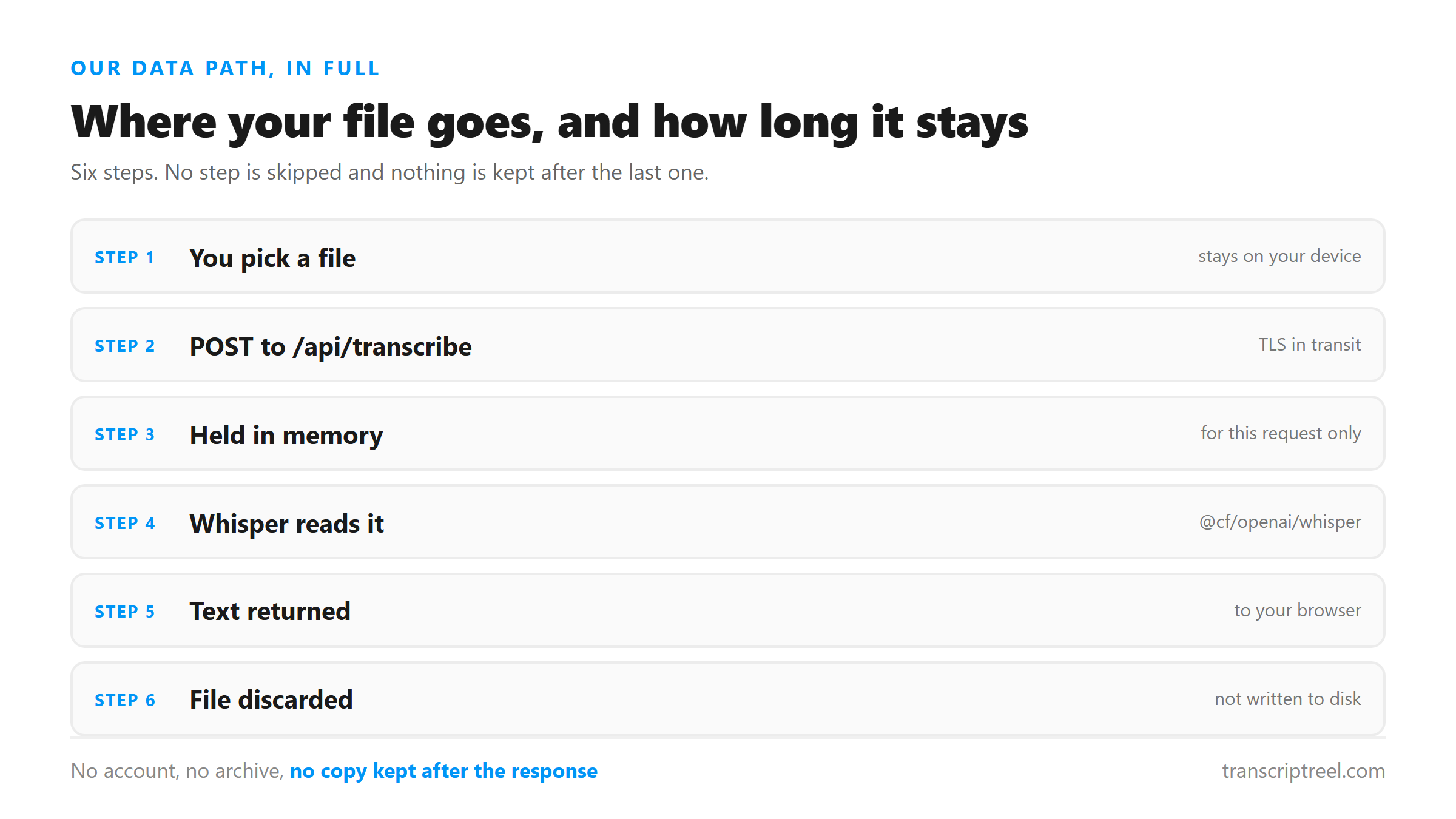
- 1. Upload. The file travels from your browser to our server over HTTPS.
- 2. Extract. If it is video, audio is extracted and converted to 16 kHz mono PCM WAV — the format the transcription model expects.
- 3. Transcribe. The audio is sent to Cloudflare Workers AI, which runs the
@cf/openai/whispermodel and returns text. - 4. Return. The text is sent back to your browser.
- 5. Delete. The working file is removed.
What we do not do
- We do not keep a library of your uploads.
- We do not ask you to create an account to use it.
- We do not route your media through an unofficial third-party download service — which is why we ask you to upload a file instead of pasting an Instagram link.
Why we do not say "processed locally"
Several tools in this space say things like "Secure & Private" or "Private by design" without saying whether data moves. Those phrases are not false, they are just uninformative. A file either leaves your device or it does not. Ours does. Stating that plainly is less comfortable than a privacy badge, but it is the only version you can actually verify.
What you should decide before uploading
- Do not upload anything you are not willing to send over a network.
- If the audio contains sensitive personal information, consider whether a transcript service is the right place for it at all.
- If you need a fully offline option, that is a different kind of tool — one that runs entirely on your own hardware. Ours is not that tool.
FAQ
How long is my file kept?
It exists only for the duration of processing and is deleted afterwards. We do not retain uploads as a library.
Do you use my audio to train anything?
No. We are not running a training pipeline on user uploads.
Why not just process it in the browser?
Running speech recognition reliably in-browser requires shipping a model to the client and enough compute on the device, which changes what hardware can use the tool. We chose server-side processing and disclose it instead.
Is the upload encrypted?
The transfer is over HTTPS, so it is encrypted in transit. That protects it on the way to us; it does not mean we never receive it.