Instagram Transcript Generator: What the Label Promises
The word generator is doing a lot of work in that sentence
Generate sounds like the page will produce whatever you need. In practice the promise is narrower than it reads. You get a run of sentences with capitalization and punctuation, in the order the words were spoken. That's it. Everything else a caption tool or a research workflow needs - timing, speakers, structure - is something you add after the text lands.
Here's the split we measured today, and it's the same split on every call:
- Promised by the label: text from a clip, readable, in your language.
- Delivered: 538 characters and 100 words out of a 36.96-second recording, in 5.46 to 6.31 seconds.
- Never delivered: timestamps, speaker labels, line breaks, a detected language.
- Delivered on request: the engine name, the byte size of your upload, and the file name you sent.
Six fields, and that's the whole product
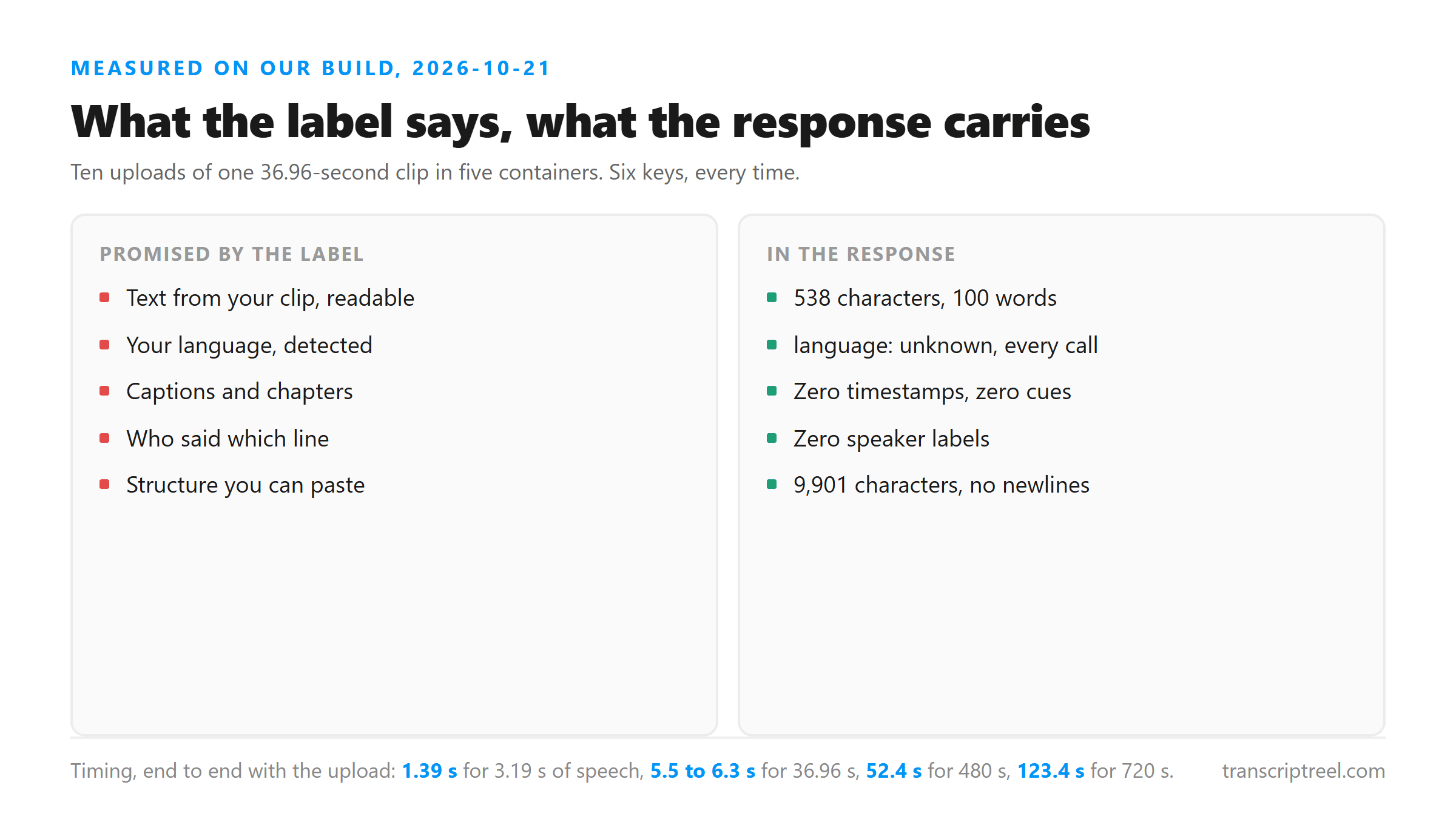
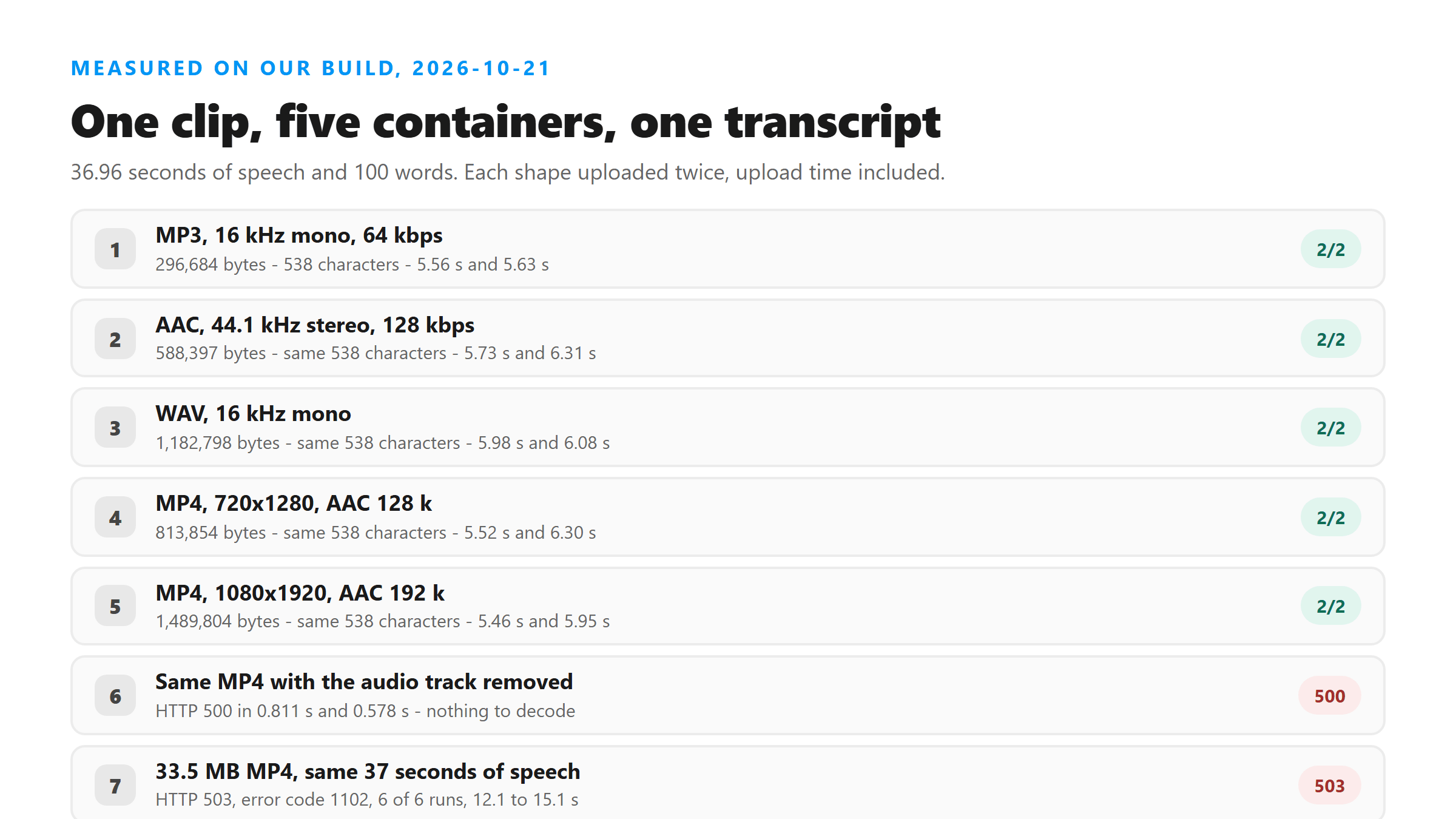
We uploaded one clip in five containers - MP3, AAC, WAV, and two MP4 sizes - twice each. All ten audio-bearing uploads returned the same object: success, transcript, language, engine, fileSize, fileName. The keys never varied. No field appeared on a video upload that was missing on an audio upload, and no field carried a number we hadn't sent.
engine matters more than the rest, because it's the only honest thing on the page. It names the model that produced the text, on every successful call. If a tool tells you its output comes from a model, that field is where the claim gets checked.
What the wait actually buys
Every generator page shouts about speed and none of them publish a curve. Here is ours from today's runs, all timed end to end with the upload included:
- 3.19 seconds of speech, 51 characters and 10 words - 1.39 seconds.
- 36.96 seconds of speech, 538 characters and 100 words - 5.46 to 6.31 seconds across ten uploads.
- 480 seconds of speech, 6,468 characters and 1,200 words - 52.4 seconds.
- 720 seconds of speech, 9,901 characters and 1,838 words - 123.4 seconds.
The curve is close to linear, roughly one second of waiting per seven to nine seconds of audio, plus a fixed five seconds of round trip. So a Reel feels instant and a twelve-minute file feels like a coffee break. If a page promises a ten-minute file in two seconds, that number did not come from a real run.
Two walls before the words
A generator that fails still fails quietly. We hit both walls today and both return an error a normal person cannot act on.
The first is a video with no audio track. A 37-second MP4 with the audio stripped, 170,395 bytes, came back HTTP 500 with "Transcription failed. Please try another supported file." in 0.811 and 0.578 seconds. The file looks fine in your gallery and plays nothing. Check for an audio stream before you re-record.
The second is size. The same 37 seconds of speech inside a 15.5 MB video worked, in 24.9 seconds. The same audio inside a 33.5 MB video failed six times out of six with HTTP 503 and the body "error code: 1102", in 12.1 to 15.1 seconds. No partial transcript, no message about size - the platform gave up while decoding. For video, plan around 15 MB.
Things a generator does not generate
This is where most people get burned, because the text looks finished. It is not a caption file and it is not a document. Four gaps, all measured in the same run:
- No timestamps. Zero in every response, so no cue start and no cue end. A chapter marker has to be placed by ear.
- No speaker labels. Two people on one clip come back as one uninterrupted voice.
- No paragraph breaks. The 720-second file returned 9,901 characters in one run, no newlines.
- No detected language. language came back "unknown" on every call today, audio and video alike.
The text also cannot see. We built a video whose frames carried a dozen lines of text and whose audio said one sentence. The response was 51 characters - that sentence, and nothing from the picture. On-screen hooks, burned-in captions, sticker text: invisible. If the words exist only as pixels, no generator on the market can pull them out for you today.
Why the same clip returns different character counts
Don't compare two runs by character count. The same 36.96-second clip came back as 538 characters on ten uploads and 542 on a later one. The only difference was punctuation: a comma where there had been a full stop. The words were identical. Count words, or diff the text, and treat character count as noise.
Repeats are the other trap. A long file built by looping one recording collapsed instead of duplicating: 13 passes of a 100-word clip returned 1,200 words, and 20 passes returned 1,838. That's fine for a real monologue that doesn't repeat itself, but don't measure a tool by feeding it the same sentence over and over.
Long files: what "unlimited" really means
No generator says unlimited, but the surrounding copy usually implies it. The real shape is a straight line with a wall at the end you can't see. The longest file we got through today was 720 seconds, 9,901 characters and 1,838 words, in 123.4 seconds. That's 123 seconds of waiting for twelve minutes of audio - roughly one second per six seconds of speech, which is the same slope as a 37-second clip.
The wall shows up earlier in video than in audio, and it isn't about length. A 33.5 MB video of only 37 seconds failed six times out of six, while a 720-second audio file at a low bitrate sailed through. Size is the variable, not minutes.
Doing the arithmetic before you upload
A sixty-second Reel holds about 150 words, so expect roughly 13 seconds of waiting plus the five seconds of round trip. Ten Reels is about three minutes of your day spent watching a spinner, and that isn't a bug in any single tool - it's the shape of the job.
Which is why the useful question isn't "which generator is fastest". It's "which one fails in a way I can see". A tool that returns HTTP 500 with a message after half a second has told you the truth. A tool that spins for two minutes and hands back a paragraph of "Thank you very much" has not.
How to read a generator page in ninety seconds
Four questions, in this order. Does it say what the response contains - fields, not adjectives? Does it publish any timing number with a clip length attached? Does it say what happens to a file with no audio track? Does the word free appear with a size or length attached?
A page that answers all four is worth your upload. A page that answers none is selling the word generator and hoping you don't ask what came back.
Got a Reel you want as text? Upload the file and download the transcript as TXT, SRT, or VTT →
The gap this page measures is between the words and the shape you need them in. Wondershare UniConverter handles the shape: it converts a downloaded Reel to MP3 or M4A at a bitrate that clears the size wall, and it can read the audio back to place subtitle timings, which is the step no transcript generator does. It does not transcribe - the text still comes from this page.
FAQ
What does an Instagram transcript generator actually return?
Six fields: success, transcript, language, engine, fileSize and fileName. Measured across ten uploads of one clip in five containers, the keys never changed and no field carried a value we hadn't sent except the transcript itself.
Does it add timestamps or speaker labels?
No. Zero timestamps and zero speaker labels in every response today, including a 720-second file that returned 9,901 characters. Both have to be added by hand afterwards.
Why did a big video fail with a platform error?
Size. 15.5 MB worked in 24.9 seconds, and 33.5 MB failed six times out of six with HTTP 503 and "error code: 1102" in 12.1 to 15.1 seconds. Pulling the audio out first is the fix.
Can a generator read text that is visible in the video?
No. Frames carrying a dozen lines of text, with one spoken sentence on the audio, returned 51 characters - only the sentence. Text in the picture never reaches the model.